!DOCTYPE html PUBLIC "-//W3C//DTD XHTML 1.0 Strict//EN" "http://www.w3.org/TR/xhtml1/DTD/xhtml1-strict.dtd">
Streamline Training & Documentation
Streamline Training & Documentation
Sunday, April 18, 2010
The Clerk in the Canterbury Tales
A lover of learning and teaching ...
Illustration and opening lines from the portion of the General Prologue to Geoffrey Chaucer's Canterbury Tales that describes the Clerk from Oxford. The full text of this section of the prologue is given below, first in modern English and then in the original Middle English.
A Clerk from Oxford was there also, Who'd studied philosophy, long ago. As lean was his horse as is a rake, And he too was not fat, that I take, But he looked emaciated, moreover, abstemiously. Very worn off was his overcoat; for he Had got him yet no churchly benefice, Nor he was worldly to accept secular office. For he would rather have at his bed's head Some twenty books, all bound in black or red, Of Aristotle and his philosophy Than rich robes, fiddle, or gay psaltery. Yet, and for all he was philosopher in base, He had but little gold within his suitcase; But all that he might borrow from a friend On books and learning he would swiftly spend, And then he'd pray diligently for the souls Of those who gave him resources to attend schools. He took utmost care and heed for his study. Not one word spoke he more than was necessary; And that was said with due formality and dignity And short and lively, and full of high morality. Filled with moral virtue was his speech; And gladly would he learn and gladly teach.
[lines 287-310 of the General Prologue to The Canterbury Tales by Geoffrey Chaucer]
The original text: A Clerk ther was of Oxenford also, That unto logyk hadde longe ygo. As leene was his hors as is a rake, And he nas nat right fat, I undertake, But looked holwe and therto sobrely. Ful thredbare was his overeste courtepy; For he hadde geten hym yet no benefice, Ne was so worldly for to have office. For hym was levere have at his beddes heed Twenty bookes, clad in blak or reed, Of Aristotle and his philosophie, Than robes riche, or fithele, or gay sautrie. But al be that he was a philosophre, Yet hadde he but litel gold in cofre; But al that he myghte of his freendes hente, On bookes and on lernynge he it spente, And bisily gan for the soules preye Of hem that yaf hym wherwith to scoleye. Of studie took he moost cure and moost heede. Noght o word spak he moore than was neede, And that was seyd in forme and reverence, And short and quyk, and ful of hy sentence; Sownynge in moral vertu was his speche, And gladly wolde he lerne, and gladly teche.
Last November, I wrote about the competencies required to be licensed by the US Coast Guard for working on a tugboat. Pretty dry (no pun intended) material, but the sort of detailed technical information I like because it creates a very specific picture of the topic.
This week The New Yorker has an entire article devoted to the details of what's involved in operating a tugboat. Naturally, the story that staff writer Burkhard Bilger tells is far more colorful than a set of competency matrices. Bilger reports on one family's involvement in running tugboats over a period that dates back to the sixties, meaning he covers the time both before and after the Coast began tightening licensing requirements.
The family of Latham Smith, which now has two factions each operating its own tugboat, bases its operations in Morgan City LA. Here are some excerpts from Bilger's report, focused on the contrast between old-style and new-style tugboating:
The Smiths are from Florida originally, of Irish and British extraction, but the Cajuns have accepted them as their own. Latham is something of a legend in the towing world. When he and [first wife] Elsbeth first took to the sea, in the late sixties, they seemed like characters from a picture book: the little tugboat family, island-hopping across the Caribbean, homeschooling five children as they went. Together and separately, Latham and his children have weathered cyclones on the Atlantic, towed barges up the Amazon, and circumnavigated the globe, even as the industry around them has grown ever more regulated and safety-conscious.
. . .
"When we started out, you could do anything," Elsbeth says. "You could pick up your crew from the homeless section of the DuPont Plaza parking lot and take 'em out and sober 'em up." ... "The other tugboats, they always went for the old alkies and the deadbeat people," Elsbeth says. "We took a different approach," ... Latham took to hiring any sailor or surfer who wandered past and whose conversation he could half abide. "It was the time of the flower children, the Beatles, and the long skirts," Elsbeth says. "We found people everywhere, just everywhere — beautiful young people. These hippies would come down on a one-way ticket from Florida to Rincón, Puerto Rico, and they'd run out of money and get desperate. So we'd hire them just for the ride back to the States." ...
When regulations began to tighten, in the seventies, and a minimum of two licensed sailors were required on every tug, Latham and Elsbeth both put in for captain's licenses.
. . .
... the footloose spirit that once sent sailors to sea has been slowly starched out of the business — mostly with good reason. Beginning with the Exxon Valdez oil spill, in 1989, regulations have ratcheted up with each high-profile accident ...
Most tug captain's licenses now require at least three years' training at sea, if not a four-year degree from a maritime academy. Background checks, safety inspections, and drug and alcohol tests are mandatory, as are certifications in radar, firefighting, first aid, and social responsibility. As a result, in the past decade oil spills have decreased by more than eighty per cent compared with the nineteen-nineties, and crew fatalities and injuries have been nearly cut in half.
... the tramping days of Latham's youth, when a sailor could spend his shore leave exploring the markets of Bangkok, the bars of Panama City, are gone.
. . .
Technology has taken some of the risk out of the business. Many new tugs can be steered by joystick — though most captains disdain it — and trainees often learn to operate them on land, in mock wheelhouses surrounded by virtual harbors. (When I tried my hand at this recently at the Maritime Simulation Institute, in Middletown, Rhode Island, I spent an hour doing doughnuts in Los Angeles Harbor; I couldn't seem to stop ramming my bow into the container ship I was towing — and that was before the computer called in the heavy fog and twenty-foot seas.) But a virtual storm is still no substitute for a howling gale, or the mad tilt and groaning steel of a ship on rough seas.
If this story of one family's life in the the tugboating world appeals to you, by all means get yourself a copy of the April 19 New Yorker and read the whole thing. The entire issue is dedicated to the theme of travel, so if that's your cup of tea, you'll find other articles of interest as well. The table of contents is here.
You will probably recognize line 625 in the excerpt below from Alexander Pope's "Essay on Criticism." The excerpt comprises lines 610 to 642. Such shameless bards we have, and yet, 'tis true, There are as mad abandoned critics, too. The bookful blockhead ignorantly read, With loads of learned lumber in his head, With his own tongue still edifies his ears, And always listening to himself appears. All books he reads and all he reads assails From Dryden's Fables down to Durfey's Tales. With him most authors steal their works or buy; Garth did not write his own Dispensary. Name a new play, and he's the poets friend Nay, showed his faults — but when would poets mend? No place so sacred from such fops is barred, Nor is Paul's Church more safe than Paul's Churchyard: Nay, fly to altars; there they'll talk you dead, For fools rush in where angels fear to tread. Distrustful sense with modest caution speaks, It still looks home, and short excursions makes; But rattling nonsense in full volleys breaks, And, never shocked, and never turned aside, Bursts out, resistless, with a thundering tide.
But where's the man who counsel can bestow, Still pleased to teach, and yet not proud to know? Unbiased, or by favor, or in spite, Not dully prepossessed, nor blindly right; Though learned, well-bred, and though well-bred, sincere, Modestly bold, and humanly severe, Who to a friend his faults can freely show, And gladly praise the merit of a foe? Blessed with a taste exact, yet unconfined; A knowledge both of books and human kind; Generous converse, a soul exempt from pride; And love to praise, with reason on his side?
Note: The Wikipedia entry for John Dryden's Fables, Ancient and Modern is here. You can read about Thomas Durfey here. The Wikipedia entry for Sir Samuel Garth is here.
In the nineteenth century, the largest immigrant groups arriving in Holyoke were the Irish and, later, French Canadians. More recently, the population of Puerto Rican extraction has grown to the point that it now comprises over a third of the total.
Many of the Puerto Ricans come from a rural background, so there was a logic back in 1992 to creation of an organization — Nuestras Raíces (Our Roots) — that promotes and enables small-scale farming within the city by adults and youth.
Senorita Ada's Casita at la Finca (The Farm) of Nuestras Raíces (2008) (masslive.com)
Urban agriculture has proven to be an effective way to promote community development because it is a way for the residents of downtown Holyoke to maintain a connection to their culture while putting down roots in their new home. Most of our members grew up on the farms of rural Puerto Rico and many first came to the Northeast as migrant farm workers. Though they may live in the city now, they are farmers at heart. They have lifetimes of experience in agriculture and it is part of their heritage. Projects based on agriculture, such as markets and community gardens, build on the skills and knowledge that participants already have, and are proud to have the opportunity to use to improve their community and to teach to a younger generation.
To read about Nuestras Raíces' various projects, including La Finca (The Farm), a thirty-acre spread on the shore of the Connecticut River within the city limits, you can start at this page of their website. A nine-minute video showing an exhibition of paso fino horses, some of which are stabled at La Finca, is below.
Today what caught my eye was an article by Scott Leibs, the editor-in-chief of CFO, about Lewis Booth, a long-time Ford employee who became the company's CFO in November 2008. Of particular interest to me, as someone focused on training, was what Lewis told Seibs concerning his discussions with executives and other operations people about how they can assist the finance department's ongoing efforts to repair Ford's balance sheet.
As Seibs explains, Lewis has made it his business to teach Ford employees about the link between finance and operations.
Within a month of assuming the CFO post, he began to walk Ford's senior-most executives through the grim realities of the company's balance sheet [which was and is heavily burdened with debt]. A month later, he extended that tutorial to an additional 400 Ford managers. "When I was in operations, the balance sheet was really viewed as a finance problem," he says. "We've managed to make it a collective responsibility."
Booth's aim was not to make Ford more finance-centric but rather to "identify what we thought was an appropriate road map" for restructuring the balance sheet. ... "The goal was to show where we are, where we want to be in three to four years, and what contribution to that effort can come from operations" versus the treasury department.
The message, Booth says, is that "it's not about borrowing more money, it's about making more money so you can pay back some of those debts." Indeed, debt is perhaps the top challenge of Ford now. GM and Chrysler face the same hurdle but to a much smaller degree, thanks to their respective bankruptcy agreements. One analyst estimates that debt servicing adds $1,500 to the cost of every vehicle Ford sells. Booth takes issue with that particular metric, arguing that "it's not particularly helpful to frame debt in $X-per-vehicle terms. I view it more in terms of what you will pay over the period of a given product program, because that excites people and keeps us focused on why we're in debt in the first place: to invest in new products."
In sum, Lewis is giving high priority to communicating to employees the importance of producing products that generate revenue at a pace that enables the company to reduce debt to a more healthy level. He is also explaining specifics of what company employees can do to help strenghthen cash flow.
For the record, Ford's ratio of long-term debt to total capital was 1.07 as of September 30, 2009.
Here are two key paragraphs in which Ripley summarizes findings of research conducted by Teach for America that investigated the characteristics of highly effective teachers:
First, great teachers tended to set big goals for their students. They were also perpetually looking for ways to improve their effectiveness. For example, when Farr [the Teach for America researcher and trainer] called up teachers who were making remarkable gains and asked to visit their classrooms, he noticed he’d get a similar response from all of them: “They’d say, ‘You’re welcome to come, but I have to warn you — I am in the middle of just blowing up my classroom structure and changing my reading workshop because I think it’s not working as well as it could.’ When you hear that over and over, and you don’t hear that from other teachers, you start to form a hypothesis.” Great teachers, he concluded, constantly reevaluate what they are doing.
Superstar teachers had four other tendencies in common: they avidly recruited students and their families into the process; they maintained focus, ensuring that everything they did contributed to student learning; they planned exhaustively and purposefully — for the next day or the year ahead — by working backward from the desired outcome; and they worked relentlessly, refusing to surrender to the combined menaces of poverty, bureaucracy, and budgetary shortfalls.
In addition to reporting on the distinguishing characteristics of highly effective teachers, Ripley discusses how Teach for America's approach to hiring has evolved over time in response to research findings. You can read Teach for America's own summary of what they're looking for when they hire by clicking here.
Don Vandergriff V: "Deciding Under Pressure and Fast" Workshop
Don Vandergriff's main training program is his "Deciding Under Pressure and Fast" workshop. The video clip below — from 0:30 to 3:17 — gives you a taste of the workshop's approach, a look at what Vandergriff's Adaptive Leadership Methodology looks like in action, and a couple of participant responses to the workshop.
The Transatlantic Network 2020 (TN 2020) summit where this workshop took place ran from September 28 to October 3, 2008 in Belfast, Northern Ireland, and Dublin, Ireland. The Vandergriff workshop took place on September 29 and 30.
As explained on their website, TN 2020 "works to strengthen ties between Europe and North America through the creation of a sustainable network of young leaders." TN 2020 is sponsored by the British Council.
Don Vandergriff I: Teaching the Adaptive Leadership Methodology
Back in December, Donald Vandergriff, a retired US Army officer who now acts as a consultant on leadership development, wrote a post for his blog that gives a good idea of the type of training he recommends — and conducts — for members of the armed forces and civilian law enforcement organizations.
Vandergriff advocates leadership development training that emphasizes adaptability. As you can see from his blog post, Vandergriff is focused on adaptability because it is essential for being able to handle complex problem situations, especially when time is of the essence.
In brief, Vandergriff teaches the Adaptive Leadership Methodology as follows:
Experimentation comes first through the execution of Tactical Decision-Making Exercises (TDEs) [see below] followed by the officers briefing their decisions, plans or orders. After the officer explained him or herself and responded to criticism from their peers and me, the group executed an intense instructor-facilitated after-action review (AARs). The “teaching” was accomplished through AARs as the officers discovered for themselves the concepts and principles included in workshop’s outcomes.
Vandergriff explains how the TDEs are set up:
Each TDE consisted of a scenario summary and a map with graphics. I either handed out a printed copy of the scenario or issued it verbally to the officers, requiring them to listen closely and take notes. The TDEs were two types (1) immediate decision exercises that gave the officers only 30 seconds or a few minutes to make a decision and (2) planning exercises that are longer in duration and culminate in the briefing of orders. In either case, the officers were given limited time and limited information to make their decisions and to complete their plans. This induced stress and allowed them to discover for themselves that delaying decisions until one has “perfect intelligence” or to wait for “permission” is both unrealistic and ineffective.
Citing the work of Robert Bjork, a psychology professor at UCLA for support, Vandergriff reports that he has consistently found that long-term learning is greater if specific tasks are taught in the larger context of problem solving (as opposed to being taught in isolation as a series of lessons that take the form "in situation X, do the following").
Barry notes that the renowned British scientist Thomas Huxley gave the keynote address at the September 12, 1876 ceremony marking Hopkins' opening. Below is an excerpt from Huxley's speech, in which he explains what he thinks a medical school's curriculum should include, and the importance of academic support of original research. At present, young men come to the medical schools without a conception of even the elements of physical science; they learn, for the first time, that there are such sciences as physics, chemistry, and physiology, and are introduced to anatomy as a new thing. It may be safely said that, with a large proportion of medical students, much of the first session is wasted in learning how to learn — in familiarizing themselves with utterly strange conceptions, and in awakening their dormant and wholly untrained powers of observation and of manipulation. It is difficult to over-estimate the magnitude of the obstacles which are thrown in the way of scientific training by the existing system of school education. Not only are men trained in mere book-work, ignorant of what observation means, but the habit of learning from books alone begets a disgust of observation. The book-learned student will rather trust to what he sees in a book than to the witness of his own eyes.
There is not the least reason why this should be so … There is not the slightest difficulty in giving sound elementary instruction in physics, in chemistry, and in the elements of human physiology, in ordinary schools. In other words, there is no reason why the student should not come to the medical school, provided with as much knowledge of these several sciences as he ordinarily picks up in the course of his first year of attendance at the medical school.
I am not saying this without full practical justification for the statement. For the last eighteen years we have had in England a system of elementary science teaching carried out under the auspices of the Science and Art Department, by which elementary scientific instruction is made readily accessible to the scholars of all the elementary schools in the country. Commencing with small beginnings, carefully developed and improved, that system now brings up for examination as many as seven thousand scholars in the subject of human physiology alone. I can say that, out of that number, a large proportion have acquired a fair amount of substantial knowledge; and that no inconsiderable percentage show as good an acquaintance with human physiology as used to be exhibited by the average candidates for medical degrees in the University of London, when I was first an examiner there twenty years ago; and quite as much knowledge as is possessed by the ordinary student of medicine at the present day.
[. . .]
I rejoice to observe that the encouragement of research occupies so prominent a place in your official documents, and in the wise and liberal inaugural address of your president. This subject of the encouragement, or, as it is sometimes called, the endowment of research, has of late years greatly exercised the minds of men in England. It was one of the main topics of discussion by the members of the Royal Commission of whom I was one, and who not long since issued their report, after five years' labour. Many seem to think that this question is mainly one of money; that you can go into the market and buy research, and that supply will follow demand, as in the ordinary course of commerce. This view does not commend itself to my mind. I know of no more difficult practical problem than the discovery of a method of encouraging and supporting the original investigator without opening the door to nepotism and jobbery. My own conviction is admirably summed up in the passage of your president's address, "that the best investigators are usually those who have also the responsibilities of instruction, gaining thus the incitement of colleagues, the encouragement of pupils, and the observation of the public." [The full text of Huxley's speech is available at http://www.fullbooks.com/Science--Education4.html.]
On October 20 Henry Roediger, a psychology professor at Washington University, and Bridgid Finn, a post-doc at the Memory Lab that Roediger heads, published a short article at ScientificAmerican.com reporting on recent research that provides further evidence of the power of the testing effect, defined as "improved performance on a later retention test arising from an earlier test."1
Roediger and Finn outline the findings from two sets of experiments aimed at determining if testing people on material they have not studied boosts their recall of the material on a subsequent test even though the testees, understandably, get most of the answers on the initial test wrong.
The first set of experiments is described in a paper (pdf) by Nate Kornell, a psychology professor at Williams College, Matthew Hays, a post-doc at USC's Institute for Creative Technologies, and Robert Bjork, a psychology professor at UCLA.2. As the abstract explains:
Taking tests enhances learning. But what happens when one cannot answer a test question — does an unsuccessful retrieval attempt impede future learning or enhance it? The authors examined this question using materials that ensured that retrieval attempts would be unsuccessful. In Experiments 1 and 2, participants were asked fictional general-knowledge questions (e.g., “What peace treaty ended the Calumet War?”). In Experiments 3–6, participants were shown a cue word (e.g., whale) and were asked to guess a weak associate (e.g., mammal); the rare trials on which participants guessed the correct response were excluded from the analyses. In the test condition, participants attempted to answer the question before being shown the answer; in the read-only condition, the question and answer were presented together. Unsuccessful retrieval attempts enhanced learning with both types of materials. These results demonstrate that retrieval attempts enhance future learning; they also suggest that taking challenging tests — instead of avoiding errors — may be one key to effective learning.
In sum: the read-only condition emulates someone sitting down and reading a portion of a textbook. How much does the person remember? Not as much as if he/she had been quizzed in advance on the material, even if the answers he/she came up with were largely wrong.
A key point is that the unsuccessful retrieval attempts need to be followed by feedback providing the right answers in order for enhanced learning to occur.
Kornell, Hays, and Bjork (KHB) also found, as have previous researchers, that the benefit of testing increased as the delay between study and the final test of the material increased. The reason seems to be that testing is more effective at preventing forgetting than is a read-only/no-initial-test approach to learning.
KHB offer three conjectures concerning the reason for the testing effect:
Testing enhances deep processing (elaborated thinking about the material), which, in turn, enhances learning.
Retrieval strengthens retrieval routes from the question to the correct answer. And "it could be that exploring incorrect retrieval routes actually weakens, rather than strengthens, those routes."
"... information generated from memory during a retrieval attempt, even if it is incorrect, can serve to cue future recall attempts. In other words, incorrect information can serve as a mediator, connecting the question with the correct answer. ... unsucessful retrieval attempts are likely to produce related information that can serve to mediate recall of the correct answer." [reference omitted]
KHB close their paper with the advice that "educators and learners should introduce challenges into learning situations, including using tests as learning events, even if doing so increases initial error rates."
The second set of experiments is described in a paper (pdf) by Lindsey Richland, an education professor at the University of California, Irvine, Nate Kornell, and Liche Sean Kao, a graduate student in education at Irvine.3 As explained in the abstract:
Testing previously studied information enhances long-term memory, particularly when the information is successfully retrieved from memory. The authors examined the effect of unsuccessful retrieval attempts on learning. Participants in 5 experiments read an essay about vision. In the test condition, they were asked about embedded concepts before reading the passage; in the extended study condition, they were given a longer time to read the passage. To distinguish the effects of testing from attention direction, the authors emphasized the tested concepts in both conditions, using italics or bolded keywords or, in Experiment 5, by presenting the questions but not asking participants to answer them before reading the passage. Posttest performance was better in the test condition than in the extended study condition in all experiments — a pretesting effect — even though only items that were not successfully retrieved on the pretest were analyzed. The testing effect appears to be attributable, in part, to the role unsuccessful tests play in enhancing future learning.
What this research suggests is that if you have a chunk of time available in which students can get themselves "in gear" for a class session on a new topic, it's better to use the time for testing — even if the students give a lot of wrong answers — than to adopt a "study hall" approach of having the students spend the time reading about the topic.4
Richland, Kornell, and Kao emphasize the importance of following the pre-testing with instruction that provides answers to the tested questions. They go on to say that
... our data suggest that instruction following testing need not be individualized to learner errors. Rather, instruction that appropriately draws attention to key content may build on the previous cognitive acts performed when attempting to answer a test question. This implies that standardized tests, or other test situations where it is difficult to provide timely item-by-item feedback, could still provide learning benefits for successful and unsuccessful test takers, as long as those test takers are given an opportunity to learn the information on which they were previously tested.
For an overview of research relating to the testing effect, you can see a survey paper published by Henry Roediger and Jeffrey Karpicke in 2006.5 In the paper Roediger and Karpicke argue:
The testing effect cannot be explained by additional exposure to the material. This suggests that retrieval processes engaged in during a test are responsible for enhancing learning. More specifically, elaboration of encoding [processing of sensory input into memory], more effortful or deeper encoding, and creation of different routes of access can account for the basic effect. ... The concept of transfer-appropriate processing is also congenial, albeit at a general level, to explaining the testing effect. [As explained earlier in the paper, "The idea behind transfer-appropriate processing is that performance on a test of memory benefits to the extent that the processes required to perform well on the test match encoding operations engaged during prior learning."]
They also note that the testing effect can be exploited with more complex learning than memorization — such as the learning required in college-level courses or at business firms — by adopting an approach of frequent assignments. In other words, "testing" should be interpreted broadly; it's not just multiple choice, true/false, and fill-in-the-blank testing of memory.
In closing, let's return to the Roediger/Finn article. The authors offer this practical advice, reflecting all the insight that has accumulated concerning the testing effect:
By challenging ourselves to retrieve or generate answers we can improve our recall. Keep that in mind next time you turn to Google for an answer, and give yourself a little more time to come up with the answer on your own.
Students might consider taking the questions in the back of the textbook chapter and try to answer them before reading the chapter. (If there are no questions, convert the section headings to questions. If the heading is Pavlovian Conditioning, ask yourself What is Pavlovian conditioning?). Then read the chapter and answer the questions while reading it. When the chapter is finished, go back to the questions and try answering them again. For any you miss, restudy that section of the chapter. Then wait a few days and try to answer the questions again (restudying when you need to). Keep this practice up on all the chapters you read before the exam and you will be have learned the material in a durable manner and be able to retrieve it long after you have left the course.
Of course, these are general-purpose strategies and work for any type of material, not just textbooks. And remember, even if you get the questions wrong as you self-test yourself during study, the process is still useful, indeed much more useful than just studying. [emphasis added]
The key take-away from all of the testing effect research is that testing is useful not only for assessment but also as a tool to promote learning.
__________ 1 Mark McDaniel, Henry Roediger, and Kathleen McDermott, "Generalizing Test-Enhanced Learning from the Laboratory to the Classroom," Psychonomic Bulletin & Review, Vol. 14, No. 2 (2007), pp. 200-206.
2 Nate Kornell, Matthew Hays,and Robert Bjork, "Unsuccessful Retrieval Attempts Enhance Subsequent Learning," Journal of Experimental Psychology: Learning, Memory and Cognition, Vol. 35, No. 4 (2009), pp. 989-998.
3 Lindsey Richland, Nate Kornell, and Liche Kao, "The Pre-testing Effect: Do Unsuccessful Retrieval Attempts Enhance Larning?" Journal of Experimental Psychology: Applied, Vol. 15, No. 3 (2009), pp. 243-257.
4 It should be noted that Richland, Korness, and Kao did not find that their pretesting slowed the rate of forgetting.
5 Henry Roediger and Jeffrey Karpicke, "The Power of Testing Memory: Basic Research and Implications for Educational Practice," Perspectives on Psychological Science, Vol. 1, No. 3 (2006), pp. 181-210.
At his Memory Lab, Roediger oversees the Test-Enhanced Learning in the Classroom (TELC) project, which is based on these four principles: "(1) Testing enhances learning (better than repeated studying), and students should be tested frequently; (2) Production tests (short answer or essay tests) produce better retention at delays than do recognition tests (multiple choice, true/false); (3) Multiple tests are better than single tests in enhancing learning; and (4) Immediate feedback improves the effect of testing, especially for facts missed on the tests."
Back in June I wrote a post about David Kennedy's approach to deterring criminal offenders, who had not yet perpetrated violent crimes, from continuing their illegal activities. Now, thanks to a book review, also dating from June, I've become aware of an approach to reducing recidivism among jailed offenders that seems to be attracting increasing attention in the US after being used successfully in San Francisco since 1997.1
Schwartz is a program administrator in the San Francisco Sheriff's Department who co-founded the department's Resolve to Stop the Violence Project (RSVP), along with Assistant Sheriff Michael Marcum and Captain Rebecca Benoit.
Participants in the RSVP Expressive Arts program learn about replacing the macho image of superiority that contributed to their violent behavior, with a more humane view of the male role in society. The theater program also helps participants learn ways of expressing their feelings and needs in a nonviolent manner. (sunnyschwartz.com)
RSVP is a version of what has come to be known as restorative justice, which is most simply defined as:
all approaches to crime that attempt to do justice by repairing the harm crime causes.2
RSVP's founders made a point of designing the program based on input from an advisory committee made up of representatives of a broad cross-section of law enforcement and community stakeholders, including crime victims. The program was the 2004 recipient of the Innovations in American Government Award, presented by the Ash Institute for Democratic Governance and Innovation of Harvard's Kennedy School of Government.
You can get a quick overview of RSVP in the 3:08 video below.
A longer account of the program is offered in the 28:23 video below, which ran on PBS in 2005 as part of the Visionaries series hosted by Sam Waterston.
Among those interviewed are Sunny Schwartz; Michael Hennessey, Sheriff of San Francisco; Ronald Rosado, a Deputy Sheriff working in the dormitory where the RSVP program is based; George Jurand, RSVP Program Coordinator and Manager; Sheryl Corke, Principal of Five Keys Charter School (see below); Teresa Camajani, a history teacher at Five Keys; Delia Ginorio, Survivor Restoration Coordinator; and Jean O'Hara, a former Victim Impact Coordinator, who lost her daughter, son-in-law, and grandson to murder.
There is also footage of unnamed inmates participating in RSVP discussions, including a victim impact presentation by Jean O'Hara.
Using data from a two-year period beginning nine months prior to the inception of RSVP, and continuing for fifteen months after its launch, James Gilligan, then a visiting professor of psychiatry, criminology, and public policy and practice at the University of Pennsylvania, and Bandy Lee. a clinical professor of law and psychiatry at Yale, evaluated the program's effects on inmate behavior. Their hypothesis:
... the dormitory in which violence-prevention skills are taught through RSVP would create a cultural environment that would generate fewer violent incidents than the dormitory without such a programme, [which] turned out to be the case.3
The effect on the frequency with which ex-offenders were re-arrested for violent crimes was also positive: Among jail inmates who took part for a full sixteen weeks, the reduction was over 80% for the first year after release, compared to a control group of non-participants.4
Gilligan and Lee argue that
The seeds of a change in [the in-jail] culture can be seen in some of the principles that characterized the in-house version of RSVP: (1) redefining the male-role image of superiority; (2) holding oneself accountable rather than minimizing or blaming; (3) offering peer-directed guidance and having avenues for promotion; (4) verbalizing rather than acting out: (5) expressing emotions as needs; and (6) offering intimacy rather than offence. ... Finding violence to be not only an ineffectual but counterproductive means of gaining respect in [the] new culture, the inmates would quickly search for other means, which facilitated their compliance and adaptation.
I was particularly interested in the nature of the integrated pre- and post-release services provided to inmates to assist in their transition back into the community, services which bear a not surprising resemblance to those offered in various programs around the country directed at populations with employability barriers.5
The services include:
Core RSVP curriculum designed to change attitudes, beliefs and behaviors — includes male role re-education (using the Manalive curriculum), victim impact presentations, drug and alcohol recovery, theater, and release planning (further details below).6
A propos of the victim impact presentations, Gilligan and Lee comment that "we have been astonished by ... how little awareness most of these men had had as to how much power they had to hurt others, until they listened to ... victims describe their own reactions to being victimized by others." 7
Community meetings — held weekly in the RSVP dormitory to allow participants to discuss day-to-day issues they are coping with.
Loss of Innocence class — participants can explore and address trauma and victimization they experienced in childhood.
Fatherhood curriculum — a twelve-week program in which participants "discuss the father's role in a child's life, the importance of providing children with a consistent and supportive environment, and issues children face as they grow up in a single parent's home."
Young Adult class — inmates twenty-eight and under address their violence, drug dependency, and recidivism problems.
Creative writing — participants contribute to the dormitory's newsletter, with the aim of strengthening writing skills and exercising creativity.
Transfer planning — produces an exit plan spelling out the steps and tools the inmate will continue to employ in order to maintain a life free of violence and substance abuse.
The transfer planning includes plans for restoration of victims and the community. For details of RSVP's services for crime victims and survivors, see here. For services to communities, see here.
Post-release programs — designed to assist ex-offenders in maintaining behavior changes learned in the in-jail program. Include the Post-Release Education Program (PREP), which continues, at least for the first year, participation in Manalive discussion groups and weekly facilitated support groups. PREP also includes a Life Skills program with three components, the first dealing with job readiness, exploration of career opportunities, and apprenticeship programs; the second involving resume preparation and practice employment interviews; and the third covering tracking of ex-offenders' progress and ongoing support with work-related issues. Participants get counseling and support in such areass as substance abuse avoidance and parenting.
Internship Program — for select participants, a four- to six-month training program that prepares them for employment as peer counselors in the jail or at human services agencies.
Community advocacy programs — ex-offenders can give back to the community in such ways as leading Manalive groups, performing in theater programs for the public, counseling youth groups, and engaging in victim restitution programs.
I'll wrap up with a summary comment from Sunny Schwartz, et al. that indicates why emulation of RSVP elsewhere is important:
As an affirmative crime prevention tool that actively engages inmates, RSVP has been successful in giving participants, collaborators, and the community a greater understanding of the nature and dynamics of violence, including the spectrum of abusive behavior, the importance of gender-role training, the significance of learned behavior, the methods for unlearning violence, and the criminal implications and consequences of violence.8
__________ 1 Helen Epstein, "America's Prisons: Is There Hope?" The New York Review of Books, Vol. 56, No. 10 (June 11, 2009).
As an example of the spread of the RSVP program, see this report by Kate Stone Lombardi in the July 6, 2008 edition of the New York Times, which describes the introduction of the RSVP approach to Westchester County.
2Restorative Juvenile Justice: Repairing the Harm of Youth Crime, Bazemore and Walgrave (eds.) (Criminal Justice Press, 1999).
3 James Gilligan and Bandy Lee, "The Resolve to Stop the Violence Project: Transforming an In-house Culture of Violence through a Jail-Based Programme," Journal of Public Health Vol. 27, No. 2 (June 2005b), pp. 149-155.
4 James Gilligan and Bandy Lee, "The Resolve to Stop the Violence Project: Reducing Violence in the Community through a Jail-Based Initiative," Journal of Public Health, Vol 27, No. 2 (June 2005a), pp. 143-148.
5 Some of these programs have been the subject of previous posts. See here, here, here, and here.
6Sunny Schwartz, Michael Hennessey, and Leslie Levitas, "Designing: Not Business as Usual," American Jails, Jan-Feb 2005, pp. 10.
The Harvard Business School Version of Participant-Centered Learning
Harvard Business School has made a collection of video and text materials available that elucidate the school's approach to helping students develop skills and powers of judgment that business managers need in order to be effective. This resource was produced in 2004, drawing on sessions of a colloquium on participant-centered learning that the business school continues to offer every year.
There are three sections to the resource:
"A Case Study Teacher in Action" The teacher in question is David Garvin.
– A 34-minute video clip making the case for participant-centered learning, along with eight shorter clips (all less than three minutes) dealing with such topics as two-way learning, advice for first-time teachers, and qualities of effective teachers.
– Fourteen short clips (the longest is just over four minutes) offering advice on how the teacher and students should prepare for classes that use the participant-centered learning approach.
– A nine-minute clip on the challenges of implementing participant-centered learning, along with six short clips (all less than four minutes) offering further advice on how to adopt and support the technique. There is also a compilation of challenges a school faces in introducing participant-centered learning, and a collection of comments about their own experiences in transitioning to participant-centered learning that members of the colloquium offered.
The concept of "mindfulness" has numerous definitions in writings on psychology, business management, and self-help.1 While I'm interested in any useful insights people have to offer on achieving "mindfulness" through meditation techniques, or through following such suggestions as, "When you are stuck in traffic, pay attention to your breathing, or the sky, or the sights around you,"2 etc., what I want to focus on here is the notion of mindfulness developed by Ellen Langer, a professor of psychology at Harvard.
Langer defines mindfulness as "a flexible state of mind in which we are actively engaged in the present, noticing new things and sensitive to context" (The Power of Mindful Learning, 1998). As an example of how this type of mindfulness can be cultivated, you can have a look at the report (pdf) on training of tourism managers that Gianna Moscardo, a professor of business studies at James Cook University in Queensland, Australia, published in the Journal of Tourism Studies in 1997.3
Moscardo investigated whether she could use exercises aimed at increasing mindfulness to produce more flexible thinking and effective problem-solving in students.
Her experiment involved four groups, which ultimately became three when the two experimental groups were combined. The experimental groups were given the following exercise: I would like you to think of yourself as the manager or director of a regional tourist authority whose responsibilities include promotion and development of the tourist products available in your region. You have been asked by your board of directors to consider opportunities in your region for the “seniors” market, that is people over the age of 65. The following questions are about the development of activities for this group of visitors.
1. Make a list of tourist activities or experiences that you believe could be appropriate for “senior” travellers.
2. Can you think of any advantages that “senior” travellers have over other travellers for enjoying their holidays? Please list them below.
3. Can you now list below any restrictions that might exist for “senior” travellers.
4. Finally, I would like you to imagine yourself as a “senior” traveller and I would like you to write a paragraph which describes your ideal holiday. Remember this is your ideal holiday for when you are 65 years or older.
The experimental groups were then asked to:
consider the region that you have been studying in the previous practicals and I would like you to design a two day tour in your region for a small group (8-12 people) of “senior” visitors. Write out the itinerary below and include information on the type of transport you would use, the accommodation, the places to be visited and the activities that would be available.
Three further tasks were similar. One involved identifying problems a group of disabled travelers and their families "might have in enjoying a holiday in your region." The next asked for solutions to these problems. The final task was to mock up a brochure with suggestions for how tourists could spend their time enjoyably if they were caught in a spell of bad weather.
The control group was given the same set of four tasks, but without the preceding exercise.
There was also a comparison group that was asked to "design a two day tour in your region for a small group (8-12 people) of visitors." Their responses were used to garner "baseline data on the range and type of activities on offer in the regions [the students were studying] for tourists in general."
Though the results did not uniformly support the hypothesis that "mindfulness training exercises would encourage more flexible, less stereotyped thinking about a range of tourist situations," the overall pattern was consistent with the hypothesis.
The moral of the story is that you can expect better results in terms of flexible thinking and creativity if you take active steps to get learners to think afresh about what categories are appropriate for sorting information in a particular situation, and to consider the issues in the situation from the perspectives of all relevant parties.
__________ 1 You can get an idea of the range of definitions of "mindfulness" from a 2008 post on Delany Dean's blog.
A dozen quotes I particularly liked from a website created in memory of Emily Rachel Silverstein (1989 - 2009) ...
The best teacher is the one who suggests rather than dogmatizes, and inspires his listener with the wish to teach himself. – Edward Bulwer-Lytton
Acquire new knowledge whilst thinking over the old, and you may become a teacher of others. – Confucius
The greatest good you can do for another is not just share your riches, but reveal to them their own. – Benjamin Disraeli
It is the supreme art of the teacher to awaken joy in creative expression and knowledge. – Albert Einstein
Experience is a dear teacher, but fools will learn at no other. – Benjamin Franklin
Good teaching is one-fourth preparation and three-fourths theater. – Gail Godwin
One of the marks of a great teacher lies not only in an ability to impart knowledge but also in knowing when to encourage a student to go off on his own. – Yo-Yo Ma
A teacher who is attempting to teach without inspiring the pupil with a desire to learn is hammering on cold iron. – Horace Mann
The greatest sign of success for a teacher... is to be able to say, "The children are now working as if I did not exist." – Maria Montessori
A master can tell you what he expects of you. A teacher, though, awakens your own expectations. – Patricia Neal
Imparting education not only enlightens the receiver, but also broadens the giver — the teachers, the parents, the friends. – Amartya Sen
It’s what you learn after you know it all that counts. – Harry S. Truman
A few days ago I wrote about Daniel Willingham's views on learning styles (he says research demonstrates that there is no such thing), and now would like to comment on what he has to say about teaching critical thinking.
In the Summer 2007 issue of American Educator, Willingham, a professor of cognitive psychology at the University of Virginia, talks about the difficulty teachers have when they try to help students strengthen their ability to think critically, by which he means "seeing both sides of an issue, being open to new evidence that disconfirms your ideas, reasoning dispassionately, demanding that claims be backed by evidence, deducing and inferring conclusions from available facts, solving problems, and so forth."
Willingham's basic argument is that "[t]he processes of thinking are intertwined with the content of thinking." Therefore, it "makes no sense to try to teach critical thinking devoid of factual content." And, in addition to acquisition of relevant knowledge, development of critical thinking requires considerable practice.
Willingham reports that experience with programs specifically designed to teach critical thinking shows that they are not very effective. Given sufficient practice, students learn how to apply critical thinking strategies to the particular areas of knowledge that the examples in the programs deal with. Outside of these areas, students are likely to know they're supposed to think critically, but not actually be able to do so because of too little specific knowledge and/or practice in different content areas.
Because of people's inability, even after considerable training, to consistently apply critical thinking in all situations where doing so is appropropriate, Willingham says that critical thinking can't really be classified as a skill. He goes on to say,
This understanding that critical thinking is not a skill is vital. It tells us that teaching students to think critically probably lies in small part in showing them new ways of thinking, and in large part in enabling them to deploy the right type of thinking at the right time.1
In Willingham's view, the need to have a knowledge base in order to do a good job of deploying critical thinking in an area like science, makes it essential to combine teaching of content with teaching of strategies for analyzing information and arguments critically. Willingnam cites a meta-analysis of forty experiments investigating methods for teaching scientific problem solving which
showed that effective approaches were those that focused on building complex, integrated knowledge bases as part of problem solving, for example by including exercises like concept mapping. Ineffective approaches focused exclusively on the strategies to be used in problem solving while ignoring the knowledge necessary for the solution.
In a sidebar at the end of the article, Willingham sums up his recommendations for teaching students to think critically:
Special critical thinking programs aren't worth it.
Instead, thinking critically should be taught in the context of subject matter. Also,"students must be given opportunities to practice — preferably in the context of normal classroom activity." This is something I heartily endorse, and I would hope that its successful implementation is picked up in tests such as the College Learning Assessment.
Critical thinking is not just for advanced students. "Virtually everyone is capable of critical thinking and uses it all the time ... The difficulty lies not in thinking critically, but in recognizing when to do so, and in knowing enough to do so successfully."
Student experiences offer entrée to complex concepts. "Although critical thinking needs to be nested in subject matter, when students don't have much subject matter knowledge, introducing a concept by drawing on student experiences can help." One example Willingham cites is illustrating the principle that "correlation does not imply causation" by discussing the high correlation between "consumption of ice cream and the number of crimes committed on a given day. With a little prodding, students soon realize that ice cream consumption doesn't cause crime, but high temperatures might cause increases in both."
To teach critical thinking strategies, make them explicit and practice them. Willingham suggests proceeding in three stages:
"The first time (or several times) the concept is introduced, explain it with at least two different examples ... [L]abel it so as to identify it as a strategy that can be applied in various contexts, and show how it applies to the course content at hand."
"In future instances, try naming the approrpriate critical thinking strategy to see if students remember it and can figure out how it applies to the material under discussion."
"With still more practice, students may see which strategy applies without a cue from you."
Although Willingham is most directly concerned with teaching in schools, his advice is a good guide for business training, as well.
__________ 1 Willingham does observe in a footnote: "... it is important to note that for people with extensive training, such as Ph.D-level scientists, critical thinking does have some skill-like characteristics. In particular, they are better able to deploy critical reasoning with a wide variety of content, even that with which they are not very familiar."
There are many versions of the concept of "learning styles." For instance, an earlier post discussed a two-dimensional model, in which the dimensions are action/reflection and feelings/facts.
Today's post focuses on a particularly popular model — the visual-auditory-kinesthetic (VAK) model — which is the focus of the video below. In the video, Daniel Willingham, a professor of cognitive psychology at the University of Virginia, explains why he rejects the notion of learning styles.
The VAK model posits that some people are visual learners, some are aural learners, and others are kinesthetic learners, and, therefore, teachers should devote time and energy to making sure their approach for each student matches the student's preferred style.
As you will see from Willingham's video, he emphatically disagrees with this advice. He accepts that people differ in what types of information they learn most readily — e.g., some, due to a combination of ability and interest, are especially able to learn information presented visually, while others learn most easily information presented auditorily, etc. What Willingham rejects is the idea that teachers should present information in different ways to to different students in order to match each student's learning preference.
Instead, Willingham's advises presenting information in the way that best suits the particular information in question. As an example, he cites the objective of having studients learn where the various countries of Africa are located. This information is most clearly presented visually, i.e., by presenting a map of the continent. Regardless of whether a student learns best visually, auditorily, or kinesthetically, the best way for any student to learn where each African country is located is to work with a visual presentation of the information — a map.
It seems that John Baldoni is a man after my own heart. In a June 22 blog post, he argues that
Explanation is a key attribute of leadership communications. Leaders know to inject their communications with verve and enthusiasm as a means of persuasion, but they also need to include an explanation for the excitement. What does it mean and why are we doing it are critical questions that every leader must answer with straightforward explanations.
Not only does Baldoni recommend taking a straightforward tack, the approach I myself consider most appropriate when making an argument or launching an initiative, but he goes on to suggest the Is/Is Not way of clarifying what one is saying, also an approach I endorse for its effectiveness is helping people grasp what they need to understand in order to coordinate their efforts with others.
Finally, Baldoni points out that you, in the role of leader, need to tell people what action you expect them to take so that they are contributing to advancing the new initiative, solving the problem the organization is facing, or otherwise addressing the issue you have been discussing.
Here at Streamline we look fondly on anything educational that accomplishes its purpose in a way that is as quick and simple as possible. A fine example of this principle in action is the 3:25 video below, "Social Bookmarking in Plain English." It was created by Lee LeFever, using decidedly low-tech materials and technique.
LeFever's flight from bells and whistles in no way compromises the clarity of his explanation of social bookmarking (i.e., sharing your favorite websites, duly tagged, with the wider world).
Although the version of the video I've embedded above is from YouTube, its original home is CommonCraft.com, the site where LeFever and his wife post short videos that introduce beginners to subjects that are confusing and complicated if too much information is presented in what is advertised as an overview.
In addition to their brevity, all the Common Craft videos use plain English, another practice that Streamline very much favors.
You can browse through Common Craft's other videos here.
As a follow-on both to yesterday's post about the latest Commmunications Arts Interactive Annual, and an earlier post about the PBS program "Trail of Tears," I'd call attention to the DVD for middle school and high school teachers that PBS created to accompany its 2008 documentary, "Andrew Jackson: Good, Evil & the Presidency."
The Andrew Jackson DVD was one of the 35 winners in this year's Interactive Annual. Ranee Chung, one of the jurors and an interactive designer herself, described the DVD as
A wonderful companion piece to the PBS series. With a clean, straightforward interface, it's easy to digest and navigate the wealth of information available, and just as simple to tailor a lesson plan for students or to save content for later reading.
In other words, even if you are not teaching in a middle or high school, you can explore this DVD as a model for your own DVD-based multimedia projects.
The connection to the "Trail of Tears" program (the third part of the five-part "We Shall Remain" series) lies in Andrew Jackson's role as the implacable force behind the removalof southeasternIndian tribes to territory west of the Mississippi.
This afternoon I went to Northampton's Academy of Music to see a preview of Episode 3 of the PBS series on Native Americans, "We Shall Remain."
I've managed to miss the first two episodes, though I plan to watch them online as soon as time permits. Episode 1, "After the Mayflower," deals with the Pilgrims and the Wampanoags, while Episode 2 looks at "Tecumseh's Vision." When the time for Episode 3, "Trail of Tears," rolled around, I was determined to find my way to the Academy because I had so enjoyed my experience with the Audubon preview I attended there about two years ago.
I found "Trail of Tears" both informative and confusing. I left the theater with a considerably more detailed understanding of the story of "Indian removal" (aka ethnic cleansing) from the eastern part of the country to the "Indian Territory" in what is now eastern Oklahoma. However, not everything was clear. Confusion arose from the way the story of presented. Not only did the producers and director resort to reenactment of events from a period which naturally lacks authentic film footage, but they also used a rather choppy editing technique, insufficiently bolstered by narration of the facts of the story.
I know I was not the only one who had a problem grasping some of the basic details because in the Q&A following the screening, executive producer Sharon Grimberg was asked some very basic questions, such as, "Where did the Trail of Tears end?" (Ans: eastern Oklahoma. Didn't you see the map of the route we showed you?) and "Were Major Ridge and the other two people who were murdered done in by fellow Cherokees?" (Ans: Yes. That's what we reenacted for you in those assassination scenes.)
I imagine that writing a script which would not raise hackles (or, at least, not many hackles) in one quarter or another was a ticklish process. The "Trail of Tears" story is inherently controversial because the Cherokees at its center were in a no-win situation. They could try to stay on their land and end up being forced off (the scenario for the majority of those living in the Southeast), or they could give up their land and move voluntarily to the Indian Territory. There is no way of proving that one or the other of the two factions that formed — the National Party and the Treaty Party, respectively — was right, while the other was wrong.
I hasten to add that the vast majority of the Cherokees signed a petition to Congress asking that the Treaty of Echota signed by leaders of the minority Treaty Party be voided. This suggests that, on democratic grounds, the National Party was representing what the bulk of the Cherokee people wanted. On the other hand, the petition was futile, so the Treaty side could still argue that, on pragmatic grounds, they were making a hard, but ultimately sensible choice.
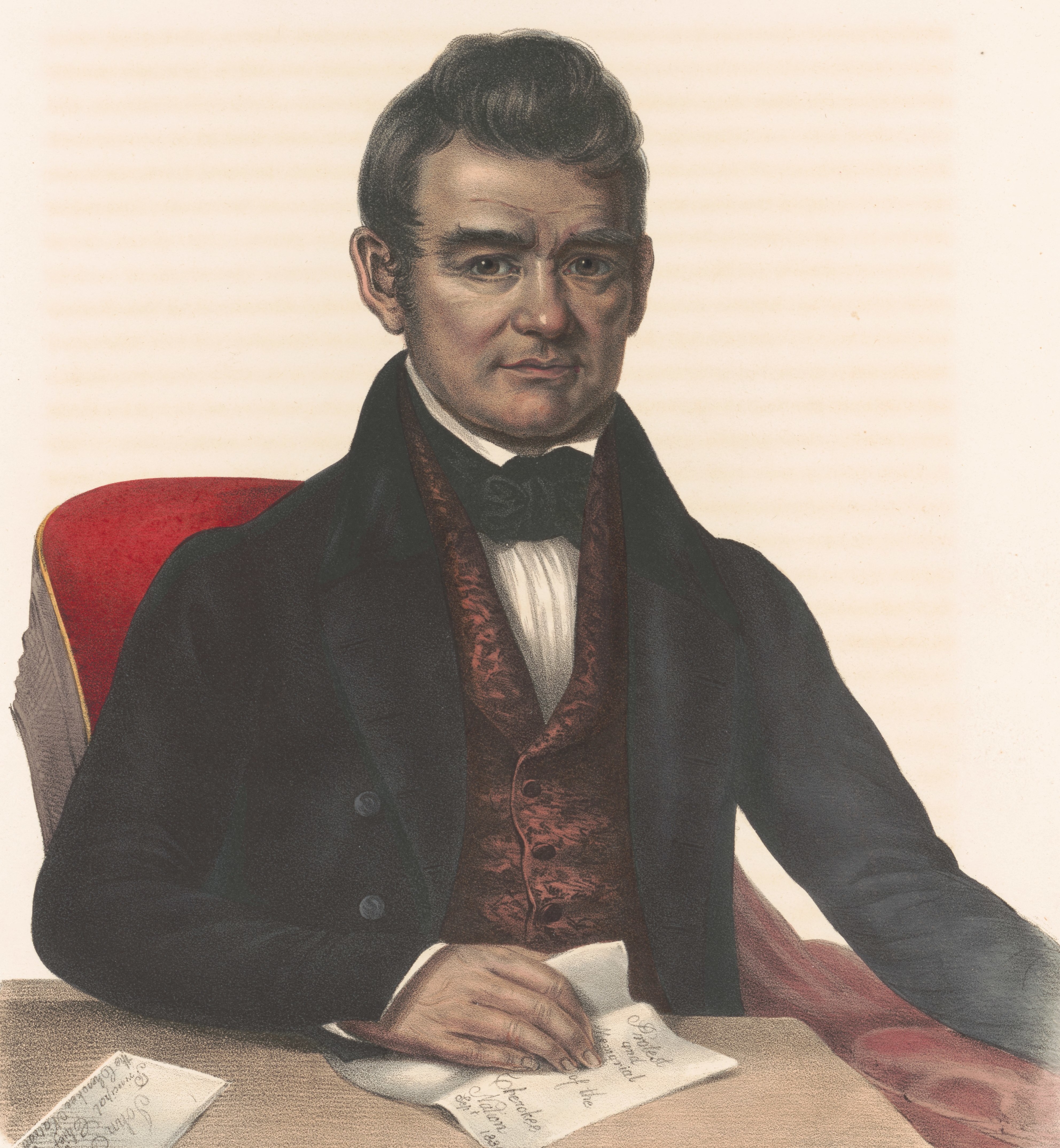
John Ross, Principal Chief of the Cherokees, 1828-1860, and head of the National Party, which opposed the Treaty Party headed by Major Ridge, et al.. (Wikipedia)
PBS has developed excellent teaching guides for school use. The guide for "Trail of Tears" is here. A National Park Service teaching guide for the Trail of Tears National Historic Trail is here.