!DOCTYPE html PUBLIC "-//W3C//DTD XHTML 1.0 Strict//EN" "http://www.w3.org/TR/xhtml1/DTD/xhtml1-strict.dtd">
Streamline Training & Documentation
Streamline Training & Documentation
Sunday, May 16, 2010
For those graduating today . . .
The Amaranth
Ah, in the night, all music haunts me here. . . . Is it for naught high Heaven cracks and yawns And the tremendous Amaranth descends Sweet with the glory of ten thousand dawns?
Does it not mean my God would have me say: — "Whether you will or no, O city young, Heaven will bloom like one great flower for you, Flash and loom greatly all your marts among?"
Friends, I will not cease hoping though you weep. Such things I see, and some of them shall come, Though now our streets are harsh and ashen-gray, Though our strong youths are strident now, or dumb. Friends, that sweet town, that wonder-town, shall rise. Naught can delay it. Though it may not be Just as I dream, it comes at last I know, With streets like channels of an incense-sea.
In his 1987 collection, The Haw Lantern, Seamus Heaney included a poem in memory of his mother, Margaret Kathleen Heaney.
Clearances in memoriam M.K.H., 1911-1984
She taught me what her uncle once taught her: How easily the biggest coal block split If you got the grain and the hammer angled right.
The sound of that relaxed alluring blow Its co-opted and obliterated echo, Taught me to hit, taught me to loosen,
Taught me between the hammer and the block To face the music. Teach me now to listen, To strike it rich behind the linear black.
1
A cobble thrown a hundred years ago Keeps coming at me, the first stone Aimed at a great-grandmother's turncoat brow. The pony jerks and the riot's on. She's couched low in the trap Running the gauntlet that first Sunday Down the brae to Mass at a panicked gallop. He whips on through the town to cries of 'Lundy!'
Call her 'The Convert.' 'The Exogamous Bride.' Anyhow, it is a genre piece Inherited on my mother's side And mine to dispose with now she's gone. Instead of silver and Victorian lace the exonerating, exonerated stone.
2
Polished linoleum shone there. Brass taps shone. The china cups were very white and big -- An unchipped set with sugar bowl and jug. The kettle whistled. Sandwich and tea scone Were present and correct. In case it run, The butter must be kept out of the sun. And don't be dropping crumbs. Don't tilt your chair. Don't reach. Don't point. Don't make noise when you stir.
It is Number 5, New Row, Land of the Dead, Where grandfather is rising from his place With spectacles pushed back on a clean bald head To welcome a bewildered homing daughter Before she even knocks. 'What's this? What's this?' And they sit down in the shining room together.
3
When all the others were away at Mass I was all hers as we peeled potatoes. They broke the silence, let fall one by one Like solder weeping off the soldering iron: Cold comforts set between us, things to share Gleaming in a bucket of clean water. And again let fall. Little pleasant splashes From each other's work would bring us to our senses.
So while the parish priest at her bedside Went hammer and tongs at prayers for the dying And some were responding and some crying I remembered her head bent towards my head, Her breath in mine, our fluent dipping knives -- Never closer the whole rest of our lives.
4
Fear of affectation made her affect Inadequacy whenever it came to Pronouncing words 'beyond her'. Bertold Brek. She'd manage something hampered and askew Every time, as if she might betray The hampered and inadequate by too Well-adjusted a vocabulary. With more challenge than pride, she'd tell me, 'You Know all them things.' So I governed my tongue In front of her, a genuinely well- Adjusted adequate betrayal Of what I knew better. I'd naw and aye And decently relapse into the wrong Grammar which kept us allied and at bay.
5
The cool that came off sheets just off the line Made me think the damp must still be in them But when I took my corners of the linen And pulled against her, first straight down the hem And then diagonally, then flapped and shook The fabric like a sail in a cross-wind, They'd make a dried-out undulating thwack. So we'd stretch and fold and end up hand to hand For a split second as if nothing had happened For nothing had that had not always happened Beforehand, day by day, just touch and go, Coming close again by holding back In moves where I was x and she was o Inscribed in sheets she'd sewn from ripped-out flour sacks.
6
In the first flush of the Easter holidays The ceremonies during Holy Week Were highpoints of our Sons and Lovers phase. The midnight fire. The paschal candlestick. Elbow to elbow, glad to be kneeling next To each other up there near the front Of the packed church, we would follow the text And rubrics for the blessing of the font. As the hind longs for the streams, so my soul . . . Dippings. Towellings. The water breathed on. The water mixed with chrism and oil. Cruet tinkle. Formal incensation And the psalmist's outcry taken up with pride: Day and night my tears have been my bread.
7
In the last minutes he said more to her Almost than in their whole life together. 'You'll be in New Row on Monday night And I'll come up for you and you'll be glad When I walk in the door . . . Isn't that right?' His head was bent down to her propped-up head. She could not hear but we were overjoyed. He called her good and girl. Then she was dead, The searching for a pulsebeat was abandoned And we all knew one thing by being there. The space we stood around had been emptied Into us to keep, it penetrated Clearances that suddenly stood open. High cries were felled and a pure change happened.
8
I thought of walking round and round a space Utterly empty, utterly a source Where the decked chestnut tree had lost its place In our front hedge above the wallflowers. The white chips jumped and jumped and skited high. I heard the hatchet's differentiated Accurate cut, the crack, the sigh And collapse of what luxuriated Through the shocked tips and wreckage of it all. Deep-planted and long gone, my coeval Chestnut from a jam jar in a hole, Its heft and hush became a bright nowhere, A soul ramifying and forever Silent, beyond silence listened for.
The strange and wonderful are too much with us. The protea of the antipodes--a great, globed, blazing honeybee of a bloom-- for sale in the supermarket! We are in our decadence, we are not entitled. What have we done to deserve all the produce of the tropics-- this fiery trove, the largesse of it heaped up like cannonballs, these pineapples, bossed and crested, standing like troops at attention, these tiers, these balconies of green, festoons grown sumptuous with stoop labor?
The exotic is everywhere, it comes to us before there is a yen or a need for it. The green- grocers, uptown and down, are from South Korea. Orchids, opulence by the pailful, just slightly fatigued by the plane trip from Hawaii, are disposed on the sidewalks; alstroemerias, freesias fattened a bit in translation from overseas; gladioli likewise estranged from their piercing ancestral crimson; as well as, less altered from the original blue cornflower of the roadsides and railway embankments of Europe, these bachelor's buttons. But it isn't the railway embankments their featherweight wheels of cobalt remind me of, it's
a row of them among prim colonnades of cosmos, snapdragon, nasturtium, bloodsilk red poppies, in my grandmother's garden: a prairie childhood, the grassland shorn, overlaid with a grid, unsealed, furrowed, harrowed and sown with immigrant grasses, their massive corduroy, their wavering feltings embroidered here and there by the scarlet shoulder patch of cannas on a courthouse lawn, by a love knot, a cross stitch of living matter, sown and tended by women, nurturers everywhere of the strange and wonderful, beneath whose hands what had been alien begins, as it alters, to grow as though it were indigenous.
But at this remove what I think of as strange and wonderful, strolling the side streets of Manhattan on an April afternoon, seeing hybrid pear trees in blossom, a tossing, vertiginous colonnade of foam, up above-- is the white petalfall, the warm snowdrift of the indigenous wild plum of my childhood. Nothing stays put. The world is a wheel. All that we know, that we're made of, is motion.
Illustration and opening lines from the portion of the General Prologue to Geoffrey Chaucer's Canterbury Tales that describes the Clerk from Oxford. The full text of this section of the prologue is given below, first in modern English and then in the original Middle English.
A Clerk from Oxford was there also, Who'd studied philosophy, long ago. As lean was his horse as is a rake, And he too was not fat, that I take, But he looked emaciated, moreover, abstemiously. Very worn off was his overcoat; for he Had got him yet no churchly benefice, Nor he was worldly to accept secular office. For he would rather have at his bed's head Some twenty books, all bound in black or red, Of Aristotle and his philosophy Than rich robes, fiddle, or gay psaltery. Yet, and for all he was philosopher in base, He had but little gold within his suitcase; But all that he might borrow from a friend On books and learning he would swiftly spend, And then he'd pray diligently for the souls Of those who gave him resources to attend schools. He took utmost care and heed for his study. Not one word spoke he more than was necessary; And that was said with due formality and dignity And short and lively, and full of high morality. Filled with moral virtue was his speech; And gladly would he learn and gladly teach.
[lines 287-310 of the General Prologue to The Canterbury Tales by Geoffrey Chaucer]
The original text: A Clerk ther was of Oxenford also, That unto logyk hadde longe ygo. As leene was his hors as is a rake, And he nas nat right fat, I undertake, But looked holwe and therto sobrely. Ful thredbare was his overeste courtepy; For he hadde geten hym yet no benefice, Ne was so worldly for to have office. For hym was levere have at his beddes heed Twenty bookes, clad in blak or reed, Of Aristotle and his philosophie, Than robes riche, or fithele, or gay sautrie. But al be that he was a philosophre, Yet hadde he but litel gold in cofre; But al that he myghte of his freendes hente, On bookes and on lernynge he it spente, And bisily gan for the soules preye Of hem that yaf hym wherwith to scoleye. Of studie took he moost cure and moost heede. Noght o word spak he moore than was neede, And that was seyd in forme and reverence, And short and quyk, and ful of hy sentence; Sownynge in moral vertu was his speche, And gladly wolde he lerne, and gladly teche.
This I saw on an April day: Warm rain spilt from a sun-lined cloud, A sky-flung wave of gold at evening, And a cock pheasant treading a dusty path Shy and proud.
And this I found in an April field: A new white calf in the sun at noon, A flash of blue in a cool moss bank, And tips of tulips promising flowers To a blue-winged loon.
And this I tried to understand As I scrubbed the rust from my brightening plow: The movement of seed in furrowed earth, And a blackbird whistling sweet and clear From a green-sprayed bough.
Readers of this blog will know that I'm fascinated by the process of improvisation, a subject I discussed most recently here. I'm firmly convinced that one of the prime aspects of expertise is the ability to conjure up promising ideas on the fly. I'm also confident that this is a skill that can be steadily honed through practice.
The Spring 2010 issue of Johns Hopkins Magazine gives its last page over to a summary of how an accomplished jazz pianist in an ensemble undertakes to improvise. The summary is provided by Timothy Murphy, a keyboardist and teacher at Hopkins' Peabody Conservatory and at Towson University.
Murphy's offers these four bits of advice:
First, clear your mind. Get rid al all the words coursing through your head. Sit quietly about 30 seconds before putting your hands on the keyboard.
Improv is a conversation. Watch the facial expressions of the other players, listen to them, try to respond to what they do with the least predictable thing that's still musical.
If you suddenly go blank, just smile and keep pressing the keys until something good happens. Now and then, the best thing to "play" is silence.
A good solo should have a shape. Pay attention to the inner voice that's telling you that you've reached a high point and it's time to wind it down and get out elegantly.
The most direct business application of Murphy's schema is to meetings in which creative thinking is needed, for example, concerning the design of a new product or service or the solution to a problem. An individual's contributions don't have to be "the least predictable thing," but they certainly shouldn't be trite. Everybody should contribute, but no one should overwhelm the conversation. Soliloquies should "have a shape" and, even if the speaker doesn't end elegantly, he or she should not run on.
Spring is like a perhaps hand (which comes carefully out of Nowhere)arranging a window,into which people look(while people stare arranging and changing placing carefully there a strange thing and a known thing here)and
changing everything carefully
spring is like a perhaps Hand in a window (carefully to and fro moving New and Old things,while people stare carefully moving a perhaps fraction of flower here placing an inch of air there)and
You're in this dream of cotton plants. You raise a hoe, swing, and the first weeds Fall with a sigh. You take another step, Chop, and the sigh comes again, Until you yourself are breathing that way With each step, a sigh that will follow you into town.
That's hours later. The sun is a red blister Coming up in your palm. Your back is strong, Young, not yet the broken chair In an abandoned school of dry spiders. Dust settles on your forehead, dirt Smiles under each fingernail. You chop, step, and by the end of the first row, You can buy one splendid fish for wife And three sons. Another row, another fish, Until you have enough and move on to milk, Bread, meat. Ten hours and the cupboards creak. You can rest in the back yard under a tree. Your hands twitch on your lap, Not unlike the fish on a pier or the bottom Of a boat. You drink iced tea. The minutes jerk Like flies.
It's dusk, now night, And the lights in your home are on. That costs money, yellow light In the kitchen. That's thirty steps, You say to your hands, Now shaped into binoculars. You could raise them to your eyes: You were a fool in school, now look at you. You're a giant among cotton plants. Now you see your oldest boy, also running. Papa, he says, it's time to come in.
You pull him into your lap And ask, What's forty times nine? He knows as well as you, and you smile. The wind makes peace with the trees, The stars strike themselves in the dark. You get up and walk with the sigh of cotton plants. You go to sleep with a red sun on your palm, The sore light you see when you first stir in
You will probably recognize line 625 in the excerpt below from Alexander Pope's "Essay on Criticism." The excerpt comprises lines 610 to 642. Such shameless bards we have, and yet, 'tis true, There are as mad abandoned critics, too. The bookful blockhead ignorantly read, With loads of learned lumber in his head, With his own tongue still edifies his ears, And always listening to himself appears. All books he reads and all he reads assails From Dryden's Fables down to Durfey's Tales. With him most authors steal their works or buy; Garth did not write his own Dispensary. Name a new play, and he's the poets friend Nay, showed his faults — but when would poets mend? No place so sacred from such fops is barred, Nor is Paul's Church more safe than Paul's Churchyard: Nay, fly to altars; there they'll talk you dead, For fools rush in where angels fear to tread. Distrustful sense with modest caution speaks, It still looks home, and short excursions makes; But rattling nonsense in full volleys breaks, And, never shocked, and never turned aside, Bursts out, resistless, with a thundering tide.
But where's the man who counsel can bestow, Still pleased to teach, and yet not proud to know? Unbiased, or by favor, or in spite, Not dully prepossessed, nor blindly right; Though learned, well-bred, and though well-bred, sincere, Modestly bold, and humanly severe, Who to a friend his faults can freely show, And gladly praise the merit of a foe? Blessed with a taste exact, yet unconfined; A knowledge both of books and human kind; Generous converse, a soul exempt from pride; And love to praise, with reason on his side?
Note: The Wikipedia entry for John Dryden's Fables, Ancient and Modern is here. You can read about Thomas Durfey here. The Wikipedia entry for Sir Samuel Garth is here.
Creating nests of cultural life required more than money. Only about 2 to 3 percent of nobles could afford to build and maintain the two hundred or so staff required, say, for a large house, church, planned garden, and other amenities; and to hire foreign conductors, musicians, ballet masters, and set designers. The middling and poorer Maecenases of art had little alternative but to deploy their serfs on the front lines of creativity and performance. But even the grandees drew on their serf population for rank-and-file performers. The belief, just starting to erode in other parts of Europe, that artists were hardly better than artisans or servants remained intact in Russia; playing a violin or dancing on stage seemed only a step away from craft skills or household and farm chores. Owners of large estates could draw from armies of field hands, drivers, under-stewards, and various technical workers. For more modest landlords, household serfs made up the recruitment pool: cooks, scullery maids, butlers, and valets. Serf artists of all kinds could be differentiated and segregated from field serfs and domestics in treatment, apparel, and even housing. Just as often, they shared the status of stable boys, millers, blacksmiths, and domestics, even alternating in these roles on a regular basis. An ex-serf recalled in his memoirs how owners inhibited initiative and pride of work by shuttling serfs from farm to house, turning cooks to coachmen, lackeys to clerks or shepherds. [p. 30]
The New York Times obituary for Richard Stites, longtime professor at Georgetown University, is here.
Three cheers for Alfred Sloan that he decided to hire top architectural talent — Eliel Saarinen and his son Eero — to design the General Motors Technical Center, which opened in Warren MI in 1956 (by which time Eero was the main architect, his father having died in 1950). As Sloan explains in Chapter 14 of My Years with General Motors, there was some disagreement over the "architectural and aesthetic standards" that should be set for the Technical Center.
Staircase, designed by Eero Saarinen, in the Research building of the General Motors Technical Center (Critical Detroit)
... Harley Earl had contended from the beginning that we should engage an architect of stature, and aim for a center that would be distinctive. Several others felt that any emphasis on high aesthetic standards might be detrimental to the practical operations of the center, and so they wanted General Motors itself to design and plan the project. At about the time this argument was in progress, I happened to visit the Ethyl Corporation laboratores in Detroit, which had just been completed. These handsome facilities made an excellent impression on me, and so I inclined to Mr. Earl's point of view more than I might have otherwise.
Among those who expressed some concern about the effects of an aesthetically oriented center was Mr. Lammot du Pont. He felt, quite properly, that he would not be fulfilling his responsibilities as a director unless he was satisfied, on certain points. I wrote to him on May 8, 1945, arguing the advantages of retaining an outside architect, and on May 17 he replied that he was satisfied on the point. His letter said, in part:
The whole layout and the description of its preparation gave me the impression that the matter of esthetic treatment, or as I would style it, "dressing up the place," had been an important factor from the beginning. I questioned whether the matter of appearance was of any importance in a project of this kind, the sole object being to get technical results. It was with this thought in mind that in offering my remarks, I started out with the layout which had been made by an architectural firm, whereas according to my line of thought, it would have been more appropriate to have had the layout made by an engineering firm or General Motors engineers.
I gather from your letter that it is not the intention to allow the appearances to interfere with the technical possibilities or to add substantially to the cost of the project. With those two assurances, my only remaining question with respect to the project would be answered.
We asked Mr. Earl himself to find the right architect for the center. He visited a number of leading architectural schools and sought out the opinions of others who were knowledgeable in the field, and he found in the end that virtually everyone made the same recommendation. The selection of the Saarinens was not a difficult choice. [The landscape architect was Thomas Church.]
[The General Motors Technical Center] is located on a 900-acre site northeast of Detroit, about twelve miles from the General Motors Building. At the center of the site is a twenty-two acre artificial lake surrounded on three sides by clusters of buildings. On the north side are the Research Laboratories. To the east are the Manufacturing Staff and the Engineering Staff buildings. To the south are the Styling Staff buildings, including a distinctive domed auditorium in which fairly sizable groups can gather for showings of the staff's work.
Below is the text of "An die Freude" by Friedrich von Schiller (1759–1805), as modified by Ludwig van Beethoven (December 16, 1770 – March 26, 1827) for the final movement of his Symphony No. 9 in D minor, Op. 125 (1825): O Freunde, nicht diese Töne! Sondern laßt uns angenehmere anstimmen und freudenvollere. Freude!
Freude, schöner Götterfunken Tochter aus Elysium, Wir betreten feuertrunken, Himmlische, dein Heiligtum! Deine Zauber binden wieder Was die Mode streng geteilt; Alle Menschen werden Brüder, Wo dein sanfter Flügel weilt.
Wem der große Wurf gelungen, Eines Freundes Freund zu sein; Wer ein holdes Weib errungen, Mische seinen Jubel ein! Ja, wer auch nur eine Seele Sein nennt auf dem Erdenrund! Und wer's nie gekonnt, der stehle Weinend sich aus diesem Bund!
Freude trinken alle Wesen An den Brüsten der Natur; Alle Guten, all Bösen Folgen ihrer Rosenspur. Küsse gab sie uns und Reben, Einen Freund, geprüft im Tod; Wollust ward dem Wurm gegeben, und der Cherub steht vor Gott.
Froh, wie seine Sonnen fliegen Durch des Himmels prächt'gen Plan, Laufet, Brüder, eure Bahn, Freudig, wie ein Held zum Siegen.
Seid umschlungen, Millionen! Diesen Kuß der ganzen Welt! Brüder, über'm Sternenzelt Muß ein lieber Vater wohnen. Ihr stürzt nieder, Millionen? Ahnest du den Schöpfer, Welt? Such' ihn über'm Sternenzelt! Über Sternen muß er wohnen.
An English translation (not the same as the video's subtitles): Oh friends, no more of these sad tones! Let us rather raise our voices together In more pleasant and joyful tones. Joy!
Joy, thou shining spark of God, Daughter of Elysium, With fiery rapture, goddess, We approach thy shrine. Your magic reunites That which stern custom has parted; All humans will become brothers Under your protective wing.
Let the man who has had the fortune To be a helper to his friend, And the man who has won a noble woman, Join in our chorus of jubilation! Yes, even if he holds but one soul As his own in all the world! But let the man who knows nothing of this Steal away alone and in sorrow.
All the world's creatures drink From the breasts of nature; Both the good and the evil Follow her trail of roses. She gave us kisses and wine And a friend loyal unto death; She gave the joy of life to the lowliest, And to the angels who dwell with God.
Joyous, as his suns speed Through the glorious order of Heaven, Hasten, brothers, on your way, Joyful as a hero to victory.
Be embraced, all ye millions! With a kiss for all the world! Brothers, beyond the stars Surely dwells a loving Father. Do you kneel before him, oh millions? Do you sense the Creator's presence? Seek him beyond the stars! He must dwell beyond the stars.
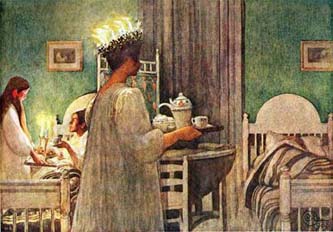
The story of "Lucia Morning," as told by cowboyannie. . . In Sweden, Denmark, Estonia, Norway, and Finland, Saint Lucy is venerated on December 13 in a ceremony where a girl is elected to portray Lucia. Wearing a white gown with a red sash and a crown of candles on her head, she walks at the head of a procession of women, each holding a candle. The candles symbolize the fire that refused to take St. Lucia's life when she was sentenced to be burned. The women sing a Lucia song while entering the room, to the melody of the traditional Neapolitan song Santa Lucia; the Italian lyrics describe the view from Santa Lucia in Naples, the various Scandinavian lyrics are fashioned for the occasion, describing the light with which Lucia overcomes the darkness. Each Scandinavian country has lyrics in their native tongues. After finishing this song, the procession sings Christmas carols or more songs about Lucia. A similar version occurs in Scandinavian communities and churches in the United States. In the Lucia procession in the home depicted by Carl Larsson in 1908, the oldest daughter brings coffee and St. Lucia buns to her parents while wearing a candle-wreath and singing a Lucia song. Other daughters may help, dressed in the same kind of white robe and carrying a candle in one hand, but only the oldest daughter wears the candle-wreath.
To hear a performance of "Sankta Lucia" in Swedish, see this post from a year ago.
A few weeks ago I made a point of attending a talk the composer Richard Einhorn was giving at Smith College. His topic — in my paraphrase — was ways in which working scientists and working composers resemble one another. The ways Einhorn discussed were basically two: an experimental approach and, for many contemporary composers, use of digital technology.
Richard Einhorn at the Academy of Music in Northampton MA. Einhorn's "Voices of Light" had its world premiere at the Academy in 1994. The composition for solo voices, chorus, and orchestra is, in Einhorn's words, "a meditation on the life and personality of Joan of Arc," an "opera/oratorio" that takes place during a screening of Carl Dreyer's 1928 silent film, The Passion of Joan of Arc. (www.richardeinhorn.com)
In his talk, Einhorn offered numerous examples from his own compositions, including his most recent major work, "The Origin," a multimedia opera/oratorio celebrating the life and work of Charles Darwin (1809-1882).
The performers at "The Origin's" premiere in February at the State University of New York at Oswego were the SUNY Oswego Festival and Community choruses, the Eastern European vocal ensemble KITKA, soprano Jacqueline Horner, and bass Eric Johnson. The video below offers an 8:17 sample.
The video below is a beautiful live rendition of the closing portion of "Der Abschied" ("The Farewell"), which is the last of the six parts of "Das Lied von der Erde" ("The Song of the Earth") by Gustav Mahler. The singer is Janet Baker. She is performing in Munich in 1970 with the Bavarian Radio Symphony Orchestra, conducted by Rafael Kubelik.
As explained in notes by the BBC, Mahler based the text of this portion of "Der Abschied" on a poem by the Tang dynasty poet Wang Wei ... Er stieg vom Pferd und reichte ihm den Trunk des Abschieds dar.
Er fragte ihn, wohin er führe und auch warum es müßte sein.
Er sprach, seine Stimme war umflort:
Du, mein Freund, mir war auf dieser Welt das Glück nicht hold!
Wohin ich geh? Ich geh, ich wandre in die Berge.
Ich suche Ruhe ... Ruhe für mein einsam Herz.
Ich wandle nach der Heimat, meiner Stätte.
Ich werde niemals in die Ferne schweifen.
Still ist mein Herz und harret seiner Stunde!
Die liebe Erde allüberall blüht auf im Lenz und grünt aufs neu!
A friend and I went to a local cineplex this afternoon to watch the simulcast of the Met's matinee performance of Turandot. The Franco Zeffirelli production, which dates to 1987, is lavish, as you would expect. There were unfortunate hiccups in the satellite transmission, but it was still very clear that Marina Poplavskaya, the Russian soprano playing the slave Liù, is a special talent.
Instead of a clip of Poplavskaya singing as Liù, something I think is not available outside of the Met's paid service, below is a 7:54 clip of the "Willow Song" from Act IV of Verdi's Otello, as Poplavskaya, playing Desdemona, sang it last year at the Salzburg Festival.
The scene is based on dialogue between Desdemona and Emilia in Scene 3 of Act 4 of Shakespeare's play. Barbara Di Castri plays the role of Emilia.
The clip has German subtitles. The original Italian lyrics and an edited English translation are reproduced beneath the clip.
Mia madre aveva una povera ancella Innamorata e bella; Era il suo nome Barbara. Amava Un uom che poi l'abbandonò, cantava Una canzone: la canzon del Salice.
– Mi disciogli le chiome. –
Io questa sera ho la memoria piena Di quella cantilena: "Piangea cantando Nell'erma landa, Piangea la mesta. O Salce! Salce! Salce! Sedea chinando Sul sen la testa! O Salce! Salce! Salce! Cantiamo! cantiamo! il Salce funebre Sarà la mia ghirlanda."
– Affrettati; fra poce giunge Otello. –
"Scorreano i rivi fra le zolle in fior, Gemea quel core affranto, E dalle ciglia le sgorgava il cor L'amara onda del pianto. O Salce! Salce! Salce! Cantiamo! cantiamo! il Salce funebre Sarà la mia ghirlanda. Scendean gli augelli a vol dai rami cupi Verso quel dolce canto. E gli occhi suoi piangevan tanto, tanto, Da impietosir le rupi." Riponi quest'anello. Povera Barbara! Solea la storia Con questo semplice suoono finir: "Egli era nato per la sua gloria, Io per amar..." Ascolta. Odo un lamento. Taci. Chi batte a quella porta? – È il vento. "Io per amarlo e per morir ... Cantiamo! cantiamo! Salce! Salce! Salce!" Emilia, addio. Come m'ardon le ciglia! È presagio di pianto. Buona notte. Ah! Emilia, Emilia, addio, Emilia, addio!
My mother had a poor maid, In love and beautiful; Her name was Barbara. She loved A man who abandoned her, and she used to sing A song: The Willow Song.
– Undo my hair. –
This evening my memory is filled With that song: "She wept, singing On the lonely heath, The sad girl wept. O Willow! Willow! Willow! She would sit with her head Drooping on her bosom! O Willow! Willow! Willow! Let us sing! Let us sing! The mournful willow Shall be my garland."
– Hurry; Othello is coming soon. –
"The brooks ran through the flowering fields, That broken heart would moan, And from her eyes her heart poured out A bitter wave of tears. O Willow! Willow! Willow! Let us sing! Let us sing! The mournful willow Shall be my garland. The birds came flying down from the somber branches Toward that sweet song. And her eyes would weep so much, so much, That the stones were filled with pity."
Put back this ring.
Poor Barbara! The story used to End with this simple sound: "He was born for his fame, I was born to lo..." Listen. I hear a lament. Quiet. Who's knocking at the door?
– It's the wind. –
"I was born to love him and die ... Let us sing! Let us sing! Willow! Willow! Willow!" Emilia, farewell. How my eyes burn! That bodes weeping. Good night. Ah! Emilia, Emilia, farewell, Emilia, farewell!
I'd like to follow up briefly on Sunday's post about research concerning how a message deliverer's expertise and expressed degree of certainty affect persuasiveness.
The research indicates that surprising consumers by having a message containing a subjective judgment be delivered by a somewhat uncertain expert, or by a highly certain non-expert, will engage consumers' interest and make it easier to persuade them that the message is valid (assuming it includes a strong argument in favor of the judgment in question).
This notion of using surprise to gain audience attention, and get them thinking about what you have to say, came back to mind as I was reading a review of William Trevor's latest novel in the November 19 issue of The New York Review of Books (not yet online).
Reviewer David Lodge likes Love and Summer. After several paragraphs explaining Trevor's long career — he is now eighty-one — and introducing the novel, Lodge makes the following comment about Trevor's writing technique: The novel begins:
On a June evening some years after the middle of the last century Mrs Eileen Commulty passed through the town of Rathmoye: from Number 4 The Square to Magennis Street, into Hurley Lane, along Irish Street, across Cloughjordan Road to the Church of the Most Holy Redeemer. Her night was spent there.
In short, it begins with a funeral, though it is not until you get to the last sentence that the penny drops. This is typical of Trevor's technique: enlivening the meticulous realism of the scene-setting not by metaphor and simile, but by little enigmas and surprises in the way information is fed to the reader. He belongs in a tradition classically represented by the fiction writers of the late nineteenth and early twentieth centuries like Maupassant, Chekhov, and the Joyce of Dubliners. The narrative voice is impersonal and detached but reliable, in complete possession of the story and its milieu, giving us enough information to be interested, but withholding a good deal to ensure that we read on, and think about what we read ...
Lodge's description of how Trevor presents his story carries a lesson for anyone wanting an engaged audience. A major part of your job in planning the flow of a presentation, especially if the size of your audience limits mid-presentation dialogue, is to decide how to launch your story in a way that gets people to sit up because it is somehow unexpected, and then how to parcel out your information and supporting arguments in a way that continues to inject surprising points that keep listeners' minds in gear.
For related ideas concerning use of stagecraft as a tool for persuasion, see this post from 2006 that talks about David Gergen's views on what effective leaders do that makes them persuasive.
My trip to Austin extended over less than two days, but I did manage to see a few sights. One was the Blanton Museum of Art on the campus of the University of Texas. A sampling of the pictures I viewed is below.
The video below shows Sosa singing "Cuando Tenga la Tierra" at the 1983 Central American Peace Concert, held in the square in front of the cathedral in Managua, Nicaragua.
The Washington Post posted a detailed obituary today (though it carries tomorrow's date).