Texas State History Museum
 Poster advertising steamship service between Hamburg, Germany, and Antwerp, Belgium, on one side of the Atlantic, and Galveston, Texas, on the other
(www.austin360.com)The one other sightseeing stop I made while I was in Austin, besides the Blanton Museum of Art
mentioned yesterday, was the
Bob Bullock Texas State History Museum. The museum is laid out in modern museum style, meaning great care has been taken to tell the state's story from multiple perspectives, with ample attention to the experiences of ordinary people — Native Americans, Mexicans, immigrants from elsewhere in the US, and immigrants from abroad.
The latter group are the subject of a special exhibit,
Forgotten Gateway: Coming to America Through Galveston Island. I certainly had not been aware of the large number of immigrants who entered the US at Galveston, and was glad to learn about their experience through the memorabilia on display, accompanied by interactive exhibits, video, and explanatory text.
The Galveston exhibit closed at the Texas State History Museum yesterday and will now be taken to other venues, including
Moody Gardens in Galveston and the
Ellis Island Museum.
###Labels: Travel
The Blanton Museum of Art
My trip to Austin extended over less than two days, but I did manage to see a few sights. One was the
Blanton Museum of Art on the campus of the University of Texas. A sampling of the pictures I viewed is below.
 Sioux Village Near Fort Laramie
Albert Bierstadt, 1859
(Blanton Museum of Art) Oil Field Girls
Jerry Bywaters, 1940
(Blanton Museum of Art) Indians at Campfire, Yosemite Valley, California
Thomas Hill, c. 1885
(Blanton Museum of Art)###Labels: Arts, Travel
The Umlauf Sculpture Garden in Austin TX
 A view of the garden of the Umlauf Sculpture Garden & Museum, where my nephew is getting married today. The garden and museum are the site for works of Charles Umlauf and other contemporary sculptors.
(Suburban Wildlife Garden)###Labels: Special occasion, Travel
Back in Boston
For me, "The Hub" means
. . . . . . the Boston bus station, from which buses back to Northampton depart.
(webshots.com)###Labels: Travel
Back in Helsinki
My home away from home
. . . Hostel Academica, on Hietaniemenkatu in the center of Helsinki. My room has a kitchenette, and there is a grocery across the street, so I find the accommodations quite convenient.
(hostelz.com)###Labels: Travel
Kangerlussuaq
Today's destination
. . . Musk Ox near Kangerlussuaq
(The Epoch Times)Those of us who elected to skip the "Musk Ox Safari" had nothing to do for most of the morning besides chat and read on the ship while waiting for the bus that would take us to the Kangerlussuaq airport for the flight back to Helsinki.
I had a long conversation in the café with
Per Langgård, a Danish linguist living in Finland who advises Greenland's government on language policy. Langgård played a lead role in development of the
spell checker for Greenlandic that was released in 2006.
###Labels: Travel
Sisimiut
Today's destination
. . . 2006 POST Greenland stamp commemorating the 250th anniversary of Sisimiut
The stamp shows Sisimiut's Whale Jaw Gate and Blue Church beneath Mt. Kællingehatten (Crone's Hood), the symbol of Sisimiut.
Artist: Miki Jacobsen
(Top of the World of Stamps)I went on a hike to see more Viking ruins — as at Narsaq, much deteriorated — and in the process got a further look at the thick grass that grows in meadows during the summer. I also visited the Blue Bethel Church featured on the stamp shown above. One corner of the church has required additional support recently because of settling of the building's foundation due to permafrost melting.
###Labels: Travel
Ilulissat
Today's destination
. . . The Ilulissat Icefjord, as seen from space
(click to enlarge)
(Telegraph.co.uk)The herd of icebergs in the fjord is certainly a sight to see. I elected to go on a 3 km hike that provided several scenic overlooks. The Ilulissat Icefjord was declared a
World Heritage Site by UNESCO in 2004.
###Labels: Travel
Evighedsfjord (Kangerdlugssuatslaq)
Today's destination
. . .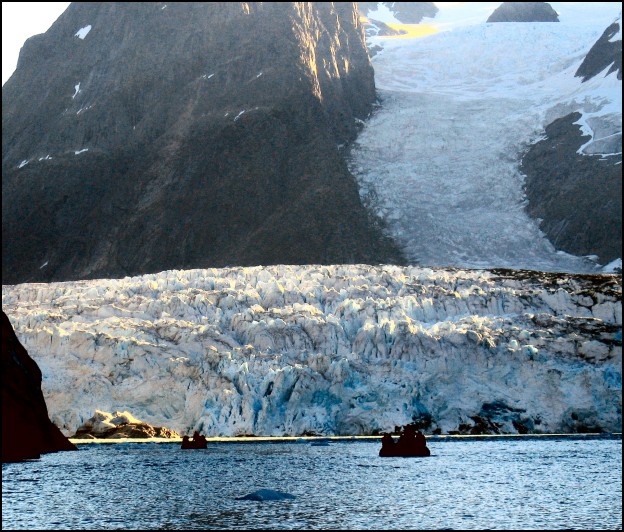 Tâterât Glacier, at head of Evighedsfjord
(click to enlarge)
(Peter Jennings)We sailed as far up the fjord as we could, stopping only at the point where the chart stopped providing depth soundings.
###Labels: Travel
Nuuk, Capital of Greenland
Today's destination
. . . Aqqusinerssuaq, Nuuk's main street
(click to enlarge)
(Karsten Bidstrup)For me the highlight of our time in Nuuk was my visit to the
Greenland National Museum and Archives, where you can view well-organized artifacts from all eras of Greenlandic history that are accompanied by sophisticated explanations in Greenlandic and English.
###Labels: Travel
Narsaq
Today's destination
. . . Narsaq
(click to enlarge)
(John Rasmussen)I went on a van excursion that got us to some vestigial Viking ruins outside of town. What was particularly striking for me was the lushness of the meadow in which the ruins were located. The buildings of a modern sheep farm, whose herd numbers 2,000, were just a few hundred yards away.
###Labels: Travel
Prins Christian Sund and Qaqortoq
Today's destinations
. . . Prins Christian Sund from the Weather Station
(www.foleysail.com) Qaqortoq
(Greenland Sagalands)We went as far as the entrance to Prins Christian Sund, but didn't venture in because of heavy ice. We later heard that a larger ship was more bold, did sail in, and then was stuck for a day, meaning they missed their stop in Qaqortoq.
The Kristina Regina, on the other hand, arrived a bit early at Qaqortoq, leaving ample time to buy postcards and stamps and have a look around. I decided none of the seal fur products (coats, hats, small leathers, doodads) appealed to me, so I gave them a pass. I also skipped the visit to the factory in which the goods are produced. Instead, I took a long walk to a scenic point overlooking the town and the ocean.
###Labels: Travel
Lindenow Fjord
Today's destination
. . . Ice at Peers Cove and Lindenow Fjord
(Ole Bendixen, 1925)
(Arktisk Institut, Copenhagen)Unfortunately, there was too much ice in the fjord to allow us to visit, so we just continued steaming south toward Prins Christian Sund, tomorrow morning's destination.
###Labels: Travel
A Day at Sea
 Statue of sailors at the Reykjavik harbor
(EuropeUpClose)Neither Out Far Nor In DeepThe people along the sand
All turn and look one way.
They turn their back on the land
They look at the sea all day.
As long as it takes to pass
A ship keeps raising its hull;
The wetter ground like glass
Reflects a standing gull
The land may vary more;
But wherever the truth may be —
The water comes ashore,
And the people look at the sea
They cannot look out far.
They cannot look in deep.
But when was that ever a bar
To any watch they keep?
—
Robert Frost###Labels: Travel
In Reykjavik
I haven't actually seen an Icelandic horse moving with the
tölt gait that is unique to the breed, but I hope to have an in-person look eventually.
 Icelandic horse performing the tölt
(Wikipedia)You can watch a 19-second video of a horse moving at an accelerating tölt
here.
###Labels: Travel
Arrival in Reykjavik
We boarded the
Kristina Regina at about 7:30 pm. Some of the passengers will go on an escorted tour of Reykjavik tomorrow. Since I've been in Reykjavik several times previously, I plan to wander around the city independently.
 The itinerary for my Greenland cruise
(Kristina Cruises)###Labels: Travel
In Helsinki
I have about 24 hours in Helsinki before I join some 200 fellow passengers on a
Kristina Cruises charter flight to Reykjavik, which is where we board
m/s Kristina Regina.
 Poster from the 1940 Olympic Games,
which were cancelled due to World War II
(Harvey Abrams – Books)###Labels: Travel
Training to Support Ecosystem Conservation
The
Río Plátano Biosphere Reserve, established in Honduras in 1982, is a prime site for ecotourism.
1 Río Plátano Biosphere Reserve,
La Moskitia, Honduras
(Erika Nortemann) Map of the Río Plátano Biosphere Reserve in northeastern Honduras (click to enlarge)
(Smithsonian Institution)A non-profit organization called
Rare includes the Río Plátano Reserve among a wide range of conservation projects it has undertaken in Africa, Asia, the Caribbean, Latin America, and the Pacific in which Rare pursues its
mission "to conserve imperiled species and ecosystems around the world by inspiring people to care about and protect nature."
A major element in Rare's efforts is training of local people in effective promotion of conservation, including through sustainable tourism.
For instance, Rare runs a
Nature Guide Training Program for local residents of areas visited by ecotourists such as the Río Plátano Reserve. The guides' training involves "three months of coursework, learning the natural and cultural history of the region and gaining the necessary skills to translate their knowledge to visitors from around the world."
A similar program has trained guides employed by
La Ruta Moskitia, "a locally-run ecotourism operation launched in early 2006, which includes six indigenous communities from the Río Plátano Biosphere Reserve ..." This training involved "eight weeks of intense classes and field study in ecosystems ranging from coastal lagoons to highland cloud forest to learn about the dramaticaly different ecosystems and natural history of the areas in which they will be leading their visitors."
2Rare's general approach to promoting conservation is to use marketing techniques to achieve the attitudinal and behavioral changes needed at the local level for conservation objectives, such as rainforest preservation, actually to be met. You can read more about Rare's
social marketing approach
here.
Of particular interest are the details of the
Masters in Communication program that Rare offers to individuals who undertake two-year
Pride Campaign projects. The curriculum, accredited by the University of Texas-El Paso, is impressive in its comprehensiveness, as you can see by reading the program
brochure (pdf).
Rare assesses project success by monitoring relevant metrics. In general terms, the organization watches the "3 C's": the
capacity for conservation that a project builds, the
constituency that is built, and the
conservation that is actually achieved.
__________
1 As
defined (pdf) by UNESCO, "Biosphere reserves are areas of terrestrial and coastal ecosystems promoting solutions to reconcile the conservation of biodiversity with its sustainable use. They are internationally recognized, nominated by national governments and remain under sovereign jurisdiction of the states where they are located. Biosphere reserves serve in some ways as 'living laboratories' for testing out and demonstrating integrated management of land, water and biodiversity. ... There are over 500 biosphere reserves in over 100 countries."
"Each biosphere reserve is intended to fulfil 3 basic functions, which are complementary and mutually reinforcing:
- a conservation function — to contribute to the conservation of landscapes, ecosystems, species and genetic variation
- a development function — to foster economic and human development which is socio-culturally and ecologically sustainable
- a logistic function — to provide support for research, monitoring, education and information exchange related to local, national and global issues of conservation and development
2 As explained in a 2008
press release, "La Ruta Moskitia was established by Rare ... and the Small Grants Programme (SGP)/GEF/ Honduras United Nations Development Programme (UNDP) in an effort to link sustainable tourism, biodiversity protection, and poverty alleviation in the [Río Plátano] Reserve."
###Labels: Communication, Latin America, Travel
Kent Rockwell Teaches His Housekeeper to Make Bread
In anticipation of my trip to Greenland next month, I decided to read
Salamina,
Rockwell Kent's account of his time in Greenland in 1931-1932. A passage which seemed particularly apt for a blog mostly devoted to training is reproduced below.
 (Rockwell Kent Gallery and Collection
of the Plattsburgh State Art Museum,
State University of New York)
To Salamina I relinquished all the cares of housekeeping, except — this brought contention — instruction in the art of cooking. She knew a little that she'd picked up here and there; that little made the trouble. She was glad to be shown things that she knew nothing about — such as how to make baked beans or cook spaghetti with tomato sauce — but she didn't like my criticism of her bread nor being told her sauce had lumps. When she would listen she was quick to learn, but having learned, she didn't like man's meddling in affairs that were, she held, exclusively a woman's. And over bread-making we had unbelievable scenes. I'd show her how: I'd mix the yeast, the sour dough, and ripen it. She'd never worked with sour dough before. I'd mix and knead the bread. I'd fix it for the night, tuck it up warm against all drafts. I'd work it into loaves and stand the loaves to rise. She'd watch me scornfully. And the minute I'd be out of sight she'd pop the half-risen bread into a half-ready oven, and ruin all. Again I'd make the bread — to have it again ruined by her defiant disobedience. Once, having set the loaves to rise and strictly ordered her to lay no hand on them, I flew into such a fury at her putting them ten minutes later into the oven that I pulled them out again and hurled the lot outdoors. That tamed her for the moment; she left the house in tears. I made and baked new bread. It turned out — God be praised! — perfection. That settled things. And now Salamina, using old-time sour dough — she swears by it — makes the only first-class A-1 white bread that I've tasted in North Greenland. If you're going to do a thing you'd better do it well.
I'll let everybody draw their own moral from Kent's story.
###Labels: Cooking and food, Travel
The USS Constellation
My sister and I are visiting my brother and his wife a bit north of Baltimore. Today Lynn and I went down to the
Inner Harbor where we made a reconnaissance visit to the
Maryland Science Center. A luncheon date with our sister-in-law forced a rushed survey of the numerous exhibits, many interactive, and we know we need to go back to do the place justice.
 (Texas Philatelic Association)
After lunch, we took a leisurely tour of the
USS Constellation. As part of the price of admission, visitors are supplied with audio wands that enable self-paced orientation to the ship's layout and operation. (There are 23 stops on the adult audio tour, 15 on the tour for families with children.)
The Constellation — the last sail-powered vessed built by the US Navy — was launched at Portsmouth, Virginia, in 1854 and commissioned in 1855. It is the only naval vessel active in the Civil War (mostly in the Mediterranean) that is still afloat.
Prior to the Civil War, the ship was used to intercept vessels engaged in illegal slave trading in the waters off west Africa. In later years, the Constellation was used by the US Naval Academy (1871-1893) and the Naval Training Station in Newport RI (1894-1933) to train midshipmen and enlisted personnel, respectively. A summary of the Constellation's operational history is
here.
For anyone who, like me, is fascinated by all things maritime, I cannot recommend highly enough a visit to the Constellation. If time permits, you can also have a look at the
US Coast Guard Cutter Taney, the
Lightship Chesapeake, the submarine
USS Torsk, and the
Seven Foot Knoll Lighthouse. All are part of the
Baltimore Maritime Museum.
###Labels: Military training, Travel


