!DOCTYPE html PUBLIC "-//W3C//DTD XHTML 1.0 Strict//EN" "http://www.w3.org/TR/xhtml1/DTD/xhtml1-strict.dtd">
Streamline Training & Documentation
Streamline Training & Documentation
Monday, March 08, 2010
A Vivid Preview of US Air Force Basic Training
You can find voluminous information about the US Air Force at www.af.mil, but if you want to check out the really cool stuff, the place to go is www.airforce.com.
Thanks to the March/April issue of Communications Arts magazine, I'm now aware of the immensely engaging and informative section of airforce.com devoted to detailing what happens during Air Force basic training. You can access this section here.
You'll find that the navigation is organized according to the eight full weeks recruits spend in basic training:
Week 1 — Fall In
Week 2 — Basic War Skills
Week 3 — Combat Lifesaving
Week 4 — Countering the Threat
Week 5 — Ready to Fight
Week 6 — The Beast (Basic Expeditionary Airman Skills Training — field exercises and combat scenarios)
Week 7 — Airmanship
Week 8 — Graduation
Each week's material includes a video overview, a short inspirational blurb (accessed by mousing over an image on the screen representing the week's focus), video comments from a Military Training Instructor, still photos, and a summary of the schedule for the week.
The site also provides guidance on how to prepare for basic training (e.g. what to study in advance, what to pack, and what not to pack).
On every screeen a visitor is one click away from launching an online chat with an "advisor" or launching a tool for finding the nearest Air Force recruiter.
Visitors can also:
click on "See What It's Like" to access video on such activities as combat search and rescue, serving on a bomb squad, and special ops.
try various interactive features, such as "Train a Military Working Dog," "Refuel a Plane," "Launch a Rocket into Space," and "Fly with the Thunderbirds."
play simulation games
The basic training section of airforce. com is the handiwork of GSD&M Idea City.
A Simulation that Helps with Counterinsurgency Training
The US military, even more than organizations in the private sector, is stepping up the pace at which it implements simulations for training. A recent example — UrbanSim — is described in a brief item in the January/February 2010 issue of The Atlantic.
Brian Mockenhaupt, a freelance journalist and former infantryman who served in Iraq, explains that the object of UrbanSim is to tilt the support of the local population in a war zone toward a U.S.-led coalition and the local government.
The game's scenarios involve named local individuals (e.g., the mayor of a town) and groups (e.g., a neighborhood), all of which are "autonomous agents that react not just to specific actions, but to the climate created by a player's overall strategy."
The intent of the simulation is to
teach commanders new ways of thinking about multiple problems in a fast-changing environment, always reevaluating instead of fixating on one approach. “You have to think through the cause and effect of your decisions,” said Colonel Todd Ebel, the director of the School for Command Preparation [where UrbanSim was first used]. “Like chess, you have to look two or three turns down the road.”
In UrbanSim, players in two-person teams take on the role of an Army battalion commander who has to plan, prepare, and execute counterinsurgency operations. The commander's task, as explained at the UrbanSim website, is to "maintain stability [a particular focus of the simulation], fight insurgency, reconstruct the civil infrastructure, and prepare for transition." Progress is measured in terms of impacts on:
governance
economics
security
essential services
capabilities of local police and soldiers
Teams receive feedback from an intelligent tutoring system (ITS) as they're working their way through whatever scenario their trainers have set up for them. The ITS is designed to help participants understand why the local individuals and groups built into the scenario react in paticular ways, given the state of the world in which they find themselves, a state significantly affected by what the battalion commander has decided to do. The ITS can also indicate the response an alternate decision by the battalion commander would have elicited from the local individuals and groups.
Don Vandergriff IV: Assessing Students in Courses that Use the Adaptive Leadership Methodology
A section of the blog post by Don Vandergriff and Fred Leland that I cited yesterday is devoted to explaining how students in classes using the Adaptive Leadership Methodology (ALM) are assessed and graded.
Vandergriff and Leland describe a couple of assessment methods:
Short-answer tests — "These examinations place [the students] in a specific tactical scenario and require them to make decisions. They must then explain the reasons behind their decision in writing. For example, student might be told that he is the commander for a convoy of vehicles that [must] travel to an assigned destination within the next several hours. After being presented with information about the composition of the convoy, a map, the nature of the enemy threat, and the specifics of the mission and Commander’s Intent,1 the student would have to determine which route he will take and then explain why he selected that route. The instructor then grades him on how he approached solving the problem using the information at hand and how well he communicates his reasoning. This gets to the point of examining 'how' the student is thinking, not 'what' he is thinking."
Graded Tactical Decision-Making Exercises (TDEs) — "Just like the short-answer tests, these are scenario-based and require students to make decisions. This technique is virtually identical to a standard in-class TDE with the exception that students are required to write out or brief their solutions to their instructors who, in turn, grade those solutions. In many cases, these examinations require students to produce a concept sketch with short hand-written notes concerning exact guidance for individuals, their teams, the sequence of events, and most importantly the purpose behind various actions."
Vandergriff and Leland note:
Regardless of the technique or format of the assessment, the tactical scenario must allow for multiple “correct” ways to solve the problem. For the assessment to be truly effective, students must have the freedom to actually make a decision on their own and formulate a plan rather than being forced to regurgitate a pre-determined “template.” If tests fail to allow room for creativity, students become focused on identifying the “approved solution” rather than thinking for themselves. In order to permit freedom of thought, scenarios must have a significant amount of ambiguity. The situation must be such that one could reasonably interpret the available information in multiple ways. Of course, this does not preclude the existence of “wrong” answers. Violations of the Commander’s Intent, unethical conduct, poor communication, or an unrealistic course of action all constitute an automatic failure. Additionally, if the student is unable to make a decision in the face of the time and information constraints of the test (the worst of all possibilities), he is assigned a failing grade.
To ensure that different instructors are applying comparable standards in grading students,
... all instructors must participate in a free exchange of ideas regarding the key concepts that are the focus of the upcoming assessment. ... [T]hese group discussions ... begin with the instructors actually taking the test followed by an open discussion regarding the content of the exam and how to approach grading. At the end of this exchange, the Course Director compiles the applicable notes from the session into a short set of general guidelines.
According to Vandergriff and Leland, this approach has produced satisfactory consistency in grading.
__________ 1 An August 14, 2009 post on the Combined Arms Center blog quotes the following definition of "commander's intent" from paragraph 5-55 of the Army Field Manual 3-0, Operations (February 2008): "The commander’s intent is a clear, concise statement of what the force must do and the conditions the force must establish with respect to the enemy, terrain, and civil considerations that represent the desired end state. The commander’s intent succinctly describes what constitutes success in an operation. It includes the operation’s purpose and the conditions that define the end state. It links the mission, concept of operations, and tasks to subordinate units. A clear commander’s intent facilitates a shared understanding and focus on the overall conditions that represent mission accomplishment. During execution, the commander’s intent spurs individual initiative."
The following paragraph adds, "The commander’s intent must be easy to remember and clearly understood two echelons down. The shorter the commander’s intent, the better it serves these purposes. Typically, the commander’s intent statement is three to five sentences long."
Don Vandergriff III: Themes in the Adaptive Leadership Methodology
In a long blog post (which seems to be the source of the article I discussed yesterday), Don Vandergriff and Fred Leland, a lieutenant in the Walpole (MA) Police Department and a security consultant, discuss the Adaptive Leadership Methodology (ALM) in detail.
Some of their key points have been covered in my previousposts. Today I'd like to note the three themes that they identify as applying to all Adaptive Leadership scenarios:
"[S]tudents learn to approach their analysis of the terrain (or tactical environment) and the opponent (criminal) with the objective of identifying that which they can use to their advantage. With respect to the enemy (criminal element), we teach our students to identify enemy strengths (which they must avoid) and weaknesses (which they must exploit)."
"[I]t is vital that students understand the long term consequences of their immediate actions. This requires the ability to operate within the framework of their higher headquarters 'Commander’s Intent.' In order to reinforce this concept, students see orders as 'contracts' between senior and subordinate. The higher commander assigns a mission (the short term contract) with the understanding that the subordinate leader will be allowed maximum latitude in figuring out exactly how he will accomplish that mission. The only stipulation is that the subordinate leader’s 'solution' must not violate the Commander’s Intent. This intent constitutes the long term contract between senior and subordinate. Ethical conduct and adherence to the Rules of Engagement (ROE) are always part of the Commander’s Intent, and this serves to emphasize the often strategic-level consequences of actions at the lowest levels."
"ALM-based courses [focus] on the way that 'tactics' are defined. In ALM-based courses, instructors describe tactics as unique 'solutions' to specific problems, not tasks or drills that must be executed through doctrinal formulas or set procedures. Following fixed rules not only results in predictability, it quickly becomes an excuse for not thinking. Since courses using ALM focus on 'how to think' about tactical problem-solving, while developing an individual’s competence and confidence, anything that discourages creative thought has no place in its curriculum."
Leland and Vandergriff cite William Lind's theory of "maneuver warfare" as the basis for these themes. Lind's theory is spelled out in his 1985 Maneuver Warfare Handbook.
Don Vandergriff II: Developing Adaptive Leaders at West Point
A couple of earlierposts discussed John Boyd, who served as an Air Force officer from 1951 to 1975. Among his notable contributions to military thinking is the "OODA loop," aka the "Boyd Cycle," a decision-making process summarized in the graphic below.
Adapted from ""No 'Approved Solutions' in Asymmetric Warfare" (pdf), by Maj. Chad Foster. The Orientation phase is highlighted because the orientation process is emphasized in West Point's military science classes that use the Adaptive Leadership Methodology.
The OODA Loop is now embedded in military science courses taught to cadets at the US Military Academy at West Point. This is part of a broader framework designed to develop students' adaptive leadership skills.
As Maj. Chad Foster explains in a brief article (pdf) published in the August 2009 issue of West Point's Assembly magazine, Don Vandergriff's Adaptive Leadership Methodology (ALM) is now used in Academy military science classes in order to nurture "effective decision-making and adaptability through experiential learning."
The graphic below shows how ALM governs the flow of a class. The OODA Loop comes into play at the points where students need to reach decisions on how to handle scenarios the teacher presents.
The emphasis is on the Orientation phase of the OODA Loop
because this is when the cadet attempts to make sense out of the information at hand. The decision is important, but how the cadet arrived at it is just as important.
In concluding his article, Foster notes that implementing the Adaptive Leadership Methodology at West Point involved considerable effort, but that the results — in terms of student engagement and learning — have clearly made the effort worthwhile.
Don Vandergriff I: Teaching the Adaptive Leadership Methodology
Back in December, Donald Vandergriff, a retired US Army officer who now acts as a consultant on leadership development, wrote a post for his blog that gives a good idea of the type of training he recommends — and conducts — for members of the armed forces and civilian law enforcement organizations.
Vandergriff advocates leadership development training that emphasizes adaptability. As you can see from his blog post, Vandergriff is focused on adaptability because it is essential for being able to handle complex problem situations, especially when time is of the essence.
In brief, Vandergriff teaches the Adaptive Leadership Methodology as follows:
Experimentation comes first through the execution of Tactical Decision-Making Exercises (TDEs) [see below] followed by the officers briefing their decisions, plans or orders. After the officer explained him or herself and responded to criticism from their peers and me, the group executed an intense instructor-facilitated after-action review (AARs). The “teaching” was accomplished through AARs as the officers discovered for themselves the concepts and principles included in workshop’s outcomes.
Vandergriff explains how the TDEs are set up:
Each TDE consisted of a scenario summary and a map with graphics. I either handed out a printed copy of the scenario or issued it verbally to the officers, requiring them to listen closely and take notes. The TDEs were two types (1) immediate decision exercises that gave the officers only 30 seconds or a few minutes to make a decision and (2) planning exercises that are longer in duration and culminate in the briefing of orders. In either case, the officers were given limited time and limited information to make their decisions and to complete their plans. This induced stress and allowed them to discover for themselves that delaying decisions until one has “perfect intelligence” or to wait for “permission” is both unrealistic and ineffective.
Citing the work of Robert Bjork, a psychology professor at UCLA for support, Vandergriff reports that he has consistently found that long-term learning is greater if specific tasks are taught in the larger context of problem solving (as opposed to being taught in isolation as a series of lessons that take the form "in situation X, do the following").
Training Law Enforcement Professionals at Art Galleries
The October issue of Smithsonian has an article by Neal Hirschfeld about training New York City police that I find encouraging in a number of ways, but two in particular I'd like to mention here.
The first point I'll discuss is what you can learn from Hirschfeld's article concerning use of training exercises that aim to simulate key on-the-job responsibilities without duplicating any but the most immediately relevant features of participants' day-to-day working environment.
Specifically, Hirschfeld describes how Amy Herman, Director of Educational Development at Thirteen/WNET, uses art to help policemen and other law enforcement, security, and military professionals hone their observation and communication skills by using art as practice material to be scrutinized and analyzed.
Looking at art, such as the painting of Madame X by John Singer Sargent featured in the Smithsonian article, is not something members of the NYPD do on-the-job, but the process of concentrating on the details that are there to be seen if you're paying enough attention, and then articulating a precise description of what you've noted, emulates in an essential way what police do when they assess a crime scene or potential crime scene.
As Herman explains in a 2007 Museum Newsarticle, she asks participants to look closely at works of art she has selected for their richness of subject matter and formal elements, and to try to reach consensus on answers to the basic investigative questions, Who, What, Where, Why, and When.
Only after practicing on paintings and sculpture, do the participants go back to working on material close to their actual day-to-day experience:
Following their session in the Frick's galleries, participants return to the conference room, where they view a series of photographs of crime scenes, urban landscapes and portraits of individuals. Asked to articulate in descriptive language similar to that utilized when looking at paintings, the officers respond by describing, in detail, what it is they see before them.
The second point I think particularly worth highlighting is how well Herman's approach has stood the test of time. Her first art-based training program actually dates back to 2000, when she was director of education at the Frick Collection in New York. She worked with the Weill Medical College of Cornell University to help medical students strengthen their observational skills. (You can read a New York Times article about the program here. The article also describes precedents for Herman's program dating back at least to 1998.)
Participant evaluations, officer feedback, and repeat business from participating organizations all indicate that Herman's program is successful in meeting its objectives of improving observational and communication skills.
For example, in Herman's Museum News report on the Frick/NYPD program she ran for a number of years, she explained that all participants
complete a written evaluation ... which specifically asks them to rate, on a numeric scale, the relevancy of the program, its applicability to their daily responsibilities and the efficacy of correlating between paintings and photographs of crime scenes. ... The vast majority of evaluators wax enthusiastic about the concept of enhancing observation skills in a setting removed from the daily work environment and praise the methodology used by museum educators to refresh their perspective on acute observation.
Specific performance improvements cited in the Smithsonian article include:
the head of the New York Police Academy now giving more specific orders to investigators.
the officer who coordinates the NYPD Grand Larceny Task Force of plainclothes officers now providing more detailed descriptions of suspected pickpockets, handbag snatchers, shoplifters, and other burglars.
an undercover agent on a task force investigating organized crime's involvement in garbage collection in Connecticut reporting that Herman's program helped him "sharpen his observations of office layouts, storage lockers, desks and file cabinets containing incriminating evidence," information that "led to detailed search warrants and ultimately resulted in 34 convictions and government seizure and sale of 26 trash-hauling companies worth $60 to $100 million."
As for repeat business, Hirschfeld reports that the program has been picked up by a range of agencies involved in law enforcement and security, including the US Secret Service, the Department of Homeland Security, the Transportation Security Administration, the Strategic Studies Group of the Naval War College, the National Guard, and the Metropolitan Police of Scotland Yard.
Anybody in the training field is familiar with the issue of deciding how best to evaluate a particular training program. Most training specialists take it for granted that evaluation is necessary, and then go on to investigate the question of what level of evaluation is feasible and appropriate in a given case.
What the typical training specialist doesn't do is entertain the idea that the evaluation step can be skipped entirely. But skipping evaluation seems to be all too common at the Department of Defense. The particular instance that got me going on this subject today is a column by Senior Chief Jim Murphy (USN, Retired) in the September issue of the Proceedings of the US Naval Institute.
According to Murphy,
For at least the past two years, every uniformed, civilian, and contract member of the Department of the Navy has been required to complete training on protecting PII [Personally Identifiable Information]. ... The new fiscal year likely signals another round of this so-called training. These "courses" are simple PowerPoint presentations that allow learners to click through the slides until reaching the end, signaled by a course certificate with blanks to fill in one's name and completion date.
Computer security instruction is not much better. DOD [Department of Defense] Information Assurance Awareness training, a separate annual requirement for all personnel, also misses the mark. In this product, information is presented in a lectured e-learning format with scenario-based questions on various topics. The training is problematic because it also allows clicking through the lecture, and worse, clicking through dialogue boxes, which explain incorrect responses to assessment questions. Also there is no retesting of missed topics. In fact, an e-learner can advance through the entire curriculum, miss every question, ignore every explanation, and still successfully complete the training.
Certificate of Completion awarded to personnel who page through the Department of Defense course on "Information Assurance Awareness." No proof of actual learning required. (US Naval Institute Proceedings)
Not surprisingly, Murphy thinks, at a minimum, the training in question should be evaluated through "formative assessments to certify comprehension" — Kirkpatrick Level 2.
Murphy sums up in his conclusion: "Only through effective training development will the Defense and Navy Departments stop wasting training funds, prevent losses of PII, and secure our systems. It's time we get serious about these issues."
Aside for what Rubel has to say about what you can learn of military significance from war gaming, his article is also useful, more generally, as a guide to learning from any strategy-based simulation. I say "strategy-based" to distinguish the simulations Rubel and I are talking about — including some that take strategy as given and operate at the tactical level — from simulations that are designed to impart concepts and principles.
Rubel adopts Peter Perla's definition of "war game":
... a warfare model or simulation whose operation does not involve the activities of actual military forces, and whose sequence of events affects and is, in turn, affected by the decisions made by players representing the opposing sides.2
In explaining his view of what one can learn from war gaming, Rubel sounds several themes, which include:
A war game is "valid" to the degree that it helps with problem solving.
"[A] war game should be designed with as much fidelity as possible without including factors that, because they are not clearly related to its purpose, risk diluting or masking valid knowledge ..."
A war game is not predictive because in the real world there are too many factors influencing the outcome of a military engagement to allow for modeling that captures determinate cause-and-effect relationships.
War games are best viewed as research tools. While they don't provide proof that A leads to B, X leads to Y, etc., they do produce insights and highlighting of issues in need of further analysis.
As Rubel puts it, "what games can reliably produce [is] knowledge about the nature of a warfare problem such as potential flaws in a plan, the potential importance of geographic features, gaps in command and control, logistical needs, etc."
Rubel explains that "the knowledge emanating from a game is ... weakly structured, meaning that such knowledge is conditional and subject to judgment in application."3 Applying judgment is not easy because of political pressures, because of game users' frequently powerful attachment to conventional wisdom, and because "game results are often equivocal, open to interpretation."
Rubel suggests, "Perhaps the best way to characterize this conditionality is to say that knowledge produced by war games is indicative — that is, at its best it can indicate the possibilities of a projected warfare situation and certain potential cause-and-effect linkages."
And then Rubel notes how war gaming can, as I would put it, help participants develop skill in improvisation: "The primary mechanism through which war games produce such knowledge is visualization. Games allow players and observers to see relationships — geographic, temporal, functional, political, and other — that would otherwise not be possible to discern. Seeing and understanding these relationships prepares the mind for decisions in a complex environment."
Letting organizational politics influence the official report of how a particular war game played out will surely warp the conclusions drawn. Rubel notes that the key to extracting all the learning that the results of a war game embody "is objective, disinterested sponsorship, or at least analysis."
As you read the above list of themes, I believe you can see that they offer helpful guidance to civilian users of "serious games." Particularly well-taken are Rubel's points concerning bringing issues to the surface for further analysis, training people on how to exercise judgment and how to improvise effectively in a complex situation, and making sure lovers of conventional wisdom are prevented from distorting the analysis of a game's results.
__________ 1 "The Epistemology of War Gaming," Robert C. Rubel, Naval War College Review, Vol. 59, No. 2, (Spring 2006), pp. 108-128.
2 You can find Perla's definition (worded slightly differently from the text quoted here) in a paper entitled "An Introduction to Wargaming and its Uses" (pdf) that he co-authored with Raymond Barrett (Center for Naval Analyses, October 1985), p.3.
3Rubel is using "weakly structured" in the sense of "structurally indeterminate," as that is defined by John Hanley on p. 13 of his 1991 Yale dissertation, On Wargaming: A Critique of Strategic Operational Gaming: "Significant elements of the problem are so little known or understood that we cannot define the problem in terms of the other forms of indeterminacy [statistical indeterminacy, stochastic indeterminacy, strategic indeterminacy]. Such elements might be 'indeterminacy in current conditions, the kinematics of the process [motion of ships and aircraft, as determined by course, speed, and altitude/depth parameters], acts of nature, the available response time, and the perceptions, beliefs and values of the decision makers.'" (Hanley's dissertation is available through Dissertation Express.)
Today's New York Times contains one of the more interesting interviews with a businessperson that I've read recently. Below I quote the story with which Gary E. McCullough, CEO of Career Education Corporation, answers Adam Bryant's opening question, "What's the most important leadership lesson you've learned?" I encourage reading the whole interview because McCullough has much wisdom to share.
The biggest [leadership lesson] I learned, and I learned it early on in my tenure in the Army, is the importance of small gestures. As you become more senior, those small gestures and little things become sometimes more important than the grand ones. Little things like saying “please” and “thank you” — just the basic respect that people are due, or sending personal notes. I spend a lot of time sending personal notes.
I’ll never forget one of the interactions we had with my commanding general of the division in which I was a platoon leader. We were at Fort Bragg, N.C. We had miserable weather. It was February and not as warm as you would think it would be in North Carolina. It had been raining for about a week, and the commanding general came around to review some of the platoons in the field. He went to one of my vehicle drivers and he asked him what he thought of the exercise we were on. To which the young private said, “Sir, it stinks.” I saw my short career flash before my eyes at that point.
He asked why, and the private said: “There are people who think this is great weather for doing infantry operations. I personally think 75 and partly cloudy is better.”
And so the commanding general said, “What can I do to make it better for you?” And the private said, “Sir, I sure could use a Snickers bar.” So a couple days later we were still moving through some really lousy weather, and a box showed up for the private. And that box was filled with 38 Snickers bars, which is the number of people in my platoon. And there was a handwritten note from the commanding general of our division that said, “I can’t do anything about the weather, but I hope this makes your day a bit brighter, and please share these with your buddies.”
And on that day, at that time, we would’ve followed that general anywhere. It was a very small thing, and he didn’t need to do it, but it impressed upon me that small gestures are hugely important.
A friend of mine, Bruce Fleming, who teaches English at the Naval Academy in Annapolis, recently posted an article at SoldiersForTheTruth.org that tries to prepare incoming plebes and cadets for what their years at one of the US military academies will actually be like.
Based on twenty-two years of direct observation at Annapolis, Fleming argues that the approach to education adopted by the military academies drains students of the idealism with which they enter. Students are subjected to a high degree of counterproductive frustration that could and should be substantially reduced, to be replaced by methods that build enthusiasm and motivation for performing well ...
... and professionally.
I benefited from reading the entire article, but here I'll just cite one passage that struck me because it alludes to one of my pet ideas, namely that people often lack a clear understanding of what "professional" behavior actually amounts to.
In discussing the start of a plebe's first academic year (which follows Plebe Summer), Fleming, addressing incoming plebes directly, says:
Simply by keeping your eyes open, you realize that many of the first-class [seniors] you were prepared to idolize are goof-offs, looking for ways to get out of doing things rather than being fired up with The Spirit. Some may be downright unprofessional. Their sloppiness may be in their uniforms, their rooms, their attitude, or their people skills. Yet so long as they pass their inspection and don’t get caught doing whatever it is they’re doing, they seem to think it’s okay. They get away with it. And it doesn’t seem to bother them. You’ll realize that people here aren’t interested so much in being good as in looking good. This will be a huge blow to your idealism, which has all the intensity of an 18-year-old eager to take on the world. How can they lecture you on not being “professional” when they’re so lax themselves?
Clearly, a goodly contingent of the soon-to-graduate first-class students have yet to internalize the notion that a professional, among other things, is a person who has the discipline to practice what he/she preaches. Instead, in Fleming's view, all too often the impact of the Naval Academy culture is creation of passive aggressive behavior that is anything but professional.
In the "Bottom line" section of his article, Fleming sums up:
Mostly you’ll learn to put your chin down and survive. If you just hang on, it’ll all be over. Midshipmen are constantly counting down to something: the next vacation, the end of the semester, Herndon, graduation. Because you get zapped for everything you do, after a while you’ll cease looking for ways to be pro-active. It’s rare to hear midshipmen enthusiastic about an academic or military challenge — unless they make it themselves.
That’s what you have to “get” about Annapolis: it has lots of opportunities, but despite our rhetoric of “ship, shipmate, self,” the opportunities aren’t collective, they’re individual. Take advantage of everything offered, accept every new challenge — vow to become a leader. On your own, I mean, because in my view that’s the only way anybody ever became a leader. Namely, because s/he decided to become one.
The Air Force defines MECs as"the higher-order individual, team, and inter-team competencies that a fully prepared pilot, crew or flight requires for successful mission completion under adverse conditions in a non-permissive environment [hostile situation]."
For air-to-air combat, the seven MECs are:
Organize forces to enable combat employment
Detect factor groups [suspicious entities] in area of responsibility
Intercept and target factor groups
Engage-employ ordnance and deny enemy ordnance
Do assessment/reconstitute-initiate follow-on actions
Remain oriented to force requirements
Recognize trigger events that require a shift in the mission phase
In order to develop these air-to-air MECs, the Air Force designs training that bolsters specific types of knowledge and specific skills:
Air-to-Air Knowledge Requirements Communication standards Commit criteria Engage criteria Follow-on options Formation Friendly capabilities Mission objectives Package composition (aircraft involved in mission) Phase of mission Rules of engagement Threat capabilities Time restrictions
Air-to-Air Skill Requirements Adapts to changes in environment Adapts to friendly changes Adapts to threat changes Anticipates problems Builds picture Controls intercept geometry Develops new options Executes merge game plan Executes short range game plan Interprets sensor output Listens Maintains formation Makes assessment Manages mission timing Manages stress Multi-tasks Prioritizes communications Radar mechanization Rebuilds picture Reforms Selects tactic Sorts information Sorts targets Speaks clearly Switchology (which switch to flip when)
Subject matter experts are surveyed to identify "critical experiences," i.e., "developmental events in the training of a warfighter, necessary either to learn or practice a particular Knowledge/Skill under operational-like conditions." The experiences (see below) are then incorporated into training scenarios.
Air-to-Air Experiences Restricted weapons load Limited fuel remaining Operating area restrictions Restrictions to visibility Visual illusions Marginal/minimal cloud clearance Daytime employment Dusk employment Night employment Mountainous terrain G-induced physical limitations Degraded communications Degraded navigation Degraded weapons employment Battle damage Supersonic employment Full range of adversary air threat/mix Full range of adversary ground threat/mix Operations with friendly IADs [integrated air defense systems] Operations with own and friendly ECM [electronic countermeasures] Operations against threat with chaff/flares [Chaff is strips of metal film released to confuse and reflect signals from radar-guided weapons.] Operations with friendly use of chaff/flares Operations against communications jam/spoofing Operations against adversary ECM Rules of engagement limitations and restrictions Fatigue/time on task Task saturation Limited time to act/react to situation Radar search responsibilities Targeting and sorting responsibilities Air refueling Live weapons employment Simulated weapons employment Various initial conditions Emergency procedures Formation responsibilities Lost mutual support Dynamic retasking/scramble operations Various employment altitudes 1:1 force ratio 1:2 force ratio 1:3+ force ratio OCA escort missions OCA sweep missions ["Offensive counter air" is suppression of an enemy's military air power by destroying or disabling the aircraft on the ground and/or destroying or crippling the runways and other infrastructure necessary to operate them.(from Wikipedia)] Employment with various packages
The aim of the MEC-based syllabus development is to make training as efficient at possible by designing focused scenarios that maximize competency development for a given amount of training effort.
When tested, this approach achieved good results: "experienced warfighters made dramatic improvements in their ability to 'kill and survive' in just four days, through the focused development of their Knowledge and Skills which was facilitated by a well-designed syllabus."
My sister and I are visiting my brother and his wife a bit north of Baltimore. Today Lynn and I went down to the Inner Harbor where we made a reconnaissance visit to the Maryland Science Center. A luncheon date with our sister-in-law forced a rushed survey of the numerous exhibits, many interactive, and we know we need to go back to do the place justice.
After lunch, we took a leisurely tour of the USS Constellation. As part of the price of admission, visitors are supplied with audio wands that enable self-paced orientation to the ship's layout and operation. (There are 23 stops on the adult audio tour, 15 on the tour for families with children.)
The Constellation — the last sail-powered vessed built by the US Navy — was launched at Portsmouth, Virginia, in 1854 and commissioned in 1855. It is the only naval vessel active in the Civil War (mostly in the Mediterranean) that is still afloat.
Prior to the Civil War, the ship was used to intercept vessels engaged in illegal slave trading in the waters off west Africa. In later years, the Constellation was used by the US Naval Academy (1871-1893) and the Naval Training Station in Newport RI (1894-1933) to train midshipmen and enlisted personnel, respectively. A summary of the Constellation's operational history is here.
Among the aspects of the military that many people are unfamiliar with is the effort put into training food service specialists.
As an example of what the US Army does to build culinary skills within its ranks, one can look at the training provided by the Quartermaster Center and School (QMC&S) at Fort Lee in Virginia.
The Culinary Skills Training Division, which provides students at all skill levels with the hands-on portion of their instruction
An annual Culinary Arts Competition held at Fort Lee
The US Army Culinary Arts Team
The Army states the following as its aims for the Culinary Arts Program:
To promote growth in the culinary profession with special attention to the tenets of modern culinary development — ability, practicality, nutrition, workmanship, economy, presentation, creativity, and concept.
To continually raise the standards of culinary excellence and professionalism in Army food service training to the soldier.
To provide recognition for excellence in culinary skills.
To provide an incentive for competitive programs of MACOMs [Major Army Commands] in food service. Recognition is in the form of certificates, medallions, engraved plaques, and trophies.
The four-part video below (dealing with how to prepare and use aspic) illustrates both the degree of skill the most expert Army chefs are expected to achieve and the quality of training videos the QMC&S can produce.
If you'd like to see more of what the US military's culinary specialists are doing, you can browse an archive of news and training videos at the militarychefs.com website. A collection of training materials for US Navy Culinary Specialists is at the navystorekeeper.com website.
I'm sure I'm not alone in being skeptical that the outdoor "ropes" courses some companies spend considerable training dollars on actually deliver work-related results that couldn't be achieved more cost effectively with alternate team training methods.
I do make an exception for the military. The November 2008 issue of the Proceedings of the U.S. Naval Institute has an article by freelance writer Ed Darack that makes a compelling case for enhancements to the outdoor training Marines go through prior to deployment to Afghanistan.
The concern highlighted in the article is that the live-fire portion of the current training is almost exclusively geared to operations in Iraq, whose desert terrain is very different from the mountains which cover much of Afghanistan. At the moment, Marines get most of their live-fire training at the Marine Air Ground Combat Center (MCAGCC) at Twentynine Palms in the Mojave Desert of California.
A convoy gets ready to transport snipers to a training exercise at Twentynine Palms in the Mojave Desert. (Lance Cpl. Sean P. Cummins, USMC)
To learn about operating in mountain terrain, Afghanistan-bound Marines go to the Mountain Warfare Training Center in the California's Sierra Nevada, an area "with elevations ranging from 6,000 feet up to more than 11,000 ... very similar to the terrain of Afghanistan's Kunar Province."
Darack describes the Mountain Warfare Training Center experience:
... Bridgeport (as the base has come to be known) presents deploying Marines with the experiences of gasping for breath at high altitude, the cold of night and the biting chill of pre-dawn, and of course the knee-pounding and ankle-twisting movement across miles of steep terrain-just like Twentynine Palms immerses troops in the realities of desert living. But while the [Twentynine Palms] combat center provides a full-fledged MAGTF [Marine Air Ground Task Force] experience, Bridgeport has only a few ranges for sniper training, with no ability to host live-fire mortar, close-air support, and artillery training.
As Colonel Norman Cooling, the commander of the Mountain Warfare Training Center explains, "The terrain dramatically changes the tactics, techniques, and procedures associated wih the accomplishment of every military task." For example,
In the desert, the gun line and target are usually at or near the same elevation, where in the mountains the difference could be 5,000 feet or more. This requires a complex ballistic solution that demands training. "It isn't something that you should face for the first time when lives are on the line in country." [comment by Captain Roe Lemons, an artillery officer with experience in Afghanistan]
Training in communications is also a major issue. As Captain Zach Rashman, a pilot with experience in eastern Afghanistan, explains:
... you need to maintain comms at all times, and in the mountains, where you're rarely in line of sight of whom you want to talk to, you really have to know how to use non-line-of-sight frequencies and channels, like SATCOM. To be able to work out techniques before setting foot in a theater of operation — talking to air, infantry, commanders in the rear, in a live-fire training setting — would give troops a tremendous advantage.
So now the Marines are looking to create a full-fledged MAGTF training ground at the Mountain Warfare Training Center. The Proceedings article is a brief for undertaking this clearly "relevant to the job" project. We'll see what happens.
For example, among the documents made available form the second Worldwide ADR Conference held last year at Elgin Air Force Base in Florida, is an excellent treatment of "Negotiating with Difficult People" (pdf), presented by Linda Myers, Associate General Counsel in the Air Force's Office of the General Counsel.
Myers' presentation covers:
Remaining calm in a difficult negotiation situation.
Staying focused on your goal — getting your interests addressed.
Establishing common ground.
Acknowledgeing differences while expressing optimism that they can be resolved.
Creating a favorable climate for negotiation.
Putting a problem-solving frame around the other party's statements.
Deflecting attacks.
Exposing tricks.
Helping the other party accept a good outcome without losing face.
Aiding your cause by educating the other party.
Making sure the final agreement can be implemented with manageable risk.
What I find so appealing about this 21-slide overview, is that it applies to any type of negotiation with a difficult counterparty, not just to the types of disputes the Air Force typically has to handle (i.e., acquisitions and contract disputes, EEO complaints, labor-management disputes, and environmental disputes).
__________ 1 In the Administrative Dispute Resolution Act of 1996, ADR is defined to include "any procedures in which parties agree to use a third-party neutral to resolve issues in controversy, including but not limited to, facilitation, mediation, factfinding, minitrials, arbitration or use of ombuds, or any combination thereof." Less formally, you can think of ADR as a "set of common sense techniques and processes to resolve disputes in a faster, cheaper, less adversarial, less formal manner that can achieve as good results or better than the traditional means of settling disputes." (Source: "Appropriate Dispute Resolution" [PowerPoint], a briefing for Tinker Air Force Base Supervisory Personnel.)
As a follow-on to my earlier post looking at what readers of the Proceedings of the US Naval Institute were recently told about the cultural profile of Arab men, I'd mention that you can see what the US Army provides in the way of basic cultural information concerning Arabs by reading through the set of factsheets (pdf) on this subject that the Army Training and Doctrine Command published in 2006. (The factsheets link takes you to a page at the Federation of American Scientists website.)
I'd also mention that I came upon this set of factsheets while browsing the UNESCO Open Training Platform offerings, a helpful resource discussed in a December 2007 post.
Cross-Cultural Relations Between US Marines and Arabs
The July issue of the Proceedings of the US Naval Institute contains an interesting report of research Thomas Affourtit, a retired US Marine Corps Lieutenant Colonel, carried out to learn about differences between the motivational profiles of the average US Marine selected for duty in the Middle East and the average Arab male.
The Proceedings article is available online only to members of the Naval Institute, but you can read an earlier version of Affourtit's article here (pdf).
Affourtit used the Edwards Personal Preference Schedule (EPPS) as his assessment tool. The EPPS, first published in 1959, measures the strength in an individual person of 15 needs or motives:
Achievement (ACH) — A need to accomplish tasks well.
Dominance (DOM) — A need to be a leader and influence others.
Deference (DEF) — A need to conform to customs and defer to others.
Endurance (END) — A need to follow through on tasks and complete assignments.
Orderliness (ORD) — A need to plan well and be organized.
Autonomy (AUT) — A need to be free of responsibilities and obligations.
Change (CHG) — A need to change activities to maintain interest. (Note that all online listings I found give a wrong definition for this item.)
Exhibition (EXH) — A need to be the center of attention in a group.
Affiliation (AFF) — A need to form strong friendships and attachments.
Intraception (INT) — A need to analyze behaviors and feelings of others.
Aggression (AGG) — A need to express one's opinion and be critical of others.
Succorance (SUC) — A need to receive support and attention from others.
Abasement (ABA) — A need to accept blame for problems and confess errors to others.
Nurturance (NUR) — A need to be of assistance to others.
Heterosexuality (HET) — A need to be associated with and attractive to members of the opposite sex.
Affourtit's surveys of Marine advisers and Arab college men in Jordan yielded the results summarized in the chart below.
Affourtit's key findings are summarized below. It is important to bear in mind that all of the summary statements are expressed in terms of averages, meaning that one should make no automatic assumptions about any individual based on these group findings.
Marines are more achievement-oriented than Arabs.
Marines are more intent on assuming leadership roles than Arabs. Conversely, Arabs are more deferential and willing to take orders. In terms of need for autonomy, Marines are at the US male norm (represented by the horizontal red line at the 50th percentile level), while Arabs are several percentiles lower.
Arabs score well above Marines on endurance.
Arabs have a stronger need for orderliness than Marines.
Arabs and Marines score similarly on need for change, and in fact are above the US male norm for this characteristic.
Marines have a markedly higher need to be the center of attention than Arabs.
Arabs are more inclined to be gregarious and generally friendly than are Marines.
Arabs and Marines are similar in their levels of intraception, i.e., need for understanding differences between themselves and others (and are at about the norm for US males).
Both Arabs and Marines score high in aggression.
Arabs score higher than Marines on need for succorance, abasement, and nurturance.
There is an extreme difference between Marines and Arabs on the need for expression of heterosexual interest, with Marines well above the US male norm, and Arabs quite low.
The summary of Affoutit's findings given above leaves out his interpretative commentary, which is highly recommended in order to more fully appreciate what can be learned from his research.
The US Army Commits Itself to Valuing Trainers' Work
One of the most significant promises of change I've come upon recently is reported in the June 19 edition of the Wall Street Journal. According to the Army Chief of Staff George Casey, the US Army is going to reform how it values training assignments when making promotion decisions.
Traditionally, time spent on a training team — for example, training police in Iraq — does not help a service member's career, no matter how well the individual in question handles the assignment. If this dismissive view of the contribution good trainers make to achieving military goals does actually change, it will be a big step forward.
I will be watching for evidence that the promised change is actually occurring.
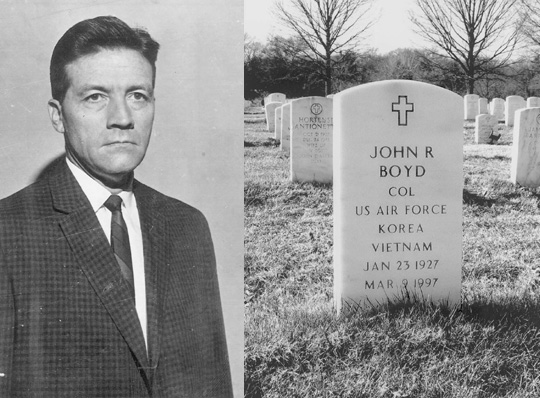
About a year ago, I wrote a post that mentioned John Boyd (1927 - 1997), a US Air Force pilot, military strategist, and fighter aircraft tactician, as an example of someone who spoke out consistently against the negative effects of careerism on the military.
Along the same lines, this past April Robert Gates, the US Secretary of Defense, cited Boyd as "a historical exemplar" that today's officers would do well to emulate in order to make substantial contributions to meeting the Air Force's pressing need to become more strategically adaptable.
Gates notes that Boyd
had to overcome a large measure of bureaucratic resistance and institutional hostility.
He had some advice that he used to pass on to his colleagues and subordinates that is worth sharing with you. Boyd would say — and I quote — "One day you will take a fork in the road, and you're going to have to make a decision about which direction you want to go. If you go one way, you can be somebody. You will have to make compromises, and you will have to turn your back on your friends. But you will be a member of the club, and you will get promoted and get good assignments. Or you can go the other way, and you can do something, something for your country and for your Air Force and for yourself. If you decide to do something, you may not get promoted, and you may not get good assignments, and you certainly will not be a favorite of your superiors, but you won't have to compromise yourself. To be somebody or to do something. In life there is often a roll call. That's when you have to make a decision: to be or to do."
For the kinds of challenges America faces and will face, the armed forces will need principled, creative, reform-minded leaders, men and women who, as Boyd put it, want to do something, not be somebody.
Gates devoted the rest of his remarks to further elaboration of his view that an "unconventional era of warfare requires unconventional thinkers." In the question-and-answer session that followed his remarks, he suggested that "the biggest challenge for out-of-the-box thinking is the wisdom of the senior leader who sees the value of that kind of thinking and protects it and the people who do it." I.e., the way to resolve the tension between people seeking to build reasonably secure careers for themselves, and speaking up in dissent when that's what circumstances require, is for senior leaders to make their organizations safe for unconventional thinking.


.jpg)