A Review of the Literature on Negotiation
Among the training resources the Food and Agriculture Organization (FAO) offers online (a full list is
here) is a thirty-page
summary (pdf) of the literature on negotiation. The authors are
Tanya Alfredson, an FAO consultant, and
Azeta Cungu, an FAO development economist.
As explained at the end of the paper, it
was prepared in the framework of a capacity building programme that FAO organized to address major strategic issues and policy challenges for agriculture and rural development, in developing countries. The programme aimed at enhancing the capacity of senior officials by providing cutting-edge knowledge, facilitating exchange, and reviewing practical mechanisms to implement policy changes in a context where policy space is increasingly limited by regional and international agreements and treaties. Owing to the increasingly important role that negotiation plays in policy-making processes, policy experts are becoming more and more aware of the need for mainstreaming negotiation into the policy cycle. ...
This paper is intended as ... easy-to-read reference material on negotiation. It presents an overview of the defining theoretical perspectives, concepts and methods that are central to the theory and practice of negotiation.
The paper is available in English, French, and Spanish.
A central topic is five approaches to negotiation discussed in the literature:
1- Structural approaches — "consider negotiated outcomes to be a function of the characteristics or structural features that define each particular negotiation. These characteristics may include features such as the number of parties and issues involved in the negotiation and the composition (whether each side is monolithic or comprises many groups) or relative power of the competing parties. Structural approaches to negotiation find explanations of outcomes in patterns of relationships between parties or their goals. They can be deterministic in that they often view outcomes as a priori once structural factors are understood."
- Strategic approaches — "have roots in mathematics, decision theory and rational choice theory, and also benefit from major contributions from the areas of economics, biology, and conflict analysis. Whereas the structural approach focuses on the role of means (such as power) in negotiations, the emphasis in strategic models of negotiation is on the role of ends (goals) in determining outcomes. Strategic models are also models of rational choice. Negotiators are viewed as rational decision makers with known alternatives who make choices guided by their calculation of which option will maximize their ends or 'gains', frequently described as ‘payoffs’. Actors choose from a 'choice set' of possible actions in order to try and achieve desired outcomes. Each actor has a unique 'incentive structure' that is comprised of a set of costs associated with different actions combined with a set of probabilities that reflect the likelihoods of different actions leading to desired outcomes."
- Behavioral approaches — "emphasize the role negotiators’ personalities or individual characteristics play in determining the course and outcome of negotiated agreements. Behavioral theories may explain negotiations as interactions between personality ‘types’ that often take the form of dichotomies, such as shopkeepers and warriors, or ‘hardliners’ and ‘soft liners,’ where negotiators are portrayed either as ruthlessly battling for all or diplomatically conceding to another party’s demands for the sake of keeping the peace."
- Concession exchange — approaches that "share features of both the structural approach (power) and the strategic approach (outcomes), [but] they describe a different kind of mechanism that centers on learning. ... negotiations consist of a series of concessions. The concessions mark stages in negotiations. They are used by parties to both signal their own intentions and to encourage movement in their opponent’s position. ...
"The risk inherent in this approach is that participants engaged in concession-trading may miss opportunities to find new, mutually beneficial solutions to their shared dilemma and end up instead in a purely regressive process which leaves both sides with fewer gains than they could have had if they had pursued a more creative approach."
- Integrative approaches — "frame negotiations as interactions with win-win potential. Whereas a zero-sum view sees the goal of negotiations as an effort to claim one’s share over a 'fixed amount of pie,' integrative theories and strategies look for ways of creating value, or 'expanding the pie, ... so that there is more to share between parties as a result of negotiation. Integrative approaches use objective criteria, look to create conditions of mutual gain, and emphasize the importance of exchanging information between parties and group problem-solving. Because integrative approaches emphasize problem solving, cooperation, joint decisionmaking and mutual gains, integrative strategies call for participants to work jointly to create win-win solutions. They involve uncovering interests, generating options and searching for commonalities between parties."
Once Alfredson and Cungu have outlined the above five approaches to negotiation, they concentrate attention on integrative negotiation, the approach taught by the the Harvard
Program on Negotiation.
__________
1 References are omitted in the quoted passages. There are also a few unmarked copy edits.
###Labels: Negotiation
The Negociatrix Policy Game
The
Project on Negotiation for Agriculture at FAO (Food and Agriculture Organization of the UN) has, with partners, developed a pair of simulations that illustrate judicious application of the simulation methodology.
Specifically, in working through the Negociatrix simulation (2005) or the Negotiatrix Policy Game (2007), participants get a good sense of what they need to know and do in order to effectively handle the complex process of managing agricultural policy in a global market environment.
The
audience the FAO negotiation project targets consists of:
- Main negotiators of agricultural policy related agreements, especially those from developing countries, a number of whom requested help from the FAO in beefing up their negotiating capacity.
- Staff working on bilateral and multilateral negotiations from national administration or Regional Economic Organizations such as the West African Economic and Monetary Union (UEMOA) or the Arab Maghreb Union (AMU).
- Civil society and professional organization representatives involved in bilateral or multilateral negotiations.
In this post, I will mostly talk about the
Negociatrix Policy Game (ftp:pdf) since it has more day-to-day applicability than the
Negociatrix simulation (ftp:pdf), which is designed to emulate participation in periodic
World Trade Organization conferences.
1The
Negociatrix Policy Game aims to help participants improve both their negotiation skills
2 and their ability to analyze trade policy impacts on such social welfare variables as farm income and net exports (exports less imports).
The linkages between agricultural policies (e.g., tariffs, price supports, and subsidies) and the variables that measure social welfare are complex. Participants quickly become aware of the difficulty of pursuing multiple objectives simultaneously in a global agricultural and food market environment, especially when the objectives are not entirely compatible. They are also confronted with the need to manage both their relationships with other parties and the negotiation process itself in order to arrive at a more-than-satisfactory and reasonably stable outcome.
There are up to twelve countries in the Policy game:
- Benglapal, modeled on Thailand and Vietnam
- Esperantia, modeled on Brazil
- Federatio, modeled on the US
- Imperia, modeled on China
- Ketanya, modeled on Tanzania and Kenya
- Insula, modeled on Mauritius
- Mabu-Fabe, modeled on Mali, Burkina Faso, and Benin
- Neosaxy, modeled on Australia
- Osterland, modeled on Japan
- Pali, modeled on Haiti
- Uniona, modeled on the EU
- ROW, i.e., the rest of the world
Note that the game can be played with fewer countries if desired.
There are three agricultural commodities in the simulation:
- a cash crop modeled on cotton
- a basic food crop modeled on rice
- a processed crop modeled on sugar and coffee
Each country is a producer and/or a consumer of at least two of these products and sometimes of all three.
For each country, the simulation designers have created a policy context (a set of current agriculture- and food-related policies) and a virtual economy (specifying such things as government expenditure and demand for and supply of food crops). All of this is modeled in a set of Excel worksheets.
An individual or, preferably, a team is assigned to each country. In what follows, let's assume that teams of two are used.
The team's job is to make policy choices for their country (e.g., by setting tariff levels) during each round of the game. Their objective is to raise the country's national welfare, as reflected in an index built from five components:
- farm income
- food consumption per capita
- government spending on agriculture
- agricultural trade balance
- GDP
How much weight is given to each of these components is determined by a particular country's policy priorities. For instance, here are the weights for three of the countries:
    Goal        Federatio  Imperia   Pali
Incr
farm income        0.23     0.06     0.14

Incr per capita
food consumption   0.21     0.12     0.22

Limit
govt spending      0.08     0.27     0.24

Improve ag
trade balance      0.41     0.51     0.35

Incr GDP           0.07     0.03     0.05
After each policy-setting round, the software displays the impacts on social welfare (farm income, food consumption, etc.) of the policy choices, impacts that reflect the interdependence of all the countries' economies. Because the participants can see the impacts for all countries, they can undertake an informed analysis of what happened during the round.
During any round, teams are free to enter into informal negotations with each other to try to improve results in a mutually beneficial way. I.e., teams can look for ways to increase the overall social value generated in the food and agricultural sector, and then negotiate how to share whatever increased value they've agreed it's feasible to achieve.
The outcome of the game will depend, to a large extent, on the negotiation strategy adopted by each team and on the quality of the team's analysis of the linkages between changes in national policy measures and changes in agricultural and food markets.
Because of the game's complexity (several countries, several policy instruments which must be balanced in order to achieve multiple goals), it's important that facilitators be ready to assist participants in understanding the impacts of policy choices on world and local markets.
__________
1 The Negociatrix simulation includes issues to be addressed explicitly by participants that are approached informally or not at all in the Negociatrix Policy Game. Some of these issues are: managing the process of conducting complex international negotiations, dealing with power asymmetry among countries, building and using coalitions, overcoming deadlocks, and managing information and communication channels.
2 FAO recommends that participants in the simulations first receive some training in these skills and concepts: active listening skills, the three tensions of negotiation (between cooperation and competition, between empathy and assertiveness, and between what principals want and what agents want), the process of creating and distributing value, preparation for negotiation, managing a mandate, handling difficult negotiations, handling multiparty negotiations, managing the negotiation process, team negotiation, relationship mapping, understanding the life of coalitions, dynamics of international trade, and trade policy instruments (e.g., tariffs).
###Labels: Negotiation, Simulation
Oliver Williamson's Research on the Role of Firms
Yesterday's
post dealt with the work of Elinor Ostrom, one of this year's recipients of the
Sveriges Riksbank Prize in Economic Sciences in Memory of Alfred Nobel. Today, I'll highlight the work of Ostrom's co-winner,
Oliver Williamson, an emeritus professor of business, economics, and law at the University of California-Berkeley.
 Oliver Williamson
(The Seoul Times)The basic question Williamson has examined in his research is what determines when the market is the best mechanism for handling business transactions, and when the firm is best.
Answering this question required Williamson to investigate what sorts of transaction costs make use of the firm structure — a hierarchical structure — more economical, relative to depending on market dealings.
As the Royal Swedish Academy of Sciences explains in its
summary for the public,
... Williamson expects hierarchical organizations to emerge when transactions are complex or non-standard [making it hard to write complete and enforceable contracts], and when parties are mutually dependent. Perhaps the most typical case of mutual dependence is that parties have assets, either physical assets or knowledge, which are only valuable inside a relationship.
For example:
The value of a coal mine in case the owner cannot agree on the terms of trade with a nearby power plant depends on the distance to the second-nearest buyer of coal, which is usually another power plant. Likewise, the value of a coal-burning power plant in case it cannot trade with the nearby coal mine depends on the distance to the second nearest mine. The larger the distances, the greater is the mutual dependence, and — according to the theory — the more likely the mine and the plant are vertically integrated. This is precisely what is observed. When there are other nearby mines and power plants, firms are typically incorporated separately and trade under relatively short and simple contracts. As the distance to alternative trading partners increases, contract duration and complexity also increase. According to one of the studies, a coal-burning power plant that is located next to a coal mine is about six times more likely to be fully integrated than is any other coal-burning power plant.
For further coverage of Williamson's work, touching upon the evidence for the validity of his theory, its policy implications, and how it has been expanded and deepened by other researchers, you can read the Academy of Sciences'
Scientific Background (pdf – about six pages each on Williamson and Ostrom).
###Labels: Conflict management, Negotiation, Notables, Productivity, Risk management
Keeping a Negotiating Team in Sync
In the September issue of the
Harvard Business Review, I lingered over only one article, namely, "
How to Manage Your Negotiating Team," by
Jeanne M. Brett (Kellogg School of Management at Northwestern University),
Ray Friedman (Owen Graduate School of Business at Vanderbilt University), and
Kristin Behfar (Paul Merage School of Business at the University of California-Irvine). The article is a short five pages.
Brett, Friedman, and Behfer (BFB) note that "The payoff from negotiating as a team is clear. With access to greater expertise and the ability to assign members to specialized roles, teams can implement more complex strategies than a solo negotiator can ever pull off." The problem is that different members of the team are likely to have different priorities and different desired outcomes, so pre-negotiation prep needs to include specific steps to get and keep the team in sync.
BFB describe four steps to take to ensure everyone on the team is committed to common goals and a common strategy:
- Map out the conflicts. BFB illustrate one way of doing this: Create a matrix that, for each goal of the negotiation, captures each internal party's interests and particular views concerning priority and preferred outcome. This helps clarify the trade-offs needed in order for the team to be able to "coalesce around the highest-margin proposal."
- Work with all the organizational constituents to get them aligned. BFB note that if "constituents are presented with all the facts, ... they might be willing to concede more ground because they'll also see the bigger picture." Another possibility is "reality testing" — illustrating "the dangers of not working together to make a deal happen" by spelling out "the worst-case outcome for the company and individual units." This approach can concentrate minds and elicit cooperation to help ensure a better outcome. Alternatively, the team might be structured to include a senior executive (or other corporate representative) with authority to bring everyone into line behind a common plan.
- Mediate any stubborn conflicts of interest. The mediator can be a team member or an outside facilitator.
- Persuade with data. Present data that make clear the effect team members' constructive efforts would have on their departments. Take whatever steps are necessary to ensure that the objectivity of the data is credited by team members.
Once the team has agreed on what they are aiming to achieve, and on the strategy for doing so, further preparation is needed to minimize the chance of deliberate or, more likely, inadvertent deviations from the plan. BFB recommend these steps:
- Do a dry run in which you simulate the negotiation. Team members role play the back-and-forth to prepare for objections; to determine who should speak up when, and who should stay quiet; to anticipate different players' likely emotional responses; and to clarify who has authority to make concessions and decisions.
- Assign roles to team members that take advantage of their strengths and interests. Help the experts on the team understand when they should weigh in and when they should let someone else do the talking, and ensure that there is a leader who will be "managing preparation logistics, making sure the team's strategy has been vetted by higher-level management or even the board, and finalizing roles and responsibilities for the bargaining session itself."
- Establish a plan for intra-team communication during the negotiation. Heading off to caucus when private intra-team communication is needed is generally an unnecessarily dramatic signal to the other side that your team is making some sort of adjustment. Instead, BFB found that effective teams "established creative ways to communicate with one another, which ranged from the explicit to the implicit and from low to high tech." Such things as putting your hands on the table and stretching to signal to the team member speaking that he/she is headed off the rez, or arranging the team's seats so nudges and note-passing can be discreet. Geographically dispersed team members might decide to use text messaging. Etc.
If you'd like to read a more detailed report of BFB's research, you can do so
here.
###Labels: Negotiation, Systems thinking
Coping with Belief Bias
As a follow-on to yesterday's
post, and to a
post from about three years ago, I'd like to mention the suggestions Mario Moussa and Richard Shell offer for handling situations in which you find yourself trying to get a fair hearing from someone who presents a strong "contrary beliefs" barrier.
In a 2007
interview published by the Conference Board, Moussa observes,
Some people are simply not persuadable because their outlook on a topic falls on an extreme end of an ideology. This is the case with things like abortion. So we suggest trying to find a different belief [perhaps deeper] or point of view around which you can come together. Never go head to head against a core belief that someone holds deeply. It's very rare for people to change such beliefs.
Moussa offers some additional "workarounds" in a 2007
presentation (pdf) he prepared for the
Wharton Strategic Persuasion Workshop:
- Persistence
- Shift audiences
- Fly under the radar
- Aim to advance "one small step"
In the
talk (video) Shell gave at Google in February 2008, he recommends
reframing the contentious issue in a way that plays down conflict with the other person's firm core beliefs, a suggestion that corresponds to Moussa's recommendation to look for a different point of view that can serve as common ground.
A further point Shell offers is that you can sometimes actually leverage the other person's beliefs in a way that helps the person see their way clear to cooperating with you.
###Labels: Conflict management, Negotiation, Persuasion
Richard Shell on Persuasiveness
The most recent discussion of
Richard Shell's views on persuasion that I've come upon is an
interview by MoneyWatch.com's Editor in Chief Eric Schurenberg published on July 7. Shell, a professor law and business ethics at the Wharton School, co-authored
The Art of Woo: Using Strategic Persuasion to Sell Your Ideas (2007) with
Mario Moussa, a management consultant and co-director of Wharton's
Essentials of Management program.
1Schurenberg asks Shell to talk about several central points made in the book, which "is directed specifically at how to be effective at persuading people within a complex organization."
First and foremost is the importance of discerning the other person's point of view and then using that knowledge to shape your approach to persuading the individual that something you're proposing is a good idea. (This principle applies to groups of people as well. You need to be able to determine the general perspective of your audience so that you can design what you say in a way that maximizes the audience's receptiveness.)
A related proposition is that you can't force the other person to change his/her mind. What you
can do is remove barriers to the other person's actually hearing what you are trying to get across.
Schurenberg proceeds to step into the other person's shoes and asks about how to resist persuasion. Shell argues,
The best antidote to persuasion is a skeptical attitude. People who get persuaded [to do things they regret] tend to get caught up in ideas that appeal to their self-interest or hold out the promise of a simple solution to a big problem. The best antidote to that is critical thinking.
For a more detailed summary of the
The Art of Woo, you can read the
article Knowledge@Wharton published at the time the book came out. Key points include the four-step process Shell and Moussa recommend for selling an idea internally:
- Polish your idea, and survey the social networks that will get you to decision makers.
- Address the barriers to having what you say actually heard. Shell and Moussa call out five barriers as the most common:
- Contrary beliefs
- Conflicting interests
- Negative relationships
- Lack of credibility
- Use of a persuasion channel that is a poor fit to the audience and situation (see below)
- "Pitch the idea in a compelling way." I.e., the person doing the persuading needs "to figure out exactly what problem their idea addresses, how their idea will solve it and why their idea is better than both the status quo and available alternatives."
- Secure both individual and organizational commitments — a largely political process.
Shell and Moussa provde a pair of tools in appendices to
The Art of Woo that can help you with self-assessment of your persuasion style and of the channels you tend to use in your efforts to persuade — either because the channels are organizationally expected or because of personal inclination.
The five persuasion styles Shell and Moussa measure in the
Persuasion Styles Assessment are laid out in the graphic below.
 (click to enlarge)
Source: Mario Moussa (pdf)Shell emphasizes, "Whatever your style is, it can be effective. It all depends on the fit with the person across the table and the circumstances."
The
Six Channels Survey is intended to help
Woo readers "understand both how these six channels work and when they should adjust their pitch ... to appeal to different kinds of audiences."
2 The six channels are:
- Authority — emphasis on using formal position or rules.
- Rationality — emphasis on using reasons.
- Vision — emphasis on organizational goals, purposes, and aspirations.
- Relationship — emphasis on liking, similarity, and reciprocity.
- Interests/Incentives — emphasis on using trades and compromises.
- Politics — emphasis on managing perceptions and building consensus.
If you have an hour to spare, you can get the basic Shell presentation on
influence,
persuasion (influence with a goal or point of view), and
negotiation (a special case of persuasion in which at least one party believes there is a conflict of interest) by watching a
video of the talk Shell gave to Google employees in February of last year. (The talk begins at 3:09.)
__________
1 Shell published an earlier book on negotiation—
Bargaining for Advantage : Negotiation Strategies for Reasonable People (Penguin, 2006) — that has been quite well-received. The book has gone into a second edition; the first edition, published in 1999, has been translated into 14+ languages.
2 Shell and Moussa have adapted their six persuasion channels from schemas defined by previous researchers, notably, David Kipnis and Stuart Schmidt (see, "Profile of Organizational Influence Strategies," University Associates, San Diego, 1985), and Gary Yukl and Cecilia Falbe (see "Influence Tactics and Objectives in Upward, Downward and Lateral Influence Attempts,"
Journal of Applied Psychology, Vol. 75, 1990, pp. 132-140).
###Labels: Critical thinking, Negotiation, Persuasion, Upward influence
Tempered Trust
In the June 2009 issue of the
Harvard Business Review,
Roderick M. Kramer, a professor of organizational behavior at the Stanford Graduate School of Business,
explains a concept that he refers to as "tempered trust." This is an attitude toward trusting people that is prudent, rather than being either unduly credulous or unduly suspicious.
Kramer argues:
We can never be certain of another's motivations, intentions, character, or future actions. ... That said, there is much that you can do to reduce the doubt — in particular, by adjusting your mind-set and behavioral habits.
Kramer offers seven rules for tempering trust:
- Know yourself. Ask yourself what your disposition toward trust is.
Someone who tends to trust people too readily must work on improving his/her ability to interpret the cues people send out, bearing in mind that just about "any indicator of trustworthiness can be manipulated or faked."
On the other hand, a person who is good at reading cues, but still hesitates to form trusting relationships, needs to develop more receptive behaviors.
- Start small. Take incremental steps, with further steps contingent on reciprocity. This way, you control the risk that the other party will exploit your good will. On an encouraging note, Kramer advises that "Salting your world with lots of small trusting acts sends a signal to others who are themselves interested in building good relationships ..." This leads to more positive interactions.
- Write an escape clause. Kramer argues, "With a clearly articulated plan for disengagement, people can trust more fully and with more commitment."
- Send strong signals. Kramer emphasizes the importance of sending clear and consistent signals of your interest in dealing with people who will trust you and be trustworthy themselves. He says, "Most of us tend to underinvest in communicating our trustworthiness to others ..."
The signals need to be unambiguous so that you attract other tempered trusters, while deterring predators, who need to recognize that you are not someone to be trifled with. The idea is to develop a reputation for fair dealing with those who reciprocate, and for retaliating strongly, but proportionately, against those who violate your trust.
- Recognize the other person's dilemma. Kramer points out that "the people we're dealing with confront their own trust dilemmas and need reassurance about whether (or how much) they should trust us. Good relationship builders are proactive at decreasing the anxiety and allaying the concerns of others."
- Look at roles as well as people. Kramer explains, "A person's role or position can provide a guarantee of his expertise and motivation" even when we have not had the opportunity for personal contact with the individual. "Role-based trust is trust in the system that selects and trains the individual."
- Remain vigilant and always question. Kramer's admonition is to keep one's due diligence concerning others' bona fides up-to-date. Admittedly, this can feel awkward because it involves regularly checking up on people with whom you have an established relationship of trust.
For an extended treatment of Kramer's views, you can turn to the the 2004 book he co-authored with Karen Cook,
Trust and Distrust in Organizations: Dilemmas and Approaches.
###Labels: Collaboration, Communication, Expertise, Negotiation, Risk management
The Trail of Tears
This afternoon I went to Northampton's
Academy of Music to see a preview of Episode 3 of the PBS series on Native Americans, "
We Shall Remain."
I've managed to miss the first two episodes, though I plan to watch them online as soon as time permits. Episode 1, "After the Mayflower," deals with the Pilgrims and the Wampanoags, while Episode 2 looks at "Tecumseh's Vision." When the time for Episode 3, "Trail of Tears," rolled around, I was determined to find my way to the Academy because I had so enjoyed my experience with the
Audubon preview I attended there about two years ago.
I found "Trail of Tears" both informative and confusing. I left the theater with a considerably more detailed understanding of the story of "Indian removal" (aka ethnic cleansing) from the eastern part of the country to the "Indian Territory" in what is now eastern Oklahoma. However, not everything was clear. Confusion arose from the way the story of presented. Not only did the producers and director resort to reenactment of events from a period which naturally lacks authentic film footage, but they also used a rather choppy editing technique, insufficiently bolstered by narration of the facts of the story.
I know I was not the only one who had a problem grasping some of the basic details because in the Q&A following the screening, executive producer Sharon Grimberg was asked some very basic questions, such as, "Where did the Trail of Tears end?" (Ans: eastern Oklahoma. Didn't you see the map of the route we showed you?) and "Were
Major Ridge and the other two people who were murdered done in by fellow Cherokees?" (Ans: Yes. That's what we reenacted for you in those assassination scenes.)
I imagine that writing a script which would not raise hackles (or, at least, not many hackles) in one quarter or another was a ticklish process. The "Trail of Tears" story is inherently controversial because the Cherokees at its center were in a no-win situation. They could try to stay on their land and end up being forced off (the scenario for the majority of those living in the Southeast), or they could give up their land and move voluntarily to the Indian Territory. There is no way of proving that one or the other of the two factions that formed — the National Party and the Treaty Party, respectively — was right, while the other was wrong.
I hasten to add that the vast majority of the Cherokees signed a petition to Congress asking that the
Treaty of Echota signed by leaders of the minority Treaty Party be voided. This suggests that, on democratic grounds, the National Party was representing what the bulk of the Cherokee people wanted. On the other hand, the petition was futile, so the Treaty side could still argue that, on pragmatic grounds, they were making a hard, but ultimately sensible choice.
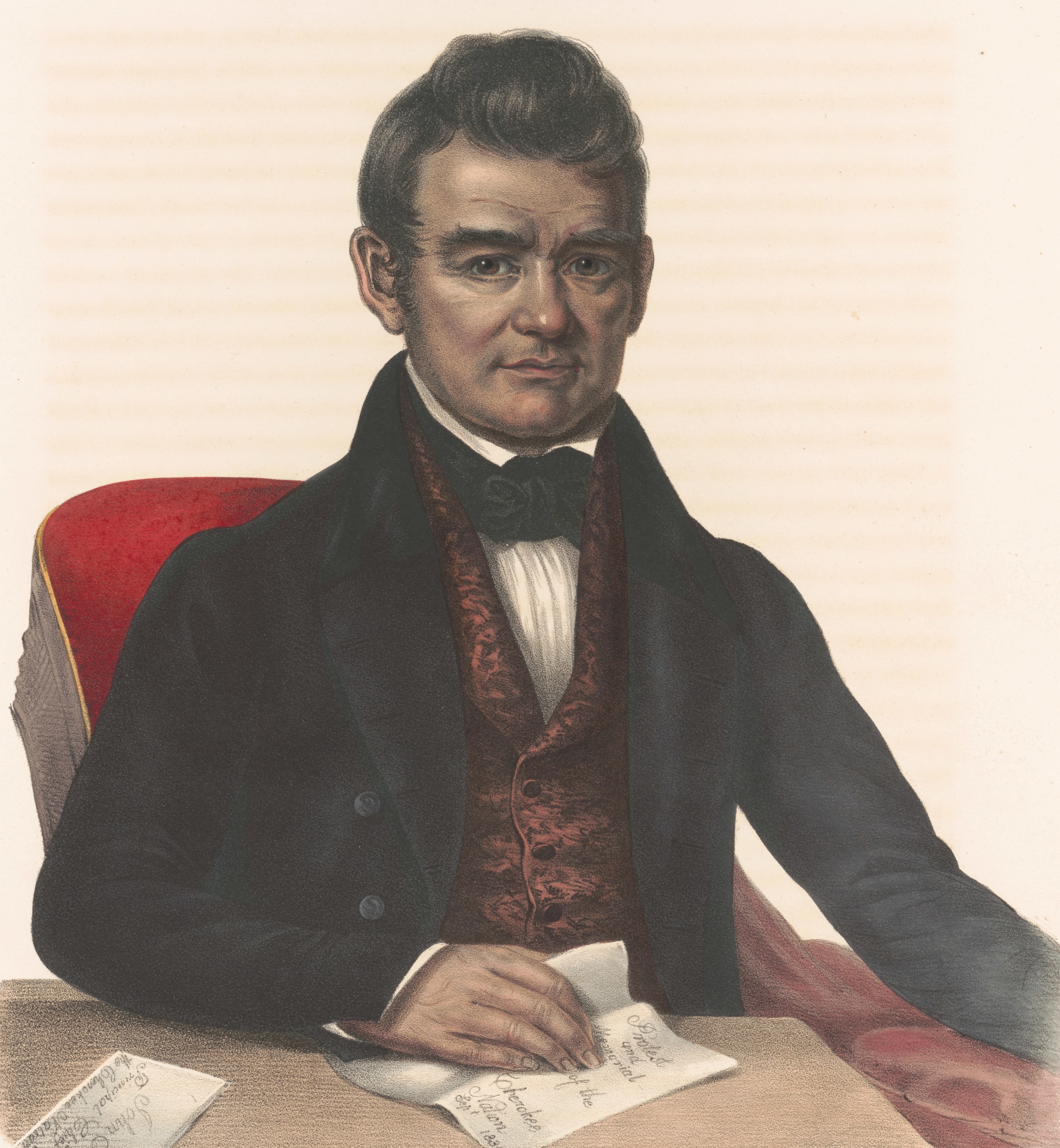 John Ross, Principal Chief of the Cherokees, 1828-1860, and head of the National Party, which opposed the Treaty Party headed by Major Ridge, et al..
(Wikipedia)PBS has developed excellent teaching guides for school use. The guide for "Trail of Tears" is
here. A National Park Service teaching guide for the
Trail of Tears National Historic Trail is
here.
###Labels: Negotiation, Notables, Special occasion, Teaching
"We Are All Negotiators Now"
As a follow-on to yesterday's
post, I'd like to cite another item
Xavier de Souza Briggs has posted online that is well worth a look.
To provide self-study materials to people with an interest — professional or otherwise — in community planning, Briggs offers five "
strategy tools" in pdf format at
The Community Problem-Solving Project @ MIT website:
All of these papers are beautifully organized and written. I want to home in on the last of the five because it happens to be the one that I think is of broadest value to people looking to strengthen their professional skills.
In just forty pages, Briggs presents a thorough review of the principles of effective negotiation, with due attention to the complexities associated with such issues of multi-party participation and use of facilitators in the process.
As a sample of the guidance Briggs offers, I'll call out what he has to say about establishing effective working relations, a subject that has especially broad application in the business world.
Briggs describes five traits that generally characterize effective working relationships. Quoting Briggs directly, these traits are:
- Forward-looking. Change is expected, even anticipated. The parties involved make room for their relationship to grow. They look ahead to anticipate shocks and opportunities in the environment that might affect the outcomes they care about — and thus the relationship.
- Committed and resilient. They withstand pressure, in part through willingness and capacity to “see things through” before resorting to “hardball.” The parties avoid making major assumptions about each others’ intentions. Effective communication is key, and this means more than sending signals clearly. It also includes active listening — listening to understand, summarizing what they say and checking with them to be sure you have understood.
- Fair — i.e., perceived as fair by both sides. The relationship reflects a balanced allocation of benefits and rewards, meets the parties’ criteria — whatever defines value — over time, even if short-term costs and benefits are uneven here and there.
- Trust-based and forgiving — but provocable. Charles Sabel and other students of cooperation recommend “studied trust” in which the parties make it easy for each other to monitor compliance with commitments made. Beyond having a practical value, supporting such mechanisms signals a willingness to do what you say. And Robert Axelrod says parties can apply a tit-for-tat rule to infractions, being “provocable but forgiving.” Abuses will not be tolerated, but parties will extend each other the benefit of the doubt and will be willing to forgive, at least within certain limits.1
- Realistic. Agreed-upon expectations are reasonable and, where possible, adjustable. In a rush to agree, parties will not insist on or agree to things that cannot be delivered, based on best-available information and standards.
A final note: Briggs's "strategy tools" are like chapters in a book — fine for self-study. Just be sure to test yourself for comprehension and retention as you go along.
2__________
1 Charles Sabel, "Studied Trust: Building New Forms of Cooperation in a Volatile Economy," in Frank Pyke and Werner Sengenberger (eds),
Industrial Districts and Local Economic Regeneration (Geneva: International Institute for Labour Studies, 1992), pp. 215-250.
Robert Axelrod,
The Evolution of Cooperation, rev. ed. (Basic Books, 2006).
2 For additional self-study materials Briggs has assembled to help people involved in community development, you can visit the
Working Smarter in Community Development site based in the MIT Department of Urban Studies + Planning.
###Labels: Communication, Conflict management, eLearning, Learning resources, Negotiation, Persuasion
Goals Need Success Criteria
Universia-Knowledge@Wharton, the Spanish-Portuguese segment of Knowledge@Wharton, published an article today that seems overwrought in cautioning organizations about the pitfalls associated with making goal-setting central to performance management.
In "'
Goals Gone Wild': How Goal Setting Can Lead to Disaster," we read about "the hazards of setting goals":
In pursuit of such mandates, employees will ignore sound business practices, risk the company's reputation and violate ethical standards.
I believe such unacceptable consequences of goal-setting are generally due to a falure to qualify goals by defining criteria that specify what successful achievement of each goal requires. Employees need to understand that
how goals are achieved will be taken into account in assessing whether the goal achievement is truly successful. For instance, in the article's opening example, the story of the ill-designed Ford Pinto, whose fuel tank was vulnerable to catching fire in a rear-end collision, it seems that Ford neglected to require engineers to include proper attention to safety in the design criteria.
The Universia-Knowledge@Wharton article summarizes a
paper (pdf) by
Maurice Schweitzer (Wharton),
Lisa D. Ordóñez (Eller College of Management at the University of Arizona),
Adam D. Galinsky (Kellogg School of Management at Northwestern University), and
Max H. Bazerman (Harvard Business School) (SOGB).
1In fairness, I must note that SOGB point to the need to monitor performance as employees pursue assigned goals, and that they base their reasoning in part on the fact that such monitoring is frequently quite difficult. Nonetheless, I would argue that SOGB overstate the degree of unmanageable risk in setting specific goals for employees to meet.
As summarized in the Universia-Knowledge@Wharton article, there are four problems SOGB emphasize as likely to accompany goal-setting:
- "Goals that are too specific often lead employees to develop such a narrow focus that they fail to recognize obvious problems unrelated to the target." I say that there is no reason for management to let employees overlook problems related to other desiderata.
SOGB also discuss the problem of setting too many goals, so that employees pick and choose in a manner that does not match organizational priorities. The counterpoint here is that managers need to clarify priorities and coach employees on gauging their efforts to match priorities.
- Time horizons for goals that are (1) too short, meaning long-term considerations are largely ignored, or (2) too long, meaning employees slack off if they manage to meet a goal in advance of the deadline they've been given. I say (1) success criteria should include optimizing the combination of short-term and long-term considerations, and (2) there is no reason not to plan for special rewards and recognition — and a revised goal/timeframe — to ensure employee productivity is maintained when the initial deadline for a goal proves longer than necessary. (I'd also note that the example of New York cab drivers electing to knock off early on rainy days — because they can meet their own, self-set goals for the daily total of fares earlier than on clear days — is not actually relevant to an analysis of employee response to goals set by management.2)
- "Workers with highly specific and ambitious targets will engage in risky practices in order to meet them." Again, it seems evident that success criteria should include requirements for appropriate risk management.
- "Unethical behavior is one of the more obvious pitfalls of overly ambitious goal setting ..." Success criteria requiring adherence to ethical standards, with compliance monitored, are a sine qua non in any respectable organization.
The last two items are aspects of the general issue of perverse incentives. Mitigating perverse incentives involves not only setting appropriate success criteria, but also directly adjusting the structure of incentives to reward desired behavior and not reward behavior that undercuts organizational values.
Where SOGB are on firm ground is their caution concerning undercutting employees'
intrinsic motivation by overemphasizing financial rewards. Also well-taken are SOGB's observations that employees will "lose their focus on learning new skills in favor of using tried-and-true methods to meet their quotas," and that "[setting] targets for individual workers can create a culture of competition in which workers tend to shun teamwork in problem solving." But even here I'd say that astute definition of both the goals and the success criteria can mitigate the danger of perverse employee behavior.
In their paper, SOGB discuss two other problems they associate with overuse of goal-setting to motivate employees.
There is the issue of "goal-induced reductions in
self-efficacy" that can occur when employees achieve a good result that nonetheless falls short of a stretch goal they were aiming for. This "can be highly dettrimental because perceptions of self-efficacy are a key predictor of task engagement, commitment, and effort." I say that effective leaders will take action in such a situation to acknowledge that employees have done a good job that has moved the organization forward; the stretch goal was overly ambitious, so no one is in trouble for falling short.
Another problem is the difficulty of tailoring goals to match individuals' particular strengths without creating perceptions of unfairness. Managing this issue is a matter of managerial judgment — that takes employee input into consideration — allied with persuasive communication. If an employee is still disgruntled after a manager has heard him/her out, responded with any goal adjustments that may be appropriate, and explained the rationale for the final determination of more or less disparate individual goals, it is fair to point out that the employee may need to find a position that better matches his/her job preferences.
For me the bottom line is that, while SOGB have done well in articulating the issues associated with making goal-setting a central element in performance management, especially in a complex setting, I believe, based on my own observation of companies intelligently implementing performance management systems, that attaching success criteria to all goal statements, providing constructive coaching, and exercising appropriate managerial oversight makes establishing goals for individual employees a crucial part of maximizing odds of mission accomplishment.
__________
1 The link takes you to the working paper version of the Schweitzer
et al. article. The published version is in
Academy of Management Perspectives, Vol. 23, No. 1 (February 2009).
2 SOGB adopt the view, "If NYC taxi drivers used a longer time horizon (perhaps weekly or monthly), kept track of indicators of increased demand (e.g., rain or special events), and ignored their typical daily goal, they could increase their overall wages, decrease the overall time they spend working, and improve the welfare of drenched New Yorkers." True, and perhaps cab drivers should be reminded of this fact regularly to make sure it hasn't slipped their minds. All the same, we're talking about utility here so, ultimately, it's up to the cabbies themselves to decide how they want to spend their time.
###Labels: Employee performance management, Management practices, Motivation, Negotiation, Organizational culture, Quality, Rewards and recognition, Risk management, Systems thinking
A China Hand Offers Advice on QC and Negotiation
To get a detailed idea of what vendors who outsource production to China have to know, you can do worse than reading David Dayton's
Silk Road International Blog.
Dayton is the owner and manager of Silk Road International, "an international procurement and project management company that helps clients find the right factories in Asia and coordinates and supervises production, logistics and quality control." He has been based in Asia for over fifteen years.
The particular posts that drew me in have to do with
quality control and
negotiation with Chinese suppliers.
The most recent
post opens with some cautions concerning personal safety in factory cities beset by rising unemployment, and then goes on to provide level-headed advice concerning how to maintain quality control standards in the face of a culture of bribes and all-too-human excuse-mongering.
Excellent (aside from the typos) posts on negotiation date back to last year. In May, Dayton compiled a list of
ten negotiation tips for striking deals with suppliers and getting those deals fulfilled. To give you the flavor of Dayton's style, here's tip #4:
Anger is a good as saying you’re gone. Because competition is so fierce in China, and because there are so many other options out there, angry emails, arguments and blow ups, unless carefully managed, tell the factory that you’ve moved on (why else would you burn personal bridges?).
A few months later, in September, Dayton provides insight on how to interpret and respond to such factory statements as "We did our best" and "This is good enough for the Japanese." He sums up his views on how to handle these and other negotiating tactics from the Chinese side of the discussion by noting:
As I’m constantly reminding my project managers, negotiations isn’t about what you want as much as it’s about understanding where the other party is coming from and what they can actually do for you. Understanding what options are realistic for your supplier is a valuable starting point in discussing how you’ll get what you expect (or at least what you can accept).
Dayton then sends you on to an
article he wrote in 2007 that has thirty-one further pearls of wisdom about how to negotiate with Chinese suppliers.
###Labels: Asia, Negotiation, Quality
Pricing that Reflects the Value of Your Services
Having had my own unhappy experiences with clients who could not manage budgets without contracting for services at specified hourly rates, I was taken with a column by
Tim Williams, a consultant to marketing communications agencies, that appears in the December issue of
Communication Arts.
Williams outlines seven things to do to get away from pricing based solely on hourly rates to pricing based on value:
- Sell the result you are going to deliver, not the activities you and your team are going to undertake in order to produce the result.
- Negotiate the price for the job before you begin working. Pre-kickoff is when your work "has the highest perceived value with the client."
- Go ahead and ask the client what they think the assignment is worth. They'll mention a high figure, or a figure that's in the same ballpark as your own estimation, or a figure that undervalues your work, in which case you need to provide evidence of why the value is more than they think (or let on).
- Offer options, and structure them bearing in mind that the client's typical inclination is to go with a choice that falls in the middle.
- "Never lower your price. Instead, add value." I.e., don't leave the client with the impression that you produce discount services.
- Be flexible in the terms you set (e.g., the timing of payments) so that you make a value-based price workable for the client.
- Be willing to walk away. This is the only way to maintain leverage in the price negotiation.
Williams emphasizes the importance of teaching all employees about pricing for value and of learning from experience. He recommends:
Conducting postmortem analyses at the end of major client assignments and relationships in order to assess what was learned, how adequate the compensation was, the value that was created and how the agency might have priced it better.
The upshot will be steady improvement in your organization's ability to set — and sell — prices that reflect the value you deliver.
###Labels: Business acumen, Competencies, Negotiation
Persuading an Internal Audience
I'm not entirely comfortable with the way in which
Jay Conger, now the Henry R. Kravis Research Chair in Leadership Studies at Claremont McKenna College, defines the concept of "persuasion" in a useful 1998
article in the
Harvard Business Review. Still, I have no problem agreeing with the process he describes for winning the support of an internal audience for an initiative one is trying to move forward.
I generally use the term "persuasion" in the same way
Robert Cialdini does in his book,
Influence: The Psychology of Persuasion (included in the suggested readings listed at right). Cialdini conceives of persuasion as what a person does in order to induce someone else to comply with a request.
Conger conceives of "persuasion" in the specialized context of getting others in an organization to join in a collaborative effort to achieve a goal, such as proceeding with development of a new product. In Conger's view:
Effective persuasion becomes a negotiating and learning process through which a persuader leads colleagues to a problem's shared solution.... it involves careful preparation, the proper framing of arguments [to show those you are seeking to persuade how they will share in the benefits of what you are advocating], the presentation of vivid supporting evidence, and the effort to find the correct emotional match with your audience.
An important implication of Conger's concept of persuasion is that it involves considerable dialogue and eschewing of any sort of
dogmatism:
Before the process begins, effective persuaders use dialogue to learn more about their audience's opinions, concerns, and perspectives. During the process, dialogue continues to be a form of learning, but it is also the beginning of the negotiation stage. You invite people to discuss, even debate, the merits of your position, and then to offer honest feedback and suggest alternative solutions. ... the best persuaders not only listen to others but also incorporate their perspectives into a shared solution.1
Conger wraps up by reiterating that "people must understand persuasion for what it is — not convincing and selling but learning and negotiation." Somehow, I believe Conger would be better off if he called this process "advocacy" or "gaining buy-in" rather than "persuasion," but I nonetheless admire the cogency of his explanation of the best way to mobilize support for a proposal or recommendation.
__________
1 In retrospect, one of Conger's examples — the push two Microsoft employees made to persuade colleagues to support development of the ill-fated
BOB interface — actually illustrates a situation Conger doesn't explicitly address, namely, cases in which dialogue with colleagues should lead persuaders to abandon the idea they're advocating.
###Labels: Leadership, Negotiation, Persuasion, Upward influence
A More Detailed Summary of the Influence Model
As a follow-on to yesterday's
post, I'd call attention to a
comprehensive summary (pdf) of their Influence Model that Allan Cohen and David Bradford published in the
Journal of Organizational Excellence in 2005.
 (click to enlarge)
The whole article is twenty-four pages (including endnotes) and easy to read. Well-selected exhibits help you pick up quickly on the points Cohen and Bradford are making.
For example, Exhibit 2 lists the situations in which you are well-advised to make conscious use of the Influence Model:
- The other person is known to be resistant.
- You don't know the other person or group and are asking for something that might be costly to them.
- You have a poor relationship (or are part of a group that has a poor relationship) with the group the other person belongs to.
- You might not get another chance.
- You have tried everything you can think of but the other person still refuses what you want.
Exhibit 6 is a helpful list of "Currencies Frequently Valued in Organizations":
- Inspiration-related currencies — vision, excellence, moral/ethical correctness.
- Task-related currencies — new resources, challenge/learning, assistance, organizational support, rapid response, information.
- Position-related currencies — recognition, visibility, reputation, insiderness/importance, contacts.
- Relationship-related currencies — acceptance/inclusion (feeling closeness and friendship), understanding (having concerns and issues listened to), personal support (receiving personal and emotional backing).
- Personal-related currencies —gratitude, ownership/involvement (ownership of and influence over important tasks), self-concept (affirmation of values, self-esteem, and identity), comfort (avoidance of hassles).
Finally, Exhibit 8 is a brief checklist that helps keep in view all the main aspects of applying the model.
###Labels: Negotiation, Networking, Persuasion, Productivity, Professionalism, Rewards and recognition, Upward influence
A Model of Influencing Without Authority
How can a person influence people over whom the person has no authority?
Allan Cohen, a professor at
Babson College, and
David Bradford, an emeritus professor at Stanford's
Graduate School of Business, answer this question in terms of the
Influence Without Authority model illustrated below.
1(click to enlarge)
Application of Cohen and Bradford's model to a variety of work situations is spelled out in their book,
Influence Without Authority, originally published in 1989 and updated in 2005.
You can get a taste of
Influence Without Authority by reading a summary of the
chapter on influencing your boss that is available
here. The main theme of the chapter is that your best bet is to develop a relationship with your boss in which you act as a junior partner (i. e., you are not a mere underling).
The do's for a boss's junior partner:
- Do stay loyal to the partnership's objectives.
- Do place the good of your organization first, ahead of your own personal druthers.
- Do value and take advantage of the differences in skills and perspectives between you and your boss.
- Do tolerate each other's foibles.
- Do give the boss the benefit of the doubt, i.e., assume that any bad behavior is due to misinformation or misguided views, rather than reflecting bad intentions.
The don'ts for a boss's junior partner:
- Don't let your boss make big mistakes.
- Don't let your boss inadvertently look bad.
- Don't let your boss move along in ignorance of information he or she should know.
In sum: "The idea is to always be on the side of your boss, not an antagonist or critic. You are always seeking to help the boss meet his or her goals."
__________
1 The graphic comes from
influencewithoutauthority.com. The website also offers seven case studies illustrating application of the Influence Model.
Note that in the context of the Influence Model, "Currencies are anything that you and your potential ally value, and can exchange to get what you need to do your work."
###Labels: Negotiation, Persuasion, Productivity, Professionalism, Upward influence
The Mindset of Too Many Russian Businesspeople
Whenever possible, it's just as well to learn from the mistakes of others, rather than waiting till you've made a mistake yourself to recognize that there's a better way.
In that spirit, I offer the provocative
post Stanislav Mishin added to his blog on Tuesday. In the post, Mishin describes the mistakes he believes many Russian manufacturers make in their approach to deal-making.
You really need to read Mishin's own words to get the full flavor of his diatribe (which he calls a "treatise"). I would just note that the lessons to be drawn fall in the areas of cultural sensitivity, negotiation, and communication. (I'd also note that you might or might not want to dip into the political ruminations you can find at Mishin's
blog.)
###Labels: Communication, Negotiation, Persuasion
Creating Maximum Value Requires System Thinking
In the Fall 2008 issue of the
MIT Sloan Management Review,
Maxim Sytch, a lecturer at Northwestern University's Kellogg School of Management, and
Ranjay Gulati, a professor at the Harvard Business School, provide an
overview of their research on the relationship between the mutual dependence of a supplier and a manufacturer, and the firms' business performance.
1The key finding is that it is a mistake to think, as many do, that
value appropriation is the only relevant process. I.e., it is
not the case that the way in which the supplier and manufacturer divvy up the value they create is determined entirely by their degree of
dependence asymmetry — "how much more (or less) one company is dependent on its business partner than vice versa."
Sytch and Gulati hypothesized that
joint dependence — "the extent to which two companies mutually depend on each other" — was also important. In other words, in reaching their decision on dividing up the value they create, the manufacturer and supplier would factor in the potential for increasing the total value. Using data from the automotive industry (Ford and Chrysler, to be specific), Sytch and Gulati found clear support for this hypothesis.
By deliberately building a relationship that involves both joint action in such areas as design, cost control, and quality improvement, and also the sharing of detailed, accurate, and timely information, manufacturer and supplier are able to enhance the performance of the procurement relationship. Performance is measured by such factors as price competitiveness, product quality, product innovation, and defect rate.
The bottom line: Managers should think systematically about dependence in interorganizational relationships. Because there are benefits to mutual dependence, "striving to maximize power in a buyer-supplier relaitonship can have a negative impact on a company's performance."
__________
1 The text of the published version of Sytch and Gulati's research is
here. This version provides a full explanation of the research methodology.
###Labels: Collaboration, Negotiation, Quality, Systems thinking
Roger Fisher on Getting and Using Influence in Negotiations
To be able to approach a negotiation with maximum, realistic confidence of being able to hold your own, you need to scope out in advance all the sources of persuasive power you can bring to the interchange.
In a 1983
article (pdf, pp. 51-71),
Roger Fisher, an emeritus professor of law at Harvard, describes six sources of
negotiating power, which, in this context, he defines as
the ability to influence others. Fisher advises tapping all these sources of power, and, generally speaking, doing so in the order shown below.
1- Skill and knowledge — You need interpersonal skills (e.g., the ability to listen), analytical skills, general knowledge (e.g., of cultural differences), and knowledge specific to the particular negotiation (most importantly, knowledge of the parties, of their respective interests, and of relevant facts).
- A good relationship — "The two most critical elements of a working relationship are, first, trust, and second, the ability to communicate easily and effectively."
- A good alternative to negotiation — As part of your preparation, identify the alternatives to reaching agreement with this particular negotiating partner, select whichever is most promising, and refine that alternative as fully as possible.
- An elegant solution — "The more complex the problem, the more influential an elegant answer."
- Legitimacy — You "can substantially enhance [your] negotiating power by searching for and developing various objective criteria and potential standards of legitimacy, and by shaping proposed solutions so that they are legitimate in the eyes of the other side."
- Commitment — An affirmative commitment is an offer of something you are willing to agree to, or an offer of what, failing agreement, you are willing to do under certain conditions.
A negative commitment is an assertion that you are "unwilling to make certain agreements (even though they would be better for [you] than no agreement)," or a "threat that, failing agreement, [you] will engage in certain negative conduct (even though to do so would be worse for [you] than a simple absence of agreement).
Note that, contrary to some people's inclinations, the idea is to hold off on resorting to threats until you have attempted to reach a satisfactory outcome by tapping your other sources of negotiating power.
As Fisher puts it, "The earlier I make a negative commitment — the earlier I announce a take-it-or-leave-it position — the less likely I am to have maximized the cumulative total of the various elements of my negotiating power." Furthermore, there is the danger of getting caught up in a battle of back and forth threats, which is unlikely to be productive.
__________
1 This post covers recommendations from Fisher that are more comprehensive than those discussed in a previous
post that drew on suggestions offered by Fisher and co-author William Ury have in their classic book,
Getting to Yes: Negotiating Agreement Without Giving In. Other posts focused on the how-to's of effective negotiation are
here and
here.
###Labels: Negotiation
When is a difficult person not a difficult person?
You can find a range of useful negotiation teaching materials at the site for the
MIT Sloan School of Management course in
Negotiation and Conflict Management, as taught in Spring 2001 by
Mary Rowe, MIT's Ombudsperson and an adjunct professor at the Sloan School.
A taste of these materials is Prof. Rowe's
list of circumstances in which a difficult person — someone who is hard to negotiate with — may be less daunting than his/her normal self. These circumstances include:
- When I perceive the “difficult person” to be “like me.”
- When someone else deals with the difficult person who does not find the person difficult.
- When the person gets his or her way.
- When the person is not feeling threatened.
- When the person agrees with me, or listens to me.
- When it is useful for me for the person to be difficult (with someone else).
- The person may not seem to be difficult to himself or herself.
- When other people are around, and constrain the difficult person.
- When we are alone together and the person relaxes.
- When the issues are depersonalized.
- When we both can laugh.
- When the person recognizes superior power, and calms down.
- When the person is effectively sanctioned.
- When we all are focused on a common goal, and immersed in the work.
- When the person is well-prepared.
- When I am not in the person’s way.
- When the person is appreciated/recognized.
- When the person recovers from illness, or from being afraid or anxious.
- When I see it’s just the person’s outward style, and learn to like and trust the person.
- When the stress is off both of us, and “the time is right.”
Note that Prof. Rowe is not trying to arouse false hope of being able to change a person's personality. Rather, she is offering ideas for circumstances to seek, or seek to create, that could make dealing with the person more manageable.
###Labels: Learning resources, Negotiation
The Paradox of Power
As the US presidential campaign grinds on, it seems useful to consider what we know about how leaders who are effective exercise their power.
Dacher Keltner, a psychology professor at Berkeley, published an
article in
Greater Good Magazine that provides an overview of what research reveals concerning this question.
Keltner talks about the "paradox of power":
... a new science of power has revealed that power is wielded most effectively when it's used responsibly, by people who are attuned to and engaged with the needs and interests of others. Years of research suggests that empathy and social intelligence are vastly more important to acquiring and exercising power than are force, deception, or terror.
This research debunks longstanding myths about what constitutes true power, how people obtain it, and how they should use it. But studies also show that once people assume positions of power, they're likely to act more selfishly, impulsively, and aggressively, and they have a harder time seeing the world from other people's points of view. This presents us with the paradox of power: The skills most important to obtaining power and leading effectively are the very skills that deteriorate once we have power.
The power paradox requires that we be ever vigilant against the corruptive influences of power and its ability to distort the way we see ourselves and treat others.1
Keltner's short article is well worth reading. He refutes several myths, including the myth that Machiavellian types are the most effective in exercising power:
It is not the manipulative, strategic Machiavellian who rises in power. Instead, social science reveals that one's ability to get or maintain power, even in small group situations, depends on one's ability to understand and advance the goals of other group members. When it comes to power, social intelligence — reconciling conflicts, negotiating, smoothing over group tensions — prevails over social Darwinism.
Thus, essential skills would-be leaders should cultivate include exactly the aforementioned areas — conflict resolution, negotiation, team-building.
As for resolving the power paradox ("What people want from leaders — social intelligence — is what is damaged by the experience of power"), Keltner recommends learning about the qualities leaders should have (see above) and rejecting irresponsible leaders, "who lead by deception, coercion, or undue force." Conversely, when in a leadership position — whether in government, in business, in a non-profit organization, or at home — a person should strive conscientiously to exercise the qualities that are the marks of responsible leadership.
__________
1 The nature of social intelligence is discussed in this earlier
post.
###Labels: Conflict management, Leadership, Negotiation, Respect


