Today what caught my eye was an article by Scott Leibs, the editor-in-chief of CFO, about Lewis Booth, a long-time Ford employee who became the company's CFO in November 2008. Of particular interest to me, as someone focused on training, was what Lewis told Seibs concerning his discussions with executives and other operations people about how they can assist the finance department's ongoing efforts to repair Ford's balance sheet.
As Seibs explains, Lewis has made it his business to teach Ford employees about the link between finance and operations.
Within a month of assuming the CFO post, he began to walk Ford's senior-most executives through the grim realities of the company's balance sheet [which was and is heavily burdened with debt]. A month later, he extended that tutorial to an additional 400 Ford managers. "When I was in operations, the balance sheet was really viewed as a finance problem," he says. "We've managed to make it a collective responsibility."
Booth's aim was not to make Ford more finance-centric but rather to "identify what we thought was an appropriate road map" for restructuring the balance sheet. ... "The goal was to show where we are, where we want to be in three to four years, and what contribution to that effort can come from operations" versus the treasury department.
The message, Booth says, is that "it's not about borrowing more money, it's about making more money so you can pay back some of those debts." Indeed, debt is perhaps the top challenge of Ford now. GM and Chrysler face the same hurdle but to a much smaller degree, thanks to their respective bankruptcy agreements. One analyst estimates that debt servicing adds $1,500 to the cost of every vehicle Ford sells. Booth takes issue with that particular metric, arguing that "it's not particularly helpful to frame debt in $X-per-vehicle terms. I view it more in terms of what you will pay over the period of a given product program, because that excites people and keeps us focused on why we're in debt in the first place: to invest in new products."
In sum, Lewis is giving high priority to communicating to employees the importance of producing products that generate revenue at a pace that enables the company to reduce debt to a more healthy level. He is also explaining specifics of what company employees can do to help strenghthen cash flow.
For the record, Ford's ratio of long-term debt to total capital was 1.07 as of September 30, 2009.
The paper discusses both how to think about agent-based modeling and simulation (ABMS), and how to actually do ABMS. The latter portion of the paper includes guidance on software and toolkits specially designed for ABMS.
Even the non-technically minded can benefit from reading through Macal and North's list of criteria for considering an agent-based approach to simulating a dynamic system. The eleven criteria — any one of which is sufficient to suggest an agent-based approach — are:
The problem has a natural representation as being comprised of agents
There are decisions and behaviors that can be well-defined.
It is important that agents have behaviors that reflect how individuals actually behave (if known).
It is important that agents adapt and change their behaviors.
It is important that agents learn and engage in dynamic strategic interactions.
It is important that agents have a dynamic relationship with other agents, and agent relationships form, change, and decay.
It is important to model the processes by which agents form organizations, and adaptation and learning are important at the organization level.
It is important that agents have a spatial component to their behaviors and interactions.
The past is no predictor of the future because the processes of growth and change are dynamic.
Scaling-up to arbitrary levels is important in terms of the number of agents, agent interactions and agent states.
Process structural change needs to be an endogenous result of the model, rather than an input to the model.
Note that items 3 and 9 are particularly relevant to the argument for agent-based macroeconomic modeling put forward by Doyne Farmer and Duncan Foley, as discussed in yesterday's post.
In the August 2009 issue of Nature, J. Doyne Farmer, a professor at the Sante Fe Institute, and Duncan Foley, an economist at the New School for Social Research, published an opinion piece (pdf) in which they argue that the types of economic models most commonly used to make economic predictions — predictions that businesses often use in their planning — are seriously flawed.
Farmer and Foley explain the two types of macroeconomic model that are currently available:
Econometric models that base predictions essentially on extrapolating from past economic data. If the economy experiences major changes from what has occurred in the past, predictions from these models go seriously off-track
Idealized models that assume a well-functioning economy, i.e., one that does not experience crises.
Farmer and Foley advocate development of an alternate type of model, one that incorporates realistic assumptions about how economic decision-makers, aka agents, behave. Such agent-based models are computerized simulations in which the agents — e.g., consumers, government policy makers, financiers, and business firms — interact through rules (preferably, derived from research) concerning the agents' actual decision-making processes.1
In such a model,
... at any given time, each agent acts according to its current situation, the state of the world around it and the rules governing its behaviour. An individual consumer, for example, might decide whether to save or spend based on the rate of inflation, his or her current optimism about the future, and behavioural rules deduced from psychology experiments. The computer keeps track of the many agent interactions to see what happens over time. ... Policy makers can ... simulate an artificial economy under different policy scenarios and quantitatively explore their consequences.
The article offers as an example the model Farmer and colleagues have created to explore how hedge funds' use of leverage — borrowing from banks to finance their investments — affects fluctuations of stock prices. The model "shows that the standard ways banks attempt to reduce their own risk can create more risk for the whole system." Admittedly, this model covers only a subportion of the larger economy, but its structure and use are nonetheless illustrative of the principles of agent-based modeling.
Framer and Foley acknowledge that there are technical issues that make creation of agent-based models a challenge, most importantly the difficulty
... in specifying how agents behave and, in particular, in choosing the rules they use to make decisions. In many cases this is still done by common sense and guesswork, which is only sometimes sufficient to mimic real behaviour. An attempt to model all the details of a realistic problem can rapidly lead to a complicated simulation where it is difficult to determine what causes what. To make agent-based modeling useful we must proceed systematically, avoiding arbitrary assumptions, carefully grounding and testing each piece of the model against reality and introducing additional complexity only when it is needed.
Farmer and Foley close their article by advocating investment of public funds in creating an agent-based model of the whole economy in order to have a more reliable tool than those currently available for "quantitatively exploring how the economy is likely to react under different [policy] scenarios."
__________ 1 You can read about some of the other areas besides economics in which agent-based models are used in this earlier post about US Army counterinsurgency training, in this wiki entry on use of agent-based models in biology and medicine, and in this paper (pdf) describing agent-based modeling of the airline industry.
Don Vandergriff III: Themes in the Adaptive Leadership Methodology
In a long blog post (which seems to be the source of the article I discussed yesterday), Don Vandergriff and Fred Leland, a lieutenant in the Walpole (MA) Police Department and a security consultant, discuss the Adaptive Leadership Methodology (ALM) in detail.
Some of their key points have been covered in my previousposts. Today I'd like to note the three themes that they identify as applying to all Adaptive Leadership scenarios:
"[S]tudents learn to approach their analysis of the terrain (or tactical environment) and the opponent (criminal) with the objective of identifying that which they can use to their advantage. With respect to the enemy (criminal element), we teach our students to identify enemy strengths (which they must avoid) and weaknesses (which they must exploit)."
"[I]t is vital that students understand the long term consequences of their immediate actions. This requires the ability to operate within the framework of their higher headquarters 'Commander’s Intent.' In order to reinforce this concept, students see orders as 'contracts' between senior and subordinate. The higher commander assigns a mission (the short term contract) with the understanding that the subordinate leader will be allowed maximum latitude in figuring out exactly how he will accomplish that mission. The only stipulation is that the subordinate leader’s 'solution' must not violate the Commander’s Intent. This intent constitutes the long term contract between senior and subordinate. Ethical conduct and adherence to the Rules of Engagement (ROE) are always part of the Commander’s Intent, and this serves to emphasize the often strategic-level consequences of actions at the lowest levels."
"ALM-based courses [focus] on the way that 'tactics' are defined. In ALM-based courses, instructors describe tactics as unique 'solutions' to specific problems, not tasks or drills that must be executed through doctrinal formulas or set procedures. Following fixed rules not only results in predictability, it quickly becomes an excuse for not thinking. Since courses using ALM focus on 'how to think' about tactical problem-solving, while developing an individual’s competence and confidence, anything that discourages creative thought has no place in its curriculum."
Leland and Vandergriff cite William Lind's theory of "maneuver warfare" as the basis for these themes. Lind's theory is spelled out in his 1985 Maneuver Warfare Handbook.
There is a group problem-solving method included in the Knowledge Sharing Toolkit — discussed in a post of a few days ago — that I found particularly intriguing. The method in question goes by the name TRIZ (pronounced "trees" because it is the tranliteration of a Russian acronym), or "theory of inventive problem-solving."
The TRIZ method was originally developed to help people creatively solve engineering problems. The method has since, in simplified form, been adopted for a whole range of situations in which people need to get beyond conventional thinking (or even a state of denial) that is impeding their efforts to improve how they work.
The Knowledge Sharing Toolkit webpage outlining TRIZ directs readers to an example documented at the Center for Integration of Medicine and Innovative Technology (CIMIT) blog. This particular case, presented in an eleven-minute video, involves exploring how to improve delivery of primary care to patients. The discussion is facilitated by Keith McCandless, a long-time TRIZ practitioner.
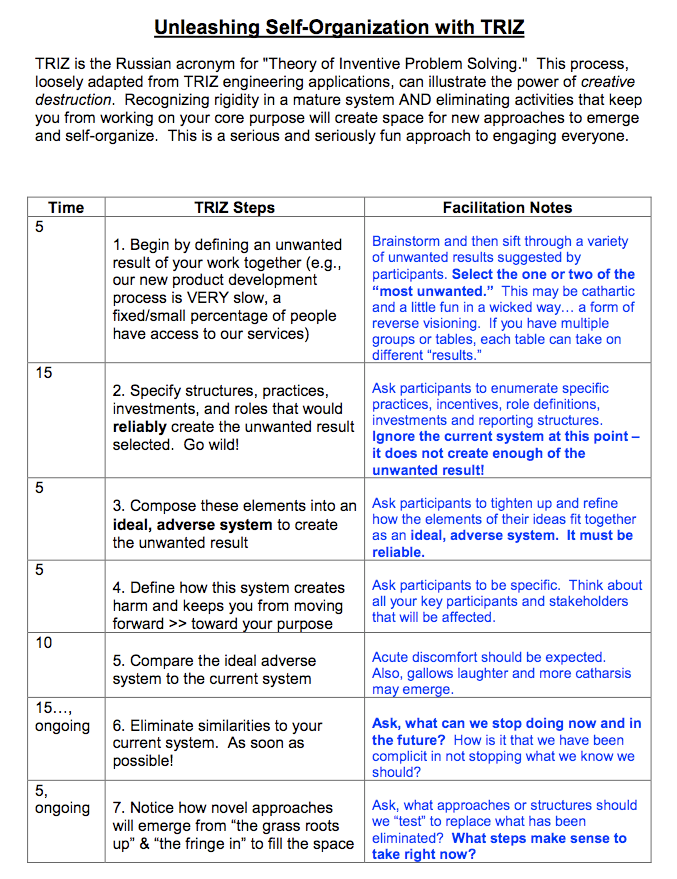
The process McCandless follows has seven steps, as shown in the graphic below:
Steps 2 through 4 indicate why the TRIZ technique is sometimes called "reverse brainstorming."
It's easy to get immersed in lots of technical detail about the TRIZ approach, but you probably don't want to unless you're working actively in an engineering-intense field. Still, if you're inclined to learn more about how TRIZ has developed since it was first conceived in 1946, you can visit Ideation International and The TRIZ Journal.
This lecture 24 (pdf) deals with what he calls project uncertainty management, giving credit for his presentation of the subject to Odmund Granli, a Norwegian expert in project management who got some of his training at MIT.
The basic point Prof. Moavenzadeh addresses is the way attention to managing uncertainty, as opposed to looking only at risks — negative eventualities — enables project managers to focus on value creation over the full life cycle of a project.
Uncertainty in this context is defined as the degree of a project manager's
ability to predict the outcome of parameters or foresee events that may impact the project. Uncertainties have a defined range of possible outcomes described by functions reflecting the probability for each outcome.
Uncertainty exists concerning both risks (negative outcomes) and opportunities (positive outcomes), and arises from variability and ambiguity, the latter due, e.g., to values conflicts among project participants.
Prof. Moavenzadeh outlines four types of uncertainty management challenges, one of which, somewhat confusingly, is itself called uncertainty, for which precautionary strategies, such as limiting the range of effects, are appropriate. The other three challenges are complexity, addressed by strategies that reduce the damage potential and limit the overall risk level (e.g., through establishing appropriate standards and procedures); dynamic processes, addressed by strategies that, e.g., reverse adverse trends and break vicious cycles; and ambiguity, addressed through consensus-seeking dialogue of advisory committees, citizen panels, etc.
The bulk of Prof. Moavenzadeh's lecture discusses how project organization and contracts can be structured to optimally manage project uncertainties — both risks and oppportunities. However, since the slides supporting this portion of the lecture are hard to absorb without the benefit of Prof. Moavenzadeh's in-class commentary, I would suggest that someone wishing to learn more read something like Uncertainty Management for Systems Planning and Design (pdf), a 2004 paper by Richard de Neufville of MIT's Engineering Systems Division.
As a follow-on to last month's Adam Smith Retrospective, I'd like to call attention to a ten-minute overview of Adam's Smith's work that Chris Berry, a professor of political theory at the University of Glasgow and an expert on Smith, has put together.
Professor Berry covers both The Theory of Moral Sentiments and An Inquiry into the Nature and Causes of the Wealth of Nations, the two books from which the Retrospective quotations were taken.
Of Adams' first book Prof. Berry says:
The Moral Sentiments is a leading example of a particular approach to moral philosophy — one that regards it not as sets of rationally or Divine ordained prescriptions but as the interaction of human feelings, emotions or sentiments in the real settings of human life. In many ways it is a book of social and moral psychology. What we can call economic behaviour is necessarily situated in a moral context. But more than that the key theme of the book is an opposition to the view that all morality or virtue is reducible to self-interest. Indeed his opening sentence declares that everyday human experience proves that false, he writes: "How selfish soever a man may be supposed, there are evidently some principles in his nature which interest him in the fortune of others, and render their happiness necessary to him, though he derive nothing from it except the pleasure of seeing it".
About the later book, Prof. Berry notes:
When Smith came to write the Wealth of Nations he made it clear that the ‘wealth’ lay in the well-being of the people. This covered not only their material prosperity but also their moral welfare. Accordingly he thought to be in poverty is to be in a miserable condition and commerce is to be praised for improving human life.
The great achievement of the Wealth of Nations was to discern the principles of order in the seeming chaos of commercial or market behaviour — it wasn’t random, it could be reduced to some simple principles. It was for this reason that Smith was described as the Newton of political economy. ...
He identifies basic principles such as the human propensity to ‘truck, barter and exchange’ that he argues underlies the division of labour but says that this depends on a market and that requires some institutional structures like those that uphold justice such as government and how that in turn mutually relies on principles of public finance.
It cannot be overemphasized that Adam Smith had a sophisticated and humane view of how people's economic interactions play out and of how those interactions should be regulated.
Elinor Ostrom's Research on Management of Common Resources
You can get an overview of Elinor Ostrom's work on "self-organizing and self-governing forms of collective action" in an interview (pdf) she gave Paul Aligica in 2003.
Elinor Ostrom talking in Stockholm about getting "Beyond the Tragedy of the Commons" (2009) (Stockholm Resilience Centre)
In the interview, Ostrom explains the gist of her thinking:
Academics, aid donors, international nongovernmental organizations, central governments, and local citizens need to learn and relearn that no government can develop the full array of knowledge, institutions and social capital needed to govern development efficiently and sustainably. The sheer variety of cultural and biological adaptations to diverse ecological conditions is so great that I am willing to make the following assertion: Any single, comprehensive set of formal laws intended to govern a large expanse of territory containing diverse ecological niches is bound to fail in many of the areas where it is applied.
Improving the abilities of those directly engaged in the particulars of their local conditions to organize themselves in deeply nested enterprises is potentially a more successful strategy for solving resource problems than attempting to implement idealized, theoretically optimal institutional arrangements. There is plenty that national government officials can do to help a self-governing society. They can provide efficient, fair, and honest court systems, effective property right systems and large-scale infrastructure projects — such as national highways — that cannot be provided locally.
Ostrom emphasizes the importance of viewing self-organized groups as complex adaptive systems and of recognizing the value of polycentric governance.
Complex adaptive systems are composed of a large number of active elements whose rich patterns of interaction produce emergent properties that are not easy to predict by analyzing the separate parts of a system. One can see them as consisting of rules and interacting agents that adapt by changing the rules dynamically on the basis of experience. ... [S]ocial scientists have yet to develop many of the concepts needed to understand the adaptability of systems. ...
Many of the capabilities of complex adaptive systems are retained in a polycentric public enterprise system. By "polycentric" I mean a system where citizens are able to organize not just one but multiple governing authorities, as well as private arrangements, at different scales. Each unit may exercise considerable independence to make and enforce rules within a circumscribed scope of authority for a specified geographical area. ... Self-organized resource governance systems, in such a system, may be special districts, private associations, or parts of a local government.
...
Serious empirical research has now shown that polycentric systems tend to generate higher levels of output at similar or lower costs than monocentric systems governing similar ecological, urban, and social systems.
Another, more recent overview of Ostrom's work is provided in the video below, which records the 8½-minute talk she gave earlier this year at the Stockholm Resilience Centre.
(Background information on Ostrom's Stockholm talk is here.)
Among those weighing in on the root causes of the current global financial crisis is Hyun Song Shin, an economics professor at Princeton. He has written a number of academic papers on the subject, but you can also find a quite accessible version of his analysis, "Securitisation and Financial Stability," at www.VoxEU.org.1
Shin's column is only about four pages, so easy to read in its entirety. In sum, Shin's argument is that
... [securitisation] undermined financial stability by concentrating risk. Securitisation allowed banks to leverage up in tranquil times while concentrating risk in the banking system by inducing banks and other financial intermediaries to buy each other's securities with borrowed money.
Shin rejects the idea that the basic problem was banks issuing risky loans, which they then passed off like "hot potatoes" to investors who, in come cases, weren't fully aware of the risk they were assuming.
In Shin's view, of much more significance was the fact that banks bought each other's subprime mortgage-backed securities. The banks then used those assets to back their own subprime lending. What resulted was an interlocking of bank balance sheets (including balance sheets of related special purpose entities), pockmarked with risky assets, that produced dangerously elevated systemic risk.
__________ 1 VoxEU.org is a portal set up by the Centre for Economic Policy Research. Professional economists are encouraged to submit columns that are policy-related, research-based, and written at a level accessible to VoxEU's intended audience, namely, "economists in governments, international organisations, academia and the private sector as well as journalists specializing in economics, finance and business."
There are a couple of short articles by Kevin Gray on BNET.com today that describe the contrasting experiences two organizations had with pay-for-performance compensation systems.
The not-so-hot case of pay-for performance was tried at Hewlett Packard in the early 1990s. As Gray explains, managers at thirteen HP worksites got approval
to adopt a pay-for-performance model, hoping to boost productivity and encourage a focus on team rather than individual performance. They designed a plan that tied 10 to 20 percent of their workers' pay to their team's performance.
Unfortunately, the results were not good, even after managers made a series of adjustments, trying to tune the system so it would work as intended. The basic problem was that the existence of contingent pay meant workers' motivation was skewed and their morale was depressed. Employees:
were resentful when circumstances beyond their control, such as slow delivery of parts, slowed them down.
"refused to allow workers they saw as less experienced join them. Less movement between teams meant that less knowledge was shared or transferred among employees."
found, if they missed their numbers, that they had trouble servicing mortgages and car loans whose size was based on the their income gross of bonus.
Needless to say, disgruntlement set in. The system didn't even reach its third anniversary before being discontinued.
The moral of the story, Gray concludes, is that "Success is never merely about numbers, so don't turn your reward system into a numbers game." Instead, think about such performance issues as whether your compensation system is compatible with solid inter-group collaboration and steady talent development.
Oddly enough, the success story Gray writes about was largely a numbers game, but one that was set up in a context where employees and colleagues were satisfied that the numbers captured fully meaningful information.
In 2003, NSLIJ agreed to participate in a pay-for-performance study organized by the Centers for Medicare & Medicaid Services (CMS). The goal was to see whether the pay-for-performance arrangement would improve the quality of patient care. Gray explains:
The rules were strict. The staff was given 30 measures to assess the treatment of thousands of patients. Heart attack victims, for example, had to receive aspirin within two hours of arrival, beta-blockers at discharge and smoking-cessation counseling. Pneumonia patients required flu screening and an assessment of the amount of oxygen reaching their blood. And surgery patients required antibiotics one hour before the first incision. The hospitals were graded on each criterion and given bonuses based on their performance.
A big part of the reason NSLIJ succeeded with the program was that they invested the considerable time and effort required to get it up and running properly. They trained their staff, they created the necessary documentation, and they ensured that results were monitored by people with authority to make any needed adjustments.
Although Gray focuses on the experience of NSLIJ, he reports that the entire cohort of 275 participating hospitals registered encouraging results. For example, the program was credited with saving the lives of 2,500 heart attack patients in its first three years.
So, now, what's the moral of this contrasting pair of pay-for-performance stories? Most obviously, defining performance appropriately is essential for a program to pay off. What's appropriate in one industry and organization is going to be different from what's appropriate in a different setting.
But it also matters whether bonuses are awarded at the individual level, the team level (the HP case), or the organizational level (the NSLIJ case), which is not something Gray addresses.
I would argue that what is significant in this regard is the degree and nature of the linkages among individual, team, and organization performance. The tighter any linkage, the more important that a pay-for-performance program be directed at the highest level involved. For example, if work is largely accomplished through effective team performance, then well-formulated team bonuses are appropriate. Conversely, where linkages are loose, e.g., where a number of individual contributors are doing the work (as in many sales situations), individual bonuses are appropriate.
Why Systemic Risk is Relatively High in the Financial Sector
If you'd like a refresher on the causes of the financial crisis, the Federal Reserve Bank of St. Louis has published an accessible recap in the September/October issue of their Review.
"Systemic Risk and the Financial Crisis: A Primer", by the St Louis Fed's CEO, James Bullard, and two economists at the Bank, Christopher J. Neely and David C. Wheelock, also explains "why the failures of financial firms are more likely to pose systemic risks than the failures of nonfinancial firms," and discusses remedies that have been suggested to better manage systemic risk in the future.
Because understanding what's unique about systemic risk in the financial sector is important for evaluating proposed policy changes affecting the sector, that's what I'll focus on in this post. The whole article is only twelve pages long and well worth a look.
First of all, here's the definition of systemic risk that Bullard, Neely, and Wheelock (BNW) use:
the risk that a triggering event, such as the failure of a large financial firm, will seriously impair financial markets and harm the broader economy.
BNW cite three reasons why the level of systemic risk is relatively high in the financial sector:
Interconnectedness among firms — The volume of inter-firm lending and trading transactions is high, the speed of transactions is rapid, and the "complex structures of many banks and securities firms make it especially difficult for a firm to fully monitor the counterparties with which it deals, let along the counterparties of counterparties." The upshot is elevated settlement risk — "the risk that one party to a financial transaction will default after the other party has delivered."
Firms' high levels of leverage — Financial firms finance a significantly higher percentage of their assets (e.g., holdings of mortgage-backed securities) through borrowing than do typical nonfinancial firms. The upshot is that financial firms are highly vulnerable to insolvency if their assets experience a downward slide in value due, say, to bursting of a real estate bubble.
Financing relatively illiquid investments with short-term debt — For example, commercial banks finance much of their lending, for which maturities are measured in years, by customer demand deposits (checking accounts), which are generally subject to withdrawal at a moment's notice. The upshot of this mismatch between the maturity of assets and the maturity of debt is that financial firms face elevated interest rate risk (the risk of having to pay a higher interest rate as existing short-term debt matures and is replaced with new borrowing) and liquidity risk (the risk of having to raise cash by selling assets during a period when asset prices are depressed, perhaps because buyer confidence is low).1
As BNW explain in a footnote, "Systemic risk constitutes a 'negative externality' in the sense that the actions of one firm harm others. ... Negative externalities are an example of a market failure that may require government intervention to ameliorate." Proposals for changes in the regulatory regime for the financial sector will be under active discussion for the foreseeable future. BNW's article helps laypeople understand the issues and market dynamics that are at the heart of the discussion.
__________ 1 During a financial crisis, lenders may withdraw from the credit markets entirely due to uncertainty about counterparty reliability and solvency, future interest rate conditions, and collateral values. In this situation, which we have seen during the current crisis, new borrowing is effectively impossible.
Schwartz outlines the scenario planning process by working through an example in which an aerospace engineer gets the process started by deciding that the question in need of investigation is "How can I future-proof my career over the next five years?"
Schwartz then outlines the five steps in the process:
List driving forces.
What variables, trends, and events could change the aerospace industry? Which are fairly certain? Which are uncertain? Which are the two most important uncertainties?
Using the two most important uncertainties, make a scenario grid showing four possible futures.
Imagine possible futures and write them up like news stories.
What could happen over the next five years?
Brainstorm implications. Then devise suitable strategies and tactics for coping with each of the futures you've imagined.
Track indicators so that you recognize when a particular future is emerging.
Schwartz closes by noting that if none of the futures you've imagined comes true, "You can always reevaluate you sense of the forces at play and rework the grid to reflect reality more accurately."
On July 22, Knowledge@Wharton published an excellent overview of how scenario planning can help companies maintain a state of preparedness despite the uncertainties that figure so prominently in today's business environment.
My own copy of the article is so heavily highlighted that I know it's something I must recommend reading in its entirety — it's only about four pages. I'll simply highlight two main themes:
Scenario planning is a way of gaining strategic flexibility in the face of an uncertain future.
"... some companies ...have developed a competitive advantage by leveraging scenario planning — first in stimulating discussion about potential outcomes arising from the swirling mix of trends shaping the world, and then in establishing monitoring mechanisms to identify which scenario is starting to unfold. In the end, the major objectives for these companies are to minimize surprises and to consistently anticipate — and act on — major emerging opportunities and challenges, ahead of competitors."
The leaders of a company need to be directly involved in the scenario planning process so that they are forced to examine their assumptions about how the world works and to experience what's involved in analyzing data with an open mind.
The artcle quotes Kristel Van der Elst, head of the scenario planning team at the World Economic Forum: "You end up changing how people think. The long-term benefit is that you open up people's minds ..."
If you'd like to take a look at the sample set of scenarios cited in the article, you can find the paper in question — "Scenarios for the Downturn & Rebound," by Rob-Jan de Jong and Paul J.H. Schoemaker — here (pdf).
In the September issue of the Harvard Business Review, I lingered over only one article, namely, "How to Manage Your Negotiating Team," by Jeanne M. Brett (Kellogg School of Management at Northwestern University), Ray Friedman (Owen Graduate School of Business at Vanderbilt University), and Kristin Behfar (Paul Merage School of Business at the University of California-Irvine). The article is a short five pages.
Brett, Friedman, and Behfer (BFB) note that "The payoff from negotiating as a team is clear. With access to greater expertise and the ability to assign members to specialized roles, teams can implement more complex strategies than a solo negotiator can ever pull off." The problem is that different members of the team are likely to have different priorities and different desired outcomes, so pre-negotiation prep needs to include specific steps to get and keep the team in sync.
BFB describe four steps to take to ensure everyone on the team is committed to common goals and a common strategy:
Map out the conflicts. BFB illustrate one way of doing this: Create a matrix that, for each goal of the negotiation, captures each internal party's interests and particular views concerning priority and preferred outcome. This helps clarify the trade-offs needed in order for the team to be able to "coalesce around the highest-margin proposal."
Work with all the organizational constituents to get them aligned. BFB note that if "constituents are presented with all the facts, ... they might be willing to concede more ground because they'll also see the bigger picture." Another possibility is "reality testing" — illustrating "the dangers of not working together to make a deal happen" by spelling out "the worst-case outcome for the company and individual units." This approach can concentrate minds and elicit cooperation to help ensure a better outcome. Alternatively, the team might be structured to include a senior executive (or other corporate representative) with authority to bring everyone into line behind a common plan.
Mediate any stubborn conflicts of interest. The mediator can be a team member or an outside facilitator.
Persuade with data. Present data that make clear the effect team members' constructive efforts would have on their departments. Take whatever steps are necessary to ensure that the objectivity of the data is credited by team members.
Once the team has agreed on what they are aiming to achieve, and on the strategy for doing so, further preparation is needed to minimize the chance of deliberate or, more likely, inadvertent deviations from the plan. BFB recommend these steps:
Do a dry run in which you simulate the negotiation. Team members role play the back-and-forth to prepare for objections; to determine who should speak up when, and who should stay quiet; to anticipate different players' likely emotional responses; and to clarify who has authority to make concessions and decisions.
Assign roles to team members that take advantage of their strengths and interests. Help the experts on the team understand when they should weigh in and when they should let someone else do the talking, and ensure that there is a leader who will be "managing preparation logistics, making sure the team's strategy has been vetted by higher-level management or even the board, and finalizing roles and responsibilities for the bargaining session itself."
Establish a plan for intra-team communication during the negotiation. Heading off to caucus when private intra-team communication is needed is generally an unnecessarily dramatic signal to the other side that your team is making some sort of adjustment. Instead, BFB found that effective teams "established creative ways to communicate with one another, which ranged from the explicit to the implicit and from low to high tech." Such things as putting your hands on the table and stretching to signal to the team member speaking that he/she is headed off the rez, or arranging the team's seats so nudges and note-passing can be discreet. Geographically dispersed team members might decide to use text messaging. Etc.
If you'd like to read a more detailed report of BFB's research, you can do so here.
The Efficacy of Microcredit in Promoting Business Growth and Alleviating Poverty
In severalpreviousposts I've discussed microcredit. These posts have all looked at programs that combine provision of credit with training in managing a small business and the revenue it generates. The key issue is how much impact these programs have on business size and on the standard of living of the people and communities involved.
Now some further research on the efficacy of microcredit in alleviating poverty and promoting business growth has come to my attention, thanks to The Economist, which published a one-page article on the subject in their July 18 issue. Two studies are described:
An investigation of the impact of access to microfinance in Hyderabad, India. The study compared low-income neighborhoods that were added to a bank's microfinance market area with low-income neighborhoods that were left out of the market area. Assignment of neighborhoods to the treatment and control groups was random.1
An investigation of the impact of access to microfinance in the Philippine provinces of Rizal and Cavite and in the Manila area. As in the Indian study, this Philippine study used randomizing to address the problem of self-selection, i.e., the problem that the most entrepreneurial individuals are the ones most likely to take advantage of microcredit, and providers of microcredit favor markets where such individuals are concentrated.
In the Philippine case, it was individual credit applicants who were assigned randomly to the treatment and control groups. Those in the treatment group received loans, while those in the control group did not. All of the applicants in question were of marginal creditworthiness, so bank loan officers, not privy to the nature of the experiment, accepted (with a few exceptions) their computer system's decree as to whether or not a particular applicant should be approved, even though the decision was, in fact, random.2
Neither of the two microcredit programs was bundled with client training.
The Hyderabad study's findings, based on a survey done 15 to 18 months after the launch of the program, suggest that
microcredit does have important effects on business outcomes and the composition of household expenditure. Moreover, these effects differ for different households, in a way consistent with the fact that a household wishing to start a new business must pay a fixed cost to do so. Existing business owners appear to use microcredit to expand their businesses: durables spending (i.e., investment) and business profits increase. Among households who did not own a business when the program began, those households with low predicted propensity to start a business do not increase durables spending, but do increase nondurable (e.g., food) consumption, consistent with using microcredit to pay down more expensive debt or borrow against future income. Those households with high predicted propensity to start a business, on the other hand, reduce nondurable spending, and in particular appear to cut back on "temptation goods," such as alcohol, tobacco, lottery tickets and snacks eaten outside the home, presumably in order to finance an even bigger initial investment than could be paid for with just the loan.3
The authors of the study note that it is
somewhat hard to assess the long run impact of the program. For example, it is possible that in the longer run those people who are currently cutting back consumption to enable greater investment will become significantly richer and increase their consumption. On the other hand, the segment of the population that increased its consumption when it got the loan without starting a business may eventually become poorer because it is borrowing against the future, though it is also possible that they are just enjoying the "income effect" of having paid down their debt to the money-lender (in which case they are richer now and perhaps will continue to be richer in the future).
Also
microcredit ... appears to have no discernible effect on [children's] education, health, or women's empowerment [decision-making concerning household spending, investment, savings, and education]. Of course, after a longer time, when the investment impacts (may) have translated into higher total expenditure for more households, it is possible that impacts on education, health, or women's empowerment would emerge. However, at least in the short term (within 15-18 months), microcredit does not appear to be a recipe for changing education, health or women's decision-making. Microcredit therefore may not be the "miracle" that is sometimes claimed on its behalf, but it does allow households to borrow, invest, and create and expand businesses.
The Philippine study also used surveys to assess microcredit impacts. The surveys were conducted 11 to 22 months following an applicant's entrance into the experiment, and yielded these findings:
Individuals assigned to the treatment group did borrow more than those in the control group.
The marginally creditworthy microentrepreneurs who received credit shrank their businesses relative to the control group. The researchers suggest that this was a result of deciding to lay off employees who were not very productive. "[T]reated microentrepreneurs used credit to re-optimize business investment in a way that produced smaller, lower-cost, and more profitable businesses."
A rise in business profit does not translate into income and consumption changes. E.g., there were no significant effects on two key measures of consumption: food quality, and the likelihood of not visiting a doctor due to financial constraints. This could be due to the combination of increased business profits and decreased outside employment (with an increase in school attendance and perhaps related expenditures), thus leading to no change in total household income or consumption.
The treatment group reported increased access to informal credit to absorb shocks. This informal credit reduced the incentive to acquire formal and informal insurance.
There was some evidence that expanding access to capital (credit in this case) increases profits for male, but not for female, microentrepreneurs. Males seem to use the increased profits to send children to school; there is a concomitant decrease in household members employed outside the family business.
There was no evidence that increased access to credit improves subjective well-being — optimism, calmness, lack of worry, life satisfaction, work satisfaction, lack of undue job stress, decision making power, and socio-economic status. To the contrary, there was some evidence of a small decrease.
In sum:
"... increased access to microcredit leads to less investment in the targeted business, to substitution away from labor and into education, and to substitution away from insurance (both explicit/formal, and implicit/informal) even as overall access to risk-sharing mechanisms increases. Thus although microcredit does have important — and potentially salutary — economic effects in our setting, the effects are not those advertised by the "microfinance movement." Rather the effects seem to work through interactions between credit access and risk-sharing mechanisms [e.g., access to loans from family members] ... . At least in a second-generation setting [in which microcredit is provided by profit/sustainability-seeking institutions], microcredit seems to work broadly through risk management and investment at the household level, rather than directly through the targeted businesses. [emphasis added]
Also:
... treatment effects [e.g., on business profits] are stronger for groups that are not typically targeted by microcredit initiatives: male, and relatively high-income, borrowers... The overall picture of our results also questions the wisdom of targeting microentrepreneurs to the exclusion of consumers/wage earners. ... [O]ur findings highlight that money is fungible. Entrepreneurs do not necessarily invest loan proceeds in their businesses. Limiting microcredit access to entrepreneurs may forgo opportunities to improve human capital and risk-sharing for non-microentrepreneurs.
The Philippine researchers' concluding note is that "household financial arrangements in developing countries are complex ... [so] it is important to measure impacts on a broad set of behaviors, opportunity sets, and outcomes. Business outcomes are not a sufficient statistic for household welfare, nor even necessarily the locus of the biggest impacts of changing access to financial services."
3 "Among those who did not already own a business a year ago, the following characteristics predict the decision to become an entrepreneur: whether the wife of the household head is literate [a proxy for willingness to defer consumption], whether the wife of the household head works for a wage [which will reduce the return to opening a business], the number of prime-aged women in the household [also a proxy for willingness to defer consumption], and the amount of land owned by the household [a proxy for initial wealth]."
The President of the New York Fed on Lessons Learned from the Financial Crisis
On June 26, William C. Dudley, the President and CEO of the New York Fed, spoke at the annual Bank for International Settlements conference in Basel, Switzerland. His topic was lessons learned from the financial crisis we've experienced over the past two years.
Since Dudley's remarks, as posted at the New York Fed website, are clearly organized, and only about 4½ pages in length, I'll simply recommend that you read through them. To whet your appetite, here, slightly edited, are the summary recommendations with which Dudley concludes:
Do a better job understanding interconnectedness. This means changing how we oversee and supervise financial intermediaries.
Change the system so that it is more self-dampening.
Improve incentives.
Increase transparency.
Develop additional policy instruments. For example, we might give a systemic risk regulator the authority to establish overall leverage limits, or collateral and collateral haircut requirements, across the system. This would give the financial authorities the ability to limit leverage and more directly influence risk premia, and this might prove useful in limiting the size of future asset bubbles.
Robert Frank, a professor of economics and management at Cornell, has a thought-provoking column in today's New York Times. (An earlier version appeared in The Guardian in May.)
Frank contrasts Adam Smith's views of the dynamics of competition with those of Charles Darwin:
Smith’s basic idea was that business owners seeking to lure customers away from rivals have powerful incentives to introduce improved product designs and cost-saving innovations. These moves bolster innovators’ profits in the short term. But rivals respond by adopting the same innovations, and the resulting competition gradually drives down prices and profits. In the end, Smith argued, consumers reap all the gains.
The central theme of Darwin’s narrative was that competition favors traits and behavior according to how they affect the success of individuals, not species or other groups. As in Smith’s account, traits that enhance individual fitness sometimes promote group interests. ...
In other cases, however, traits that help individuals are harmful to larger groups. For instance, a mutation for larger antlers served the reproductive interests of an individual male elk, because it helped him prevail in battles with other males for access to mates. But as this mutation spread, it started an arms race that made life more hazardous for male elk over all. The antlers of male elk can now span five feet or more. And despite their utility in battle, they often become a fatal handicap when predators pursue males into dense woods.
In Darwin’s framework, then, Adam Smith’s invisible hand survives as an interesting special case. Competition, to be sure, sometimes guides individual behavior in ways that benefit society as a whole. But not always.
Individual and group interests are almost always in conflict when rewards to individuals depend on relative performance, as in the antlers arms race. In the marketplace, such reward structures are the rule, not the exception. The income of investment managers, for example, depends mainly on the amount of money they manage, which in turn depends largely on their funds’ relative performance. ...
In cases like these, relative incentive structures undermine the invisible hand. To make their funds more attractive to investors, money managers create complex securities that impose serious, if often well-camouflaged, risks on society. But when all managers take such steps, they are mutually offsetting. No one benefits, yet the risk of financial crises rises sharply.
The solution, Frank argues, is regulation "to reconcile conflicts between individual and collective interests."
Continuing my periodic citation of work by Jeffrey Pfeffer (most recently here), one of my favorite business academics, let me recommend reading the two-page piece he has in the July-August issue of the Harvard Business Review.
"Shareholders First? Not So Fast ..." deals with today's renewed appreciation of the value of considering all stakeholders in business planning and decision-making. Pfeffer argues:
In the 1950s and 1960s, the stakeholder was king. CEOs saw their role as one of balancing the interests of the various groups that touched their companies — customers, employees, suppliers, shareholders, and the community at large. This reflected the executives' sophisticated understanding not only of their role as stewards of the valuable resources entrusted to them but also of their own enlightened self-interest: Each of these groups was essential for organizational success. What was true then is even more so today, in an age of knowledge work, outsourcing, global supply chains, and activist interest groups.
Pfeffer goes on to say that
opinions on deregulation, finance, time horizons, and the wisdom of corporate leaders are all shifting, and the logic for putting the creation of shareholder wealth ahead of the creation of stakeholder-value is rightfully under fire.
To build profitability and productivity, enlightened managers are
implementing high-commitment work practices. These include investing in training, decentralizing decision making, and having pay be contingent on organizational, not just individual, performance. Other sources [of research] show the benefits companies reap from customer loyalty and high levels of customer satisfaction.
Pfeffer points to the increased prominence of balanced scorecards and other assessment tools as evidence that companies using such tools recognize the suboptimality of focusing exclusively on financial metrics.
Of particular interest to people in the training field, are Pfeffer's repeated references the the importance of employee training in implementing strategies that embody a balancing of stakeholders' interests.
As a follow-on to yesterday's post, I'd like to mention the Miradi software that the Conservation Measures Partnership (CMP) and Benetech have been jointly developing since 2007. ("Miradi" is a Swahili word that means "project" or "goal.")
Miradi is designed to provide project teams with the essential features that they need to design, manage, monitor, and learn from their conservation projects, in other words, to practice good adaptive management. Currently, most conservation practitioners go through the adaptive management process either using pen and paper, or by cobbling together functions from a wide range of programs including flowcharting, mapping, project planning, spreadsheet, accounting, and other software packages. Miradi takes the right functions from each of these different kinds of programs and bundles them together in one easy-to-use integrated package.
To get a project set up in the software, the user works through a step-by-step process that matches the flow of the Open Standards for the Practice of Conservation developed by the CMP. Those steps are:
Once the conservation project is set up in Miradi, the project can be managed and tracked using the various data views the software provides.
The Diagram View shows the conceptual model underlying the project:
In a complete conceptual diagram, the overall project scope is linked to specific conservation targets that are each in turn linked to direct threats and the contributing factors that lead to these threats. The diagram also displays the strategies that the project team is taking to counter these threats, showing the key assumptions that the project team is making about how their actions will lead to their desired outcomes. The diagram also allows users to focus on the specific results chain that they predict will happen as a result of their interventions and to determine what indicators they need to measure to test these assumptions over time. [emphasis added]
Other views include the Threat Rating View, Viability Analysis (showing the status of each conservation target, e.g., "coral reefs"), Strategic Planning View, Monitoring View, Work Plan View, and Budget View.
For over thirty-five years, BRAC, an NGO founded by Fazle Hasan Abed, has been pursuing a gradually expanding mission of alleviating poverty, first in Bangladesh and, more recently in other Asian countries (e.g., Afghanistan) and Africa (e.g., Tanzania). (Originally, "BRAC" was an acronym for "Bangladesh Rural Advancement Committee," but now the name BRAC stands on its own.)
The video below is Abed's own summary (in January 2008) of BRAC's history and mission. Note the importance he attaches to developing programs that can be effectively scaled up.
In the video below, produced by the Uganda Broadcasting Corporation, you can get an idea of BRAC's approach to alleviating poverty, which involves an array of programs — notably, in microfinance, education, health, disaster management, environmental protection, social development, human rights, and legal services — aimed at promoting long-term development in a systematic fashion.
A shorter article about BRAC was published in the May/June 2009 issue of Saudi Aramco World.1
__________ 1 As a sidenote, I'd mention that the virtual walking tours of the Alhambra in Granada, Spain; the Süleymaniye Mosque in Istanbul; and the Dome of the Rock and Al-Aqsa Mosque in Jerusalem offered at the Saudi Aramco World website are not to be missed. I am grateful to my friend Diana Wolfe Larkin for calling these virtual tours to my attention.