!DOCTYPE html PUBLIC "-//W3C//DTD XHTML 1.0 Strict//EN" "http://www.w3.org/TR/xhtml1/DTD/xhtml1-strict.dtd">
Streamline Training & Documentation
Streamline Training & Documentation
Sunday, March 07, 2010
William Kamkwamba's Book
In a couple of 2007posts, I wrote about William Kamkwamba, a young Malawian man, now 22, who distinguished himself back in 2002 by building a windmill in his home village, using timber, bicycle parts, and varous materials from a junkyard.
Bryan Mealer going over the manuscript of The Boy Who Harnessed the Wind with William Kamkwamba and translator Blessings Chikakula (Gift Kamkwamba)
The video below (1:17:22) shows Kamkwamba and Mealer speaking (after some technical difficulties) at MIT on October 27, 2009. The program was under the auspices of MIT's Technology and Culture forum.
This next video is much shorter — only 4:31 minutes. It shows Kamkwamba answering questions submitted by readers of the reddit blog.
If you want to keep up with William Kamkwamba's blog, you can find it here.
For over thirty-five years, BRAC, an NGO founded by Fazle Hasan Abed, has been pursuing a gradually expanding mission of alleviating poverty, first in Bangladesh and, more recently in other Asian countries (e.g., Afghanistan) and Africa (e.g., Tanzania). (Originally, "BRAC" was an acronym for "Bangladesh Rural Advancement Committee," but now the name BRAC stands on its own.)
The video below is Abed's own summary (in January 2008) of BRAC's history and mission. Note the importance he attaches to developing programs that can be effectively scaled up.
In the video below, produced by the Uganda Broadcasting Corporation, you can get an idea of BRAC's approach to alleviating poverty, which involves an array of programs — notably, in microfinance, education, health, disaster management, environmental protection, social development, human rights, and legal services — aimed at promoting long-term development in a systematic fashion.
A shorter article about BRAC was published in the May/June 2009 issue of Saudi Aramco World.1
__________ 1 As a sidenote, I'd mention that the virtual walking tours of the Alhambra in Granada, Spain; the Süleymaniye Mosque in Istanbul; and the Dome of the Rock and Al-Aqsa Mosque in Jerusalem offered at the Saudi Aramco World website are not to be missed. I am grateful to my friend Diana Wolfe Larkin for calling these virtual tours to my attention.
Jacqueline Novogratz's Ideas for Alleviating Global Poverty
You can get an overview of Jacqueline Novogratz's views concerning alleviating poverty in developing countries by reading a short article about her work that appears in the May 23 issue of The Economist.
Novogratz is the CEO of Acumen Fund, which she founded in 2001. As the website explains,
Acumen Fund is a non-profit global venture fund that uses entrepreneurial approaches to solve the problems of global poverty. We seek to prove that small amounts of philanthropic capital, combined with large doses of business acumen, can build thriving enterprises that serve vast numbers of the poor. Our investments focus on delivering affordable, critical goods and services — like health, water, housing and energy — through innovative, market-oriented approaches.
To hear directly from Novogratz, you can watch the video below, which is the talk she gave at the conclusion of the 2008 Aspen Ideas Festival.
In the video, Novogratz addresses at a general level lessons learned and to do's for those seeking to assist with alleviating global poverty. For more detail about such matters as Acumen's investment principles and performance metrics, you can browse through the Acumen website.
In sum, the Acumen approach is to
use philanthropic capital to make disciplined investments — loans or equity, not grants — that yield both financial and social returns. Any financial returns we receive are recycled into new investments.
About two years ago, I wrote a post commenting on a book presenting the story of a remarkable health worker in Mali named Monique Dembele. Monique and the Mango Rains, by Kris Holloway, captures not only Dembele's spirit and accomplishments, but also offers a vivid picture of Mali, a country that has been relatively successful in its development efforts, despite a difficult climate and high prevalence of HIV/AIDS.
For someone interested in knowing more of what's happening in Mali, another encouraging account can be found in the story of Teriya Bugu, a village on the Bani River.
Teriya Bugu — "Friendship House" in the Bambara language — started on the path to its current status as a model farm and ecotourism site back in the 1960s, when a French priest named Bernard Vespieren struck up a friendship with a local fisherman, and eventually decided to focus his development assistance efforts on this particular spot.
As indicated in the video below (narrated in French, Mali's official language), Teriya Bugu takes well-earned pride in its orchards, field crops, kitchen garden, honey, animal husbandry, forestry (over forty species of trees, with an emphasis on eucalyptus), use of renewable energy (solar, wind, and biofuels), and its tourist facilities (guest accommodations, restaurant, conference center for up to one hundred people, museum, zoo, boating, swimming, fishing, birdwatching, and other leisure activities). There are also a school, a dispensary, a library, and a cooperative store.
The ethic that underlies the day-to-day work and the ongoing improvements in Teriya Bugu is one of sustainable and equitable development. It is in this sense that Teriya Bugu qualifies as a model village, a term typically used to characterize Teriya Bugu in published reports.
Yesterday's edition of Bill Moyers Journal included one of the most arresting features I have ever seen on TV. In the segment in question, Moyers presented lengthy excerpts from "Playing for Change: Peace Through Music," a film produced by Mark Johnson, a sound producer/engineer and film director.
As explained at the Bill Moyers Journal website:
"Playing for Change" "brings together musicians from around the world — blues singers in a waterlogged New Orleans, chamber groups in Moscow, a South African choir — to collaborate on songs familiar and new, in the effort to foster a new, greater understanding of our commonality.
Johnson traveled around the globe and recorded tracks for such classics as "Stand By Me" and Bob Marley's "One World" — creating a new mix in which essentially the performers are all performing together — worlds apart. Often recording with just battery-powered equipment, Johnson found musicians on street corners or in small clubs and they would in turn gather their friends and colleagues — in all, they recorded over 100 musicians from Tibet to Zimbabwe.
You can watch the "Stand By Me" portion of the film in the video below. A transcript of Moyers' interview with Johnson is here.
All of the "Stand By Me" performers are wonderful. I found myself especially taken with "Grandpa Elliot" Small, a New Orleans street musician.
The country of Eritrea in east Africa has had a difficult history. The United Nations federated Eritrea with Ethiopia in 1952, and then Ethiopia annexed Eritrea ten years later. This precipitated armed resistance that ended with independence from Ethiopia in 1991, confirmed through a referendum in 1993. A subsequent border dispute precipitated further conflict in 1998-2000, which was brought to an end through United Nations intervention to arbitrate drawing of the border. Unfortunately, there is lingering disagreement over a portion of this border. (A detailed chronology is here.)
Internally, Eritreans have faced an indefinite delay in putting into effect the democratic constitution that was ratified in 1997. Isaias Afworki, elected president in 1993 by a transitional legislature, remains in office, never having exposed himself to the electoral process laid out in the constitution.
Even as advances toward democracy have remained stalled, Eritrea has made progress on other fronts, notably in the area of healthcare. The two videos below, produced by the Geneva University Hospitals provide some background on the opening of Eritrea's first medical school in 2003. (The videos are parts 1 and 2 of a single narrative.)
Only four years after the medical school was established, Eritrea opened the Orotta Post-Graduate Medical School to train specialists — initially in surgery and pediatrics.
For additional detail concerning Eritrea's efforts to modernize and expand its health system, you can read the Eritrean Ministry of Health's 2006-2010 strategic plan here (MSWord).
At one point while I was traveling in Germany last month, I found myself in immediate need of a clean shirt, so a bought one on sale for 5 euros. It turned out to be a product associated with the Cotton made in Africa (CmiA) project, whose aim is to improve the social and economic conditions of small cotton farmers in Africa.
CmiA's specific goals are:
Improvement of cotton growing, moving towards sustainable production. This includes using water, fertilizers, and pesticides in the best way for achieving high yields without damaging the environment. It also includes encouraging parents to send their children — girls as well as boys — to primary school, and helping farmers access markets without being forced to accept artificially low prices set by monopolistic buyers.
Enhancing the competitiveness of African cotton. The farmers' cotton is of high quality, which makes it attractive on the world market — if its price is competitive. CmiA helps farmers learn optimized management practices that enable them to maximize their gross margins.
Corporate responsibility in dealings affecting cotton farmers and the environment.
CmiA's effectiveness is evaluated using five sustainability indicators:
Children completing primary education
Efficiency of water usage
Pesticide use (avoidance of overuse)
Fertilizer use (avoidance of overuse)
Farmers' income (including timely receipt of payment from buyers)
CmiA's three-year pilot phase in three countries — Benin, Burkina Faso, and Zambia — is just now coming to an end. I will be watching to see how learning from the pilot is used to widen CmiA's impact.
I'd like to to follow up on an earlier post about the concerted effort Absa Bank made in 1998, following amalgamation of four South African bank brands into one Absa brand, to ensure that its employees would deliver on the brand promise of quality service to customers.
Julia Scheffer completed a master's thesis (pdf) in 2005, which, though generally heavy going, does provide further detail concerning the specific steps Absa took internally as part of its overall effort to achieve its branding aims. As summarized in a chart on pp. 196-197, the goals of the bank's plan for communications to employees concerning the new Absa brand were to:
Undo confusion.
Share information.
Obtain employee buy-in.
Change customers' perceptions of the bank.
Provide in-depth knowledge of where Absa was heading and why.
Explain the financial implications of the amalgamation.
Explain the long-term financial benefit.
Gain market share.
Ensure optimum solutions for customers.
Retain customers.
Suit customer convenience.
Support simplified systems.
In their content, the communications to employees covered:
The fact that Absa was a single commercial bank.
The time frame for the changeover from multiple banks to a single bank.
The benefits and implications for employees.
The benefits and implications for customers.
The benefits and implications for other stakeholders.
The cost implications for Absa Group.
Product implications.
The fact that Absa was readying itself for the future.
How divisions were being consolidated.
The importance of the steps being taken for the bank's survival in a changing environment.
Leadership's emphasis on ethical operations and being forward-looking.
The prospect of gains for everyone from the consolidation.
The nature of the infrastructure changes being introduced.
Management expectations of employees.
The fact that consolidation would enable Absa to be more true to its mission.
An array of communication actions and channels were used:
Electronic channels — The launch was done live on the ABSA Channel, an in-house TV channel, and the message also went out via email.
Print media — Communication via ABACUS, an internal publication; information packs sent to all managers; personalized letters to employees; tent cards for tables.
Group dialogue and discussions held via Absa communication representatives and "action line" employees.
Private discussions with Branch Managers.
Absa Communication Centre (a call center for answering employees' questions).
Employees also attended a series of branding orientation sessions which introduced them "to the core values of the new brand by setting up the Brand Wall, which was a series of posters and web pages dedicated to various facets of the new brand." And, as noted in my earlier post, employees attended specially designed "I Am the Absa Brand" training workshops that taught them what to do in specific situations in order to achieve solid customer satisfaction.
In sum, Absa Bank's comprehensive communications program both for motivating employees to embody the single bank brand, and to equip them to do so effectively, is an instructive model for other companies attempting similar brand building.
21st Century Journalism XXVIII: The Rwanda Initiative
An important change introduced following the Rwandan genocide of 1994 was concerted effort to improve the performance of Rwandan news media, some of which were implicated in the genocide.
Recognizing Rwandan journalists' and aspiring journalists' need for solid practical training, Allan Thompson, a journalism professor at Carleton University's School of Journalism and Communication in Ottawa, launched the Rwanda Initiative in January 2006. The Initiative is a joint effort between Carleton and the School of Journalism and Communication at the National University of Rwanda (NUR). The NUR journalism school has only been in existence since 1996.
The introduction to the Initiative's blog reviews the situation the Initiative seeks to address:
The media sector in Rwanda was devastated by the 1994 Genocide. Most professional journalists were killed, exiled or implicated in the slaughter through their involvement with hate media. The media sector remains traumatized. Many working journalists lack professional training and the journalism school is chronically short-staffed.
To supplement Rwanda's slim cadre of journalism educators, teachers from Carleton serve as visiting lecturers at NUR. In addition, the Initiative helps with curriculum development, runs an internship program for Canadian journalism students at Rwandan media organizations, and collaborates with NUR in organizing media-training workshops for working journalists.
As Thompson explained in June of last year, "The essence of Carleton's Rwanda Initiative has been to address both sides of [the] media equation, to build the capacity of the media in Rwanda and to foster an interest in Africa among a new generation of Canadian journalists."
The Rwanda Initiative has also sponsored internships in Canada for Rwandan journalism students. You can read about the experiences of one of the interns, Eugene Kwibuka, in the July-September 2007 issue of Intercultures Magazine. In his article Kwibuka mentions his experience covering the trial in Montreal of a suspected genocide participant, but he concentrates on explaining how the Rwanda Initiative's training has helped him and his fellow students:
The big difference between [the Canadian lecturers'] way of training and that of Rwandan lecturers is the fact they put a particular emphasis on practice rather than theory. They step in journalism classrooms equipped with materials like cameras, computers and notebooks. They show students how to use them, then assign them to do stories. They make students learn by doing. ...
Most journalism students at the National University of Rwanda will tell you that what they enjoy about Canadian lecturers is practice. They love being introduced to new techniques of how to pitch a story, how to take a nice shot, how to use ambient sounds in a radio story and how to deal with ethical issues in journalism. It’s helpful that the lecturers who are teaching them these techniques are themselves practicing journalists or have been journalists for a long time.
A little later today, I will be meeting with a friend (American) who taught literature at NUR several years before the genocide. I will be interested to hear his thoughts about the approach the Rwanda Initiative is taking to helping the country's journalists become more professional and more effective in promoting understanding in their country.
I'm reading Three Cups of Tea, Greg Mortenson's story, co-written with David Oliver Revlin, of his work, underway since the mid-1990s, of building schools in remote villages in Pakistan for education of both boys and girls. Early in the book, Mortenson talks briefly about his father Dempsey's work raising funds for and founding the Kilimanjaro Christian Medical Center (KCMC) in Moshi, Tanzania. The story is an inspiring example of effective delivery of professional training in a developing country.
When [Dempsey's] teaching hospital was up and partially running, he insisted, against the wishes of many foreign members of the board, that they focus on offering medical scholarships to promising local students, rather than simply catering to expat children and the offspring of East Africa's wealthy elite.
At the ribbon-cutting ceremony in 1971, Dempsey
began by thanking his Tanzanian partner at the hospital, John Moshi, who Dempsey said was just as responsible for the medical center's success as he was. "I have a prediction to make," he said in Swahili, ..."In ten years, the head of every department at the Kilimanjaro Christian Medical Center will be a Tanzanian. It's your country. It's your hospital."
According to Greg Mortenson,
My dad got blasted by the expats for that. But you know what? It happened. The place he built is still there today, the top teaching hospital in Tanzania, and a decade after he finished it, all the department heads were African.
In 1997 the Kilimanjaro Christian Medical College opened at KCMC, with a range of training programs, including a five-year program for training doctors, a three-year program for training nurses, and a postgraduate studies and research program.
You can get a quick introduction to how South Africa is approaching the need to build people's skills, and to do so in a way that redresses injustices of the apartheid era, by reading the March 10 article by Anne Newman, Nkhabele Marumo, Lynn Hunt, and Catherine Mercer Bing of ITAP International posted at the Training magazine website (and published in somewhat abbreviated form in the March/April issue of the magazine).
A key point is that the Sectional Educational Training Authorities (SETAs) established under the Skills Development Act are getting considerable criticism from businesses whose needs for skilled workers the SETAs are supposed to address by helping to standardize and accredit training programs and by funding worker training that is effective in increasing participants' employability and productivity. As the Training article notes, restructuring of the SETAs is likely in the near future.
[A note about an acronym in the Training article: "FMCG" refers to fast moving consumer goods, aka consumer packaged goods.]
The latest edition of the newsletter our mayor sends out periodically was in my email today. After detailing Northampton's budget woes, the newsletter mentioned a visit to the mayor on Valentine's Day by Cecilia Appianim (pdf), a cocoa farmer from the village of Asentem in central Ghana.
Appianim was accompanied by Niki Lagos, sales and marketing associate of Divine Chocolate, a farmer-owned fair trade chocolate company. A major portion of the ownership of Divine Chocolate is held by the Kuapa Kokoo Society, a cooperative of 45,000 Ghanaian cocoa farmers, including Appianim, founded in 1993.
Appianim is Kuapa Kokoo's recorder in her village, which means she is responsible for collecting farmers' dried cocoa beans, checking that the beans meet quality standards, weighing them, arranging transport to storage and market points, and receiving and disbursing the farmers' payment for their beans. You can read more about Kuapa Kokoo here.
Note that the benefits of membership in the Kuapa Kokoo cooperative include training for farmers and, as one result of enhanced income, higher school attendance rates for farmers' children.
An exemplary approach to figuring out how to promote effective implementation of third-world development programs is described in a 2007 discussion paper posted online by the International Food Policy Research Institute (IFPRI). (Another of IFPRI's discussion papers was the subject of yesterday's post.)
In "The Power Mapping Tool: A Method for the Empirical Research of Power Relations," Eva Schiffer, a post-doctoral fellow at IFPRI, describes a practical approach to "empirical measurement of power in governance processes."
The problem the Power Mapping Tool helps address is the perennial difficulty in getting technically sound economic development interventions implemented in a way that actually accomplishes their goals. For example, all too often, development assistance intended for the poorest segment of a country's population ends up in the hands of the country's relatively well-off, a phenomenon referred to in the development literature as "elite capture."
The Power Mapping Tool seeks to bolster effective implementation by determining in advance, or as implementation proceeds, the power structure within which a program is being carried out. With this information in hand, implementation can be adjusted to maximize positive contributions of various actors, while minimizing dysfunctional influences.
The Power Mapping Tool involves interviewing individuals with first-hand knowledge of a program's governance context. The interviewees answer three basic questions:
Who is involved?
What is each actor's range of action?
How much power does each actor have?
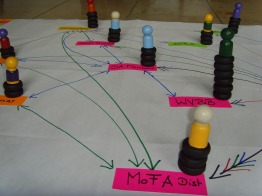
To elicit complete, meaningful answers to these questions, the Power Mapping Tool adopts a set-up resembling a board game.
As illustrated in the photo below, the Who question is answered by assigning each actor a playing piece. The actors are placed in ovals representing the various organizational bodies involved in implementation. When an actor is a participant in more than one organization, this is captured by having the corresponding ovals overlap.
The range-of-action question is answered by having the intervieweee assign up to four types of playing card to each actor. The four types of cards bear symbols representing, respectively:
Observing
Giving advice
Making decisions
Providing funding
The amount-of-power question is answered by placing each actor's playing piece atop a stack of disks (e.g., checkers). The height of the stack for a particular actor represents that actor's power relative to the power of the other actors an interviewee has identified.
The Power Mapping Tool produces both quantitative and qualitative information. The latter is obtained through discussing with the interviewee the thinking behind his/her answers to the Who, range-of-action, and amount-of-power questions.
I highly recommend reading Schiffer's entire paper (21 pages). Then, as a next step, you can look at the Net-Map toolbox Schiffer has developed to integrate power mapping and social network mapping (see illustration below).
As a follow-on to the post on Hans Rosling's efforts to help people draw accurate conclusions from statistics on economic development, I'd like to note the work of MIT's Abdul Latif Jameel Poverty Action Lab (J-PAL), which has a similar "let's look at the evidence" philosophy.
dedicated to fighting poverty by ensuring that policy decisions are based on scientific evidence. We achieve this objective by undertaking, promoting the use of, and disseminating the results of randomized evaluations of poverty programs. [The rationale for using randomized trials is explained here.]
The first treatment groups is offered access to DrumNet, a Kenyan NGO. These clients are told about opportunities to sell their crops, and are provided access to transportation so they can complete advantageous sales.
The second treatment group is offered the same services, but in addition is offered an in-kind loan at the local agriculture supply store. This is a short-term loan that gives the client just enough credit to buy fertilizer, herbicide, or other chemicals before harvest. The loan is repaid directly from the proceeds from the sale of the client's crops. Hence the only risks for the lender are that the client's crop fails for some reason, or that the client leaves the DrumNet system and sells their crop through another channel. By directly linking the credit to the crop sales, it is hoped that this can be a sustainable agricultural lending model that helps farmers gain access to working capital to invest more in their harvest.
Results so far (the project is ongoing):
More and more farmers are growing horticultural produce for export, investing more inputs.
As a result of higher investment, farmers are seeing higher net margins and higher gross prices for their produce.
DrumNet is an effective model for encouraging the production of export-oriented crops.
Farmers are less likely to grow horticultural produce for export without credit.
A comparison of members of farmer self-help groups with access to credit to those without shows that credit is effective in improving yield per acre, but the improvement does not translate into differential income gains.
A December 2005 report on the DrumNet project is here (pdf).
The Illusion of Sustainability — An investigation in Kenya of several pediatric de-worming interventions, notably, free provision of de-worming drugs vs. numerous approaches intended to be financially sustainable (i.e., not requiring ongoing subsidy), such as cost sharing, health education, and verbal commitments (a mobilization technique).
The main results:
It appears that there may be no alternative to continued subsidies for de-worming.
Providing medicine to treat worms is extremely cost-effective, although medicine must be provided twice a year indefinitely in order to keep children worm-free.
An effort to promote sustainability by educating schoolchildren on worm prevention had no impact on the children's worm prevention behaviors — and thus child health is likely to be worsened to the extent that funds are diverted from medical treatment into health education in this setting.
A verbal commitment intervention — which asked people to commit in advance to adopt the de-worming drugs, taking advantage of a finding from social psychology that individuals strive for consistency in their statements and their actions — had no impact on treatment rates.
Take-up was highly sensitive to drug cost: the introduction of a small fee led to an 80% reduction in take-up, relative to free treatment.
A June 2003 report on the de-worming project is here (pdf).
In 2006, and then again in 2007, Hans Rosling, a widely respected professor of international health at the Karolinska Institute in Sweden, gave talks at the annual TED conference about reducing poverty. These talks have attracted considerable attention.
Rosling, along with his son and daughter-in-law, developed data visualization software called Trendalyzer. The software uses animation of graphed data to help people grasp the stories (trends) embedded in time series data, such as statistics on national income and infant mortality. (Trendalyzer was acquired by Google in 2007.)
Rosling's goal is to facilitate evidence-based formulation of development policy. His key message is that more social and economic improvement is possible in developing countries than people unfamiliar with the details buried in development statistics realize.
You can watch the 2007 talk in the video below.1 If you want to skip the BMW commercials, start at 00:25 and stop at 19:06. If you want to skip Rosling's demo of sword-swallowing, stop at 17:20. Note that at 13:23, Rosling talks about the challenges African farmers face in getting their crops to market, the subject of an earlier post dealing with the Ethiopia Commodity Exchange.
Rosling's 2006 talk is here:
You can read a description of Trendalyzer that Rosling presented at an OECD meeting here (.doc). You can read a brief interview with Rosling here.
__________ 1 As I read Rosling's Trendalyzer bubble graphs, they accommodate as many as six variables (exported from an Excel spreadsheet): item name (e.g., country), item trait (e.g., geographical region, indicated by bubble color), x-coordinate (e.g., per capital GDP), y-coordinate (e.g., infant survival to age one, per thousand live births), bubble size (e.g., population), and time (shown via animation of the bubbles).
Creation of a mechanism that, in theory, enables farmers to time their sales in light of knowledge of global market prices that has heretofore been inaccessible to them, is an encouraging innovation for a region that has suffered from recurrent instability in production and heartbreaking famines.
At the same time, it seems important to note an aspect of the story that does not appear in Roger Thurow's WSJ article, namely the potential for ECEX transactions to be skewed by corporations with market power that are tied to the Ethiopian government. See, for example, this reaction to the creation of ECEX. The government is the 100% owner of ECEX.
Since this political level of the story is something which I, so far, understand only superficially, I'm now looking to learn more once ECEX is actually up and running.
Last September an organization called Literacy Bridge began operating as a Seattle-based non-profit, taking as its mission
to empower children and adults with tools for knowledge sharing and literacy learning, as an effective means towards advancing education, health, economic development, democracy, and human rights
Literacy Bridge's major program is the Talking Book Project. The idea is to develop affordable digital audio technology that can become the delivery mechanism for:
Information — presented in oral rather than written form, so reading ability is not needed.
Literacy training — so that people in increasing numbers will gradually be equipped to make use of information in both oral and written form.
The initial Talking Book program will be carried out in Ghana, whose adult literacy rate was reported as 58% in 2004.
You can learn more about Literacy Bridge's work by watching the video below. It's the hour-long talk Executive Director Cliff Schmidt gave on January 8 to Google employees as one in Google's ongoing series of Tech Talks.
The Ghana Institute of Management and Public Administration
One of the most interesting tales of change management I've encountered involves the Ghana Institute of Management and Public Administration (GIMPA) in Accra.
GIMPA's rector, Stephen Adei, outlines the background, the steps taken to turn the institution around, and the learning to be derived from the experience in a presentation available here (pdf).
Unfortunately, Dr. Adei is currently in the midst of a legal wrangle over his use of the title "Professor" and over his management style at GIMPA, so we have to reserve judgment on just what type of a success story GIMPA actually is.
I will be watching further developments. Availability of high-quality business training in developing countries is important for enabling enterprises in these countries to compete effectively in world markets, so knowing what role GIMPA plays in Ghana is of considerable interest.
As a follow-up to an earlier post concerning improvements in cocoa farming in West Africa (where 75% of the world’s cocoa is grown on small family holdings), here is a short video put together by the International Cocoa Initiative (ICI). The video introduces ICI's work to reduce exploitation of child labor.
(Though the running time is given as 6:35, the actual time is 3:08.)
ICI, based in Switzerland, is a foundation set up in 2002 as a partnership among non-governmental organizations (NGOs), labor unions, cocoa processors and the major chocolate brands. ICI's mission is
to oversee and sustain efforts to eliminate the worst forms of child labour and forced labour in the growing and processing of cocoa beans and their derivative products.
In order to accomplish its mission, ICI takes a long-term view:
By working in concert with communities, we create the building blocks necessary to ensure long-term change. Changing long-standing and deeply embedded local practices is not a quick fix. Affecting meaningful and sustainable change must, therefore, be driven by community-based solutions that harness local knowledge, capabilities and buy-in.
The ICI video gives a sense of how their pilot projects work locally
to ensure children are not involved in hazardous practices, a mechanism for the identification and rescue of trafficked children, investment in education and youth programmes and a framework to ensure these changes become permanent.
If you want additional detail, you can go to ICI's website to read a brief write-up of the pilot program in Attobrakrom — the community in Ghana featured in the video — and a summary of an evaluation of how the pilot program fared in all the communities in which it was instituted.
Improving the Quality of Cocoa Production in West Africa
In 2004 the World Cocoa Foundation (WCF) began a training program for cocoa farmers in the West and Central African countries of Cameroon, Côte d'Ivoire, Ghana, Liberia and Nigeria. The aim of the training was to help participating farmers "increase their family incomes by educating them on better growing techniques, crop diversification and other productivity-enhancing steps."
The WCF's 18-session Farmer Field Schools "also raise awareness of safe pest management and responsible labor practices," the latter including encouraging parents to send their children to school.
As one gauge of the success of the training, the WCF reports that participants' farm-generated income rose between 15% and 55% following the training. As one particular example, the WCF describes the experience of a cocoa farmer in Ghana named Kwabena Antwi-Boasiako:
Prior to attending the Farmer Field School (FFS) ... Mr. Antwi-Boasiako had never thinned out [his cocoa trees] ... or remove[d] chupons and mistletoes (light pruning). By attending the FFS and participating in field exercises, he saw and learned how crowded trees are thinned out, and mistletoes and chupons are pruned. He used to believe that the more cocoa trees per unit area, the more pods he would harvest. But through the FFS discovery-based learning exercise, he came to appreciate that correct spacing of cocoa trees (8-10ft x 8-10ft.) and regular removal of chupons resulted in increased pod formation and size, while reducing pests and diseases. Mr. Antwi-Boasiako has since put into practice all that he learned, especially by thinning out and reducing the number of trees on his field. He has witnessed increases in yields and income of over 60% within one year after FFS as evidenced from his cocoa sales pass book.
aims to improve the economic and social well being of tree crop farmers and the environmental sustainability of their systems in West and Central Africa. During the Pilot Phase [2003-2006], a first set of technology transfer, marketing, and institutional innovations were introduced and validated in the field. As part of this, 16,320 farmers were directly trained through the participatory Farmer Field School approach and 38,716 farmers indirectly benefited through farmer-to-farmer diffusion of knowledge. Trained farmers realized yields 15% to 40% greater than non-trained ones. Farmers participating in group sales arrangements received 5% to 15% higher prices for their cocoa. Phase II of the program [2007-2011] will build upon the successes of the pilot and address additional production, marketing and policy opportunities identified during the pilot, while strengthening local capacity.
You can view a video (about seven-minutes long) describing STCP's work in Ghana here. (The audio is sometimes hard to decipher.)