!DOCTYPE html PUBLIC "-//W3C//DTD XHTML 1.0 Strict//EN" "http://www.w3.org/TR/xhtml1/DTD/xhtml1-strict.dtd">
Streamline Training & Documentation
Streamline Training & Documentation
Saturday, January 16, 2010
21st Century Journalism XXXVIII: Training Rural Journalists in India
On January 14, India Knowledge@Wharton published an article reporting on what newspaper publishers in India are doing to attract rural readers. Despite a rural literacy rate of only 50% and road conditions that make delivery arduous, Indian newspapers are succeeding in maintaining circulation in rural areas by covering topics of local interest, marketing vigorously, and employing resourceful delivery people.
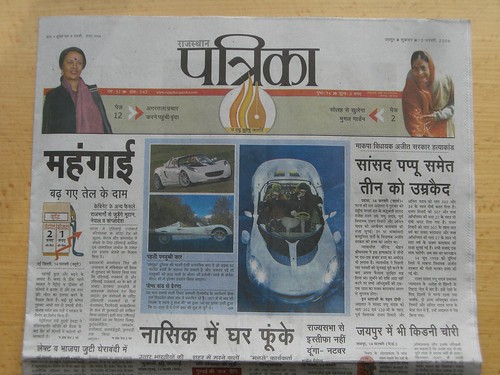
Rajasthan Patrika, a Hindi-language newspaper that has made a point of building rural readership (Dan Reynolds)
The article opens with an account of rural distribution of a city paper, Rajasthan Patrika, and then goes on to describe a paper that is more strictly local:
Khabar Lahariya, or News Waves, [is] a weekly newspaper based in Chitrakoot, one of the poorest districts in central India. Written in Bundeli, the local language, the paper's all-female staff has forged a reputation for investigative journalism and support of grassroots causes since the paper was founded in 2002 by Nirantar, a New Delhi-based literacy education non-profit.
With a readership of 35,000 in 400 villages and costing 4 U.S. cents, the paper has no glitzy promotion strategy like its urban counterparts. Khabar Lahariya's marketing strength is instead its bold reporting on issues concerning lower-caste communities, for which it won the 2009 King Sejong Literacy Prize from UNESCO, among other recent accolades. However, the main reason why Khabar Lahariya receives such kudos is that it is run by trained women from marginalized communities and it conducts (in conjunction with Nirantar) journalist training and writing programs for locals — a vital step, many believe, in increasing rural literacy.1
Khabar Lahariya'straining effort offers a promising model. You can get an idea of how Nirantar organizes its training workshops from an August 2007 report (pdf) that Nirantar has made available online.
A Nirantar training workshop on rural journalism (Nirantar)
The workshop described in the report ran for seven days with eighteen participants. It was a mix of "group discussions, analysis of written material, field visits, film screening,2 debates, lectures and role plays."
The basic journalism concepts covered were:
What constitutes news
Sources of news
Verifying sources
Questioning gender norms
Completing stories
Effective interviewing
Ways of writing up interviews (Q&A, feature story)
I would note that the field trips, which were timed to support the discussions of what constitutes news, maintaining neutrality,3 identifying and tapping reliable sources, conducting interviews, and doing a thorough job of gathering information, were vital for giving the training participants a real feel for the process of reporting.
It is also notable that the workshop's interviewing role plays were especially well received:
This was definitely the highlight of this session: a combination of entertaining characterizations and the excitement of interacting with the trainers in a different role really worked to draw the group into the exercise. Six groups were formed, and each given a different character to interview — ranging from officials to interesting personalities (A sleazy District Magistrate, a boatwoman, a station master, a woman freedom fighter, a woman pradhan). They were given a situation, and asked to plan/prepare questions for the interview. Some of the issues that emerged were — how to deal with long, rambling, unfocussed interviewees; how to deal with officials behaving inappropriately (and thus distracting attention from the questions asked); and how to extract important information from sources who are busy/evasive. In general, the energy was high through this activity, and provided a spur to the field trips that followed.
The report closes with notes on how the training was evaluated. To test retention the trainers used a competition, with questions in various forms — multiple choice, matching, true/false, and items dealing with more detailed issues covered inthe training. The trainers' assessment:
It was deeply heartening to see that most of the group had a grasp of the basic concepts of journalism, but also were able to articulate some of the more complex issues — of what news is important, and why, of how to write certain news. It was also an exhilarating way to end the fairly long and draining week we’d had.
In addition, the trainers solicited oral and written feedback from the participants. In the oral feedback,
[m]any participants said they were nervous before they came ... – about the work that would be expected of them - but had enjoyed meeting so many people, and speaking to them, and learning so much. Many people listed the key concepts in the course (we were sure none of the 18 participants would ever forget what LEAD or KHABAR ["news"] or INTERVIEW meant!). [S]ome people shared the difficulty in understanding or remembering words that were used in the course ... but hoped that what they didn’t recall, they would in the work to follow. Uma shared what a different experience it was to be encouraged to go out and speak to so many different people.
__________ 1 You can see a sample 2007 edition of Khabar Lahariyahere.
2The film used in the workshop was Mrityudand ("The Death Sentence"), a 1997 Hindi-language release.
3 In the Indian context, maintaining neutrality was difficult for some of the training participants because they felt that the (mythical) stories they learned in their religious instruction should take precedence over alternate stories based on standard journalistic fact-finding.
The American Press Institute, a training organization for journalists founded at Columbia University in 1946, has in recent years been giving focused attention to investigating what sort of viable future newspapers can create for themselves.
API's Newspaper Next initiative, launched in 2006, "provides the industry with new business models, non-traditional ways to see opportunities that produce sustainable growth, and ways to reshape organizations for consistent innovation."
The Newspaper Next project team worked with Innosight, headed by Clayton Christensen, a professor at Harvard Business School, to develop a recommended approach to innovation for newspapers. The "job to be done" is one of the central concepts of the Innosight approach. The thinking is that
... customers don't buy products, they hire them to get important jobs done. Understanding the jobs that customers care about but can't adequately get done with existing products can point to new paths for growth. ... One challenge for the newspaper industry is that many of the information-related jobs that people used to hire newspapers to get done are now done better by emerging competitors.
Newspaper Next developed three one-page interview forms that newspapers can use to identify the "jobs" they can profitably do for their customers — consumers and businesses.
The questions suggested for consumers — readers and prospective readers — are:
What are some things (for example, related to local information) that you have most trouble trying to do at the moment?
Why and when do you typically seek to do this?
Where did you look for help? Describe the process you followed.
What frustrated you most?
Describe a perfect solution. What will it do?
What are the emotions that the perfect solution would make you feel ("emotional hiring criteria")?
The suggested questions for businesses — currently served by newspapers mostly through advertising — are:
How do you make money?
What are the things about running your business that keep you up at night?
What are some things ("jobs") that you are having problems getting done?
Under what circumstances do you usually try to do these things?
What do you currently use to help you?
What other options have you considered? Why did you use or reject these?
How would you describe the perfect solution?
What are the most important characteristics of this solution?
There is also a questionnaire for employees with these suggested questions:
What are some things that customers have asked us to do in the past that we could not do?
What types of customers typically ask us for this?
Why couldn't we deliver what they wanted?
What alternatives did they use instead?
How well did these alternatives meet their needs?
What would the perfect solution for them look like?
What would be the most important characteristics ("hiring criteria") of this solution?
Newspaper Next preaches what they call their "gospel":
Innovation requires structure and resources. Companies hoping to transition from the old, monolithic newspaper business model to a diverse and growing portfolio of products need to create clear innovation processes and allocate resources to support promising projects.
Though not all industries will necessarily be best off if their companies focus their innovation efforts on developing "a diverse and growing portfolio of products," the Innosight approach to innovation, and specifically the sorts of questions suggested for customers and employees, can provide a model for how to get headed down a productive path toward long-term growth.
Laughter is the Best Medicine XXIV: From the Newsroom
Peridically, I have a look around the Internet to see if I can turn up any G-rated office humor for my proudly staid blog. Invariably, it's slim pickings. Most of the amusement either isn't actually funny (a problem shared with the cartoons in the Harvard Business Review and the Wall Street Journal), or it's too racy to suit my purposes.
However, today I've hit paydirt. At the Facebook page "Overheard in the Newsroom," status entry #1686 reports this remark from a young visitor: Home-school kid on tour of newsroom to copy editors/paginators: “So basically... your job is a bunch of clicking.”
Several of the responses from "fans" of the page are also worth quoting: I had a fourth-grade kid on a tour ask "So if a guy shot someone's face off with a bazooka would you have a story about it?"
Designers just don't click ... They also draw boxes.
My wife used to ask why I came home tired after 8 or 10 or however many hours on the copy desk, "all you do is sit there and push a few buttons." Then she got a job there, too. She didn't ask anymore.
I always described being a graphic designer as doing 'executive colouring in'.
wow - remember when we actually *went* somewhere to do interviews??
The woman who gave tours at my former job told people all the copy desk did was cut and paste.
21st Century Journalism XXXVI: An Exemplary Article
I have found myself increasingly hard-hearted as I read about the declining fortunes of the news industry. As a news junkie, I am only too happy to find significant and accurate material in the various newspapers I check each day (online, except in the case of my local paper). Unfortunately, much of what is published is shallow and inaccurate. Why should anybody pay money for this?
More specifically, the news reports I read are frequently poorly sourced and poorly fact-checked. The whole idea of "enterprise reporting" seems to have become etiolated. Instead of pressing to "get the story," many reporters phone their favorite official sources (often anonymous) and simply transfer quotes into their articles, with no attempt to assess the accuracy of what they've been told, even though many of the sources in question have a track record of mendaciousness.
Feeling starved for reporting I can trust and learn from, I find myself responding with marked relief when I encounter a story that reminds me of the good old days of expert reporting.
Such an article showed up in the Financial Times on August 29. Written by Martin Sandbu, "The Iraqi who saved Norway from oil" recounts the career of Farouk al-Kasim, a man who has lived in Norway with his Norwegian wife and their chilcren since 1968. During that time, he has provided expertise, largely in obscurity, that has helped Norway develop its oil resources in a way that is contributing to the long-run welfare of the country's residents.
Sandbu's thesis, which he supports with evidence from the publicly known history of Norway's oil sector and from his own research, is that al-Kasim has played a major role in helping preserve Norway from the severe economic distortions other oil countries have experienced. The most significant of these distortions are inefficiency in the oil sector, insufficient investment in economic activity outside of oil extraction, and a skewed distribution of income among residents (resulting in part from corruption).
The encouraging health of Norway's oil business is an outgrowth of balancing state participation in the oil sector with involvement of private-sector oil companies. Al-Kasim provided guidance for this balancing act.
I encourage you to have a look at Sandbu's article to form your own opinion of its quality and, perhaps, to adopt it as a benchmark for other newspaper articles dealing with topics of substantial economic and social importance.
21st Century Journalism XXXV: Clay Shirky on What the Future Holds
I was quite taken with a blog postClay Shirky published in March, in which he talks about the difficulty newspapers are having building a future for themselves. His thesis:
With the old economics destroyed, organizational forms perfected for industrial production have to be replaced with structures optimized for digital data. It makes increasingly less sense even to talk about a publishing industry, because the core problem publishing solves — the incredible difficulty, complexity, and expense of making something available to the public — has stopped being a problem.
The burning question is how news providers will actually arrive at the digital future.
Looking at the experience of transitioning from handwritten to printed books, Shirky argues that journalism's transition process will be — is — chaotic because people have to try various possibilities with no certainty about what ultimately will pan out. Shirky believes that
For the next few decades, journalism will be made up of overlapping special cases. Many of these models will rely on amateurs as researchers and writers. Many of these models will rely on sponsorship or grants or endowments instead of revenues. Many of these models will rely on excitable 14 year olds distributing the results. Many of these models will fail. No one experiment is going to replace what we are now losing with the demise of news on paper, but over time, the collection of new experiments that do work might give us the journalism we need.
I found Shirky's post stimulating and informative — well worth a reflective reading.
The Center for Social Media, based in the School of Communications of American University in Washington DC, provides a wealth of information on fair use of copyrighted materials.
An early success in clarifying the concept of fair use was the Documentary Filmmakers' Statement of Best Practices in Fair Use, released in November 2005. The document was developed by the Association of Independent Video and Filmmakers, the Independent Feature Project, the International Documentary Association, the National Alliance for Media Arts and Culture, and the Washington chapter of Women in Film and Video, in consultation with the Center for Social Media.
As reported in an FAQ relating to the Documentary Filmmakers' Statement, it
has provoked dramatic change in the industry ... PBS and ITVS [Independent Television Service] have used the Statement to release programs, and so have cable casters including IFC [Independent Film Channel]. All four of the national errors and omissions insurers now issue fair use coverage if a lawyer says that the use is within the terms of the Statement. [link added] (For more on the success of the Statement, see here.)
The Statement "is organized around four classes of situations that [documentary filmmakers] confront regularly in practice":
Employing copyrighted material as the object of social, political, or cultural critique
Quoting copyrighted works of popular culture to illustrate an argument or point
Capturing copyrighted media content in the process of filming something else
Using copyrighted material in a historical sequence
Each of these situations is described, and then the relevant fair use principle is explained, along with limitations on application of the principle.
Similar fair use issues arise in the creation and posting of online videos. Accordingly, the Center for Social Media released a Code of Best Practices in Fair Use for Online Video in June 2008 that builds on the work done in developing the Documentary Filmmakers' Statement. The situations covered in the Online Video Code are:
Commenting on or critiquing of copyrighted material
Using copyrighted material for illustration or example
Capturing copyrighted material incidentally or accidentally
Reproducing, reposting, or quoting in order to memorialize, preserve, or rescue an experience, an event, or a cultural phenomenon
Copying, reposting, and recirculating a work or part of a work for purposes of launching a discussion
Quoting in order to recombine elements to make a new work that depends for its meaning on (often unlikely) relationships between the elements
21st Century Journalism XXXIV: If Layoffs Loom ...
Unfortunately, nowadays there are scores of newspaper people being laid off, so guidance on how to cope with looming and actual job loss is certainly timely.
In January, the Poynter Institute posted a two-part "Journalist's Survival Guide." Part 1 had tips for "What to Do Before the Ax Falls," and Part 2 continued with "What to Do When the Ax Falls." These concise, practical recommendations were compiled by a group of 14 laid-off journalists who back in November attended the first of a planned series of "Standing Up for Journalism" seminars at Poynter.
The idea was to share with colleagues in the profession insights concerning "what we wished we'd known before we lost out jobs, how we wished we'd prepared for life outside the Mother Ship." Though the tips and advice are targeted specifically to journalists, they can serve as guidance for just about anyone wanting to be prepared for transitioning to a new job.
Media Cloud is a system that lets you see the flow of the media. ... Media Cloud automatically builds an archive of news stories and blog posts from the Web, applies language processing, and gives you ways to analyze and visualize the data.
What types of stories are covered by which media sources?
Where do particular news stories begin?
What areas of the world garner attention, and which do not?
How does the blogosphere's coverage of an issue compare to the mainstream media's?
What role do comments and other participatory channels on the Web play in setting the news or political agenda?
An alpha release of the Media Cloud code is available for download. The code sets up a web application that lets you manage a set of about 1500 media sources (including blogs) and their feeds. The system periodically crawls the feeds and downloads any new stories. Then, the system "[e]xtracts the substantive text from the downloaded story content (minus the ads, navigation, comments, etc) and associates a set of tags with each story based on that extracted text."
At the moment, only three types of visualization of a media source's news coverage are available. You can compare up to three sources at a time.
The three chart types are:
A bar chart showing the ten terms used most frequently in each of your chosen sources. The image below is an example.
(generated using the Media Cloud system)
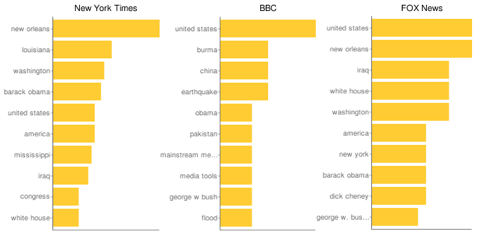
A bar chart showing, for a prominent person, place, or event you select, the ten terms used most frequently in each of your chosen sources. The image below is an example. It shows the top 10 phrases used by the New York Times, the BBC, and Fox News in stories, from the past six months, that referenced "Katrina."
You can get a good picture of the nature of investigative journalism (IJ) by looking at how the needed skills are taught in a context in which combatting corruption is an especially critical aspect of strengthening civil society.
The context I have in mind is that of developing countries. The example of organized training I'd offer is a toolkit for facilitators (pdf) developed in Tanzania by Pact, a non-profit organization based in Washington DC that helps organizations in developing countries with technical assistance, capacity building, and monetary grants.
to build empowered communities, effective governments and responsible private institutions that give people an opportunity for a better life. We do this by strengthening the capacity of organizations and institutions to be good service providers, represent their stakeholders, network with others for learning and knowledge sharing, and advocate for social, economic and environmental justice. Interdependence, responsible stewardship, inclusion of vulnerable groups, and respect for local ownership and knowledge are core values across all of our programs.
The specific goal of Pact's IJ training is to achieve "increased media scrutiny [that] will contribute to improved accountability, tranparency and good governnance at the national and local levels."
In developing the IJ training and the associated facilitator's manual, Pact collaborated with the Tanzanian chapter of the Media Institute of Southern Africa (MISA), an NGO whose aim is "to promote a free, independent and pluralistic press in Tanzania." Funding came from the US Millennium Challenge Corporation and USAID. The training effort began in December 2006, and the manual was published in September 2008.
The first chapter of the manual defines IJ, discusses how it works and its advantages, looks at how to identify stakeholders (e.g., councilors, district council officials, media, civil society organizations, and influential community members), details the principles of ethical conduct when pursuing IJ, and explains the concept and methodology of Public Expenditure Tracking Systems (PETS), a "follow the money" approach to holding governments accountable for how funds are budgeted and utilized. (The governments in question are typically at the local level.)
The second chapter deals with corruption. It defines corruption, describes the two major types — petty corruption and grand corruption, explores causes and effects of corruption, and discusses how to respond to corruption via prevention, education, institution building, and legal enforcement.
The third chapter deals with good governance. It defines good governance, explores its various aspects (transparency, accountability, honesty, adherence to the rule of law, protection of human rights, separation of powers), and discusses the connections between politics and good governance.
The fourth chapter covers the role of IJ in anti-corruption efforts and strengthening of governance, discusses starting points for investigative journalists looking to uncover corruption and governance problems (and successes), and explains how to identify possible stakeholders (i.e., sources).
Pact Tanzania provides its take on the outcome of the IJ training effort here.
21st Century Journalism XXXI: The International Reporting Project
The International Reporting Project (IRP), based at the Johns Hopkins School for Advanced International Studies in Washington, has been offering learning experiences to journalists since 1998. The goal is to counteract the decline in reporting on international affairs that has occurred as media organizations find themselves under financial pressure.
You can see an example of the type of fact-finding trip arranged for "gatekeeper editors"in the video below.1 The footage comes from a 2006 visit to Egypt by a dozen editors selected from a pool of applicants.
Two of the editors who participated in the Egypt trip reflect on their experience in the video below.
In addition to its fellowships for editors, IRP also offers fellowships for junior and senior journalists doing international reporting.
Johns Hopkins Magazine recently published an article on IRP, which you can read here.
__________ 1 "Gatekeepers are defined as any journalists in supervisory positions at any type of media who help to determine what news items will be selected for publication or broadcast. In the past, gatekeepers have included editors-in-chief, executive editors, managing editors, senior producers, foreign editors, editorial page editors, wire editors, national editors, news editors and other similar positions. Gatekeepers must be U.S. citizens or else working as fulltime staff editors in the U.S. for a U.S.-based news organization." (from the IRP website)
The well-respected blogger, Tanta — the family nickname Doris Dungey used to sign her posts at Calculated Risk — died yesterday. Tanta was an ex-mortgage banker who developed deep expertise in the field before giving up her job in 2006 in order to be treated for ovarian cancer.
You can get the flavor of Tanta's expertise and style from this September post in which she takes on Gretchen Morgenson, financial columnist at the New York Times. You can read the Times obituary here.
21st Century Journalism XXX: The Savvy View of Office Politics
Kudos to Phyllis Korkki, writing in the New York Times on November 16 about "The Win-Win Way to Play Office Politics." In FAQ format, Korkki does a good job of concisely explaining the ethical way in which savvy people handle the political dimension of their work lives.
Korkki reports input from four experts/gurus (all female BTW):
understanding who has power and how decisions are made; being aware of how your managers and co-workers prefer to operate; adapting to the culture of your organization; and behaving and speaking in a way that helps you advance — and not hurt — your goals and those of your company.
Marilyn Puder-York, a psychologist and author of The Office Survival Guide. Key points: When you've engaged well in office politics, "you've enhanced your reputation with the right people." Effective involvement in office politics also means being able "to diffuse the conflicts that inevitably emerge in a group of people with different temperaments, needs, backgrounds, agendas and goals."
Franke James, editor of officepolitics.com and creator of a game called Office Politics. A key point: Pay attention to the interpersonal dynamics in your organization so that you "develop an awareness of the interrelationships and levels of influence that exist in your office and how those could affect your job and the work that you do."
Lewis first came to attention as the author of Liar's Poker, his 1989 memoir of his four-year career in the mid-'80s as a twenty-something bond trader at Salomon Brothers. As Lewis explains in the opening paragraphs of his Portfolio article,
To this day, the willingness of a Wall Street investment bank to pay me hundreds of thousands of dollars to dispense investment advice to grownups remains a mystery to me. I was 24 years old, with no experience of, or particular interest in, guessing which stocks and bonds would rise and which would fall. The essential function of Wall Street is to allocate capital — to decide who should get it and who should not. Believe me when I tell you that I hadn’t the first clue.
I’d never taken an accounting course, never run a business, never even had savings of my own to manage. I stumbled into a job at Salomon Brothers in 1985 and stumbled out much richer three years later, and even though I wrote a book about the experience, the whole thing still strikes me as preposterous — which is one of the reasons the money was so easy to walk away from. I figured the situation was unsustainable. ...
Unless some insider got all of this down on paper, I figured, no future human would believe that it happened.
I thought I was writing a period piece about the 1980s in America. Not for a moment did I suspect that the financial 1980s would last two full decades longer or that the difference in degree between Wall Street and ordinary life would swell into a difference in kind.
What distinguishes this piece of journalism is not only the vividness and detail of the story it tells, but also, in more general terms, its model execution of the journalist's job. As an example of long-form journalism, the Lewis piece exhibits a number of essential principles, among them steady authorial concern for good sourcing, clarity, and coherent flow.
I am firmly of the opinion that the news organizations that survive into the future (I am not talking about more feature-oriented publications, such as People) will make quality assurance a central value for their writers and editors. And they will invest the resources their staff need in order to meet high quality standards.
One of my favorite living economists, Paul Krugman of Princeton University, has just been awarded the Sveriges Riksbank Prize in Economic Sciences in Memory of Alfred Nobel.
I regularly read Krugman's Monday and Friday columns in the New York Times, learning considerably from them — most recently about the moves taken by the British to cope with the freeze-up in the world's credit markets.
For a summary of the work for which the Royal Swedish Academy of Sciences recognized Krugman, you can go here (pdf).
21st Century Journalism XXVIII: The Rwanda Initiative
An important change introduced following the Rwandan genocide of 1994 was concerted effort to improve the performance of Rwandan news media, some of which were implicated in the genocide.
Recognizing Rwandan journalists' and aspiring journalists' need for solid practical training, Allan Thompson, a journalism professor at Carleton University's School of Journalism and Communication in Ottawa, launched the Rwanda Initiative in January 2006. The Initiative is a joint effort between Carleton and the School of Journalism and Communication at the National University of Rwanda (NUR). The NUR journalism school has only been in existence since 1996.
The introduction to the Initiative's blog reviews the situation the Initiative seeks to address:
The media sector in Rwanda was devastated by the 1994 Genocide. Most professional journalists were killed, exiled or implicated in the slaughter through their involvement with hate media. The media sector remains traumatized. Many working journalists lack professional training and the journalism school is chronically short-staffed.
To supplement Rwanda's slim cadre of journalism educators, teachers from Carleton serve as visiting lecturers at NUR. In addition, the Initiative helps with curriculum development, runs an internship program for Canadian journalism students at Rwandan media organizations, and collaborates with NUR in organizing media-training workshops for working journalists.
As Thompson explained in June of last year, "The essence of Carleton's Rwanda Initiative has been to address both sides of [the] media equation, to build the capacity of the media in Rwanda and to foster an interest in Africa among a new generation of Canadian journalists."
The Rwanda Initiative has also sponsored internships in Canada for Rwandan journalism students. You can read about the experiences of one of the interns, Eugene Kwibuka, in the July-September 2007 issue of Intercultures Magazine. In his article Kwibuka mentions his experience covering the trial in Montreal of a suspected genocide participant, but he concentrates on explaining how the Rwanda Initiative's training has helped him and his fellow students:
The big difference between [the Canadian lecturers'] way of training and that of Rwandan lecturers is the fact they put a particular emphasis on practice rather than theory. They step in journalism classrooms equipped with materials like cameras, computers and notebooks. They show students how to use them, then assign them to do stories. They make students learn by doing. ...
Most journalism students at the National University of Rwanda will tell you that what they enjoy about Canadian lecturers is practice. They love being introduced to new techniques of how to pitch a story, how to take a nice shot, how to use ambient sounds in a radio story and how to deal with ethical issues in journalism. It’s helpful that the lecturers who are teaching them these techniques are themselves practicing journalists or have been journalists for a long time.
A little later today, I will be meeting with a friend (American) who taught literature at NUR several years before the genocide. I will be interested to hear his thoughts about the approach the Rwanda Initiative is taking to helping the country's journalists become more professional and more effective in promoting understanding in their country.
"My article was about the burning of the clipper-ship 'Hornet' on the line, May 3, 1866. There were thirty-one men on board at the time, and I was in Honolulu when the fifteen lean and ghostly survivors arrived there after a voyage of forty-three days in an open boat, through the blazing tropics, on ten days' rations of food. A very remarkable trip; but it was conducted by a captain who was a remarkable man, otherwise there would have been no survivors. He was a New Englander of the best sea-going stock of the old capable times — Captain Josiah Mitchell.
. . .
"I had been in the islands several months when the survivors arrived. I was laid up in my room at the time, and unable to walk. Here was a great occasion to serve my journal, and I not able to take advantage of it. Necessarily I was in deep trouble. But by good luck his Excellency Anson Burlingame was there at the time, on his way to take up his post [as the American minister] in China, where he did such good work for the United States. He came and put me on a stretcher and had me carried to the hospital where the shipwrecked men were, and I never needed to ask a question. He attended to all of that himself, and I had nothing to do but make the notes. It was like him to take that trouble. He was a great man and a great American, and it was in his fine nature to come down from his high office and do a friendly turn whenever he could.
"We got through with this work at six in the evening. I took no dinner, for there was no time to spare if I would beat the other correspondents. I spent four hours arranging the notes in their proper order, then wrote all night and beyond it; with this result: that I had a very long and detailed account of the 'Hornet' episode ready at nine in the morning, while the other correspondents of the San Francisco journals had nothing but a brief outline report — for they didn't sit up. The now-and-then schooner was to sail for San Francisco about nine; when I reached the dock she was free forward and was just casting off her stern-line. My fat envelope was thrown by a strong hand, and fell on board all right, and my victory was a safe thing. All in due time the ship reached San Francisco, but it was my complete report which made the stir and was telegraphed to the New York papers, by Mr. Cash; he was in charge of the Pacific bureau of the 'New York Herald' at the time.
"When I returned to California by-and-by, I went up to Sacramento and presented a bill for general correspondence at twenty dollars a week. It was paid. Then I presented a bill for 'special' service on the 'Hornet' matter of three columns of solid nonpareil at a hundred dollars a column. The cashier didn't faint, but he came rather near it. He sent for the proprietors, and they came and never uttered a protest. They only laughed in their jolly fashion, and said it was robbery, but no matter; it was a grand 'scoop' (the bill or my 'Hornet' report, I didn't know which): 'Pay it. It's all right.' The best men that ever owned a newspaper."
21st Century Journalism XXVII: Digging for Business Info
At the website of the Society of Professional Journalists, Glenn Lewin, a freelance writer, reporter, and researcher, provides a detailed list of tips (here condensed and slightly edited) for gathering information about a particular business enterprise:
Work from the outside in, peeling back the “layers of the onion.” "The most solid and reliable information is obtained (and verified) through a variety of sources."
Conduct documents and public records searches. I.e., check out past litigation, property records, etc.
Develop multiple sources within the target company. "Constantly look for fresh sources; it’s a mistake to continually tap the same sources. ... Know who in the organization has information, and what information they have."
Seek information sources from outside the company, such as headhunters, industry consultants, and former employees (especially people from the sales and marketing departments).
Become familiar with the company’s physical location and business activity. "If, for example, the business claims to be a distributor, but operates out of a small office, is it really just a mail-drop operation posing as a stocking distributor?"
Generate referrals — both from inside and outside the company. "Managers [and] key decision-makers are often more accessible if approached with a referral."
Employ investigative interviewing techniques. E.g.: "Build bridges by looking for people and interests you may have in common ... Stay alert for information that doesn’t seem to fit or to make sense..."
Leverage information / trade information. "... use what you know to obtain still more information. Understand that information is not a one-way street. Be willing to share information with your sources; [this] creates trust, costs nothing, and demonstrates that you are thinking of their needs as well as your own."
Know who your target company does business with. "Important information may be obtained from the customers and vendors ..."
Adopt and maintain the proper attitude. "The best investigators are open-minded, diligent, thorough, creative and — above all — persistent."
Having watched with a good deal of dismay the poor use of sources that seems endemic in today's journalism, I would particularly echo Lewin's insistence on tapping a variety of sources, and constantly developing new sources. This advice, which I'd supplement by noting that becoming too buddy-buddy with official sources detracts from one's journalistic independence, applies to all beats, not just business.
Did you know that Calvin Coolidge's famous assertion that "the chief business of the American people is business" came in a speech to the American Society of Newspaper Editors (ANSE)? I didn't until today.
Below are excerpts from the 1925 speech, as posted at the ASNE website. Note that Coolidge follows his statement about "the chief business of the American people" with the caveat that "Of course, the accumulation of wealth cannot be justified as the chief end of existence."
The relationship between governments and the press has always been recognized as a matter of large importance. Wherever despotism abounds, the sources of public information are the first to be brought under its control. Wherever the cause of liberty is making its way, one of its highest accomplishments is the guarantee of the freedom of the press. It has always been realized ... that truth and freedom are inseparable. ...
Our American newspapers serve a double purpose. They bring knowledge and information to their readers, and at the same time they play a most important part in connection with the business interests of the community, both through their news and advertising departments.
Probably there is no rule of your profession to which you gentlemen are more devoted than that which prescribes that the editorial and the business policies of the paper are to be conducted by strictly separate departments. Editorial policy and news policy must not be influenced by business consideration; business policies must not be affected by editorial programs. ...
When I have contemplated these adjustments of business and editorial policy, it has always seemed to me that American newspapers are peculiarly representative of the practical idealism of our country. ...
Some people feel concerned about the commercialism of the press. They note that great newspapers are great business enterprises earning large profits and controlled by men of wealth. So they fear that in such control the press may tend to support the private interests of those who own the papers, rather than the general interest of the whole people.
It seems to me, however, that the real test is not whether the newspapers are controlled by men of wealth, but whether they are sincerely trying to serve the public interests. There will be little occasion for worry about who owns a newspaper, so long as its attitudes on public questions are such as to promote the general welfare. A press which is actuated by the purpose of genuine usefulness to the public interest can never be too strong financially, so long as its strength is used for the support of popular government.
There does not seem to be cause for alarm in the dual relationship of the press to the public, whereby it is on one side a purveyor of information and opinion and on the other side a purely business enterprise.
Rather, it is probable that a press which maintains an intimate touch with the business currents of the nation, is likely to be more reliable than it would be if it were a stranger to these influences. After all, the chief business of the American people is business. They are profoundly concerned with producing, buying, selling, investing and prospering in the world. I am strongly of the opinion that the great majority of people will always find these the moving impulses of our life. ...
Of course, the accumulation of wealth cannot be justified as the chief end of existence. But we are compelled to recognize it as a means to well-nigh every desirable achievement. So long as wealth is made the means and not the end, we need not greatly fear it...
So I think there is little cause for the fear that our journalism, merely because it is prosperous, is likely to betray us. But it calls for additional effort to avoid even the appearance of the evil of selfishness. In every worthy profession, of course, there will always be a minority who will appeal to the baser instinct. There always have been, probably always will be, some who will feel that their own temporary interest may be furthered by betraying the interest of others. ...
The power of the spirit always prevails over the power of the flesh. These furnish us no justification for interfering with the freedom of the press, because all freedom, though it sometimes tends towards excesses, bears within it those remedies which will finally effect a cure for its own disorders.
American newspapers have seemed to me to be particularly representative of this practical idealism of our people. Therefore, I feel secure in saying that they are the best newspapers in he world. I believe that they print more real news and more reliable and characteristic news than any other newspapers. I believe their editorial opinions are less colored in influence by mere partisanship or selfish interest than are those of any other country. Moreover, I believe that our American press is more independent, more reliable and less partisan today than at any other time in its history. I believe this of our press, precisely as I believe it of those who manage our public affairs. Both are cleaner, finer, less influenced by improper considerations, than ever before. ...
It is only those who do not understand our people, who believe that our national life is entirely absorbed by material motives. We make no concealment of the fact that we want wealth, but there are many other things that we want much more. We want peace and honor, and that charity which is so strong an element of all civilization.
The chief ideal of the American people is idealism. I cannot repeat too often that America is a nation of idealists. That is the only motive to which they ever give any strong and lasting reaction. No newspaper can be a success which fails to appeal to that element of our national life. It is in this direction that the public press can lend its strongest support to our government. I could not truly criticize the vast importance of the counting room, but my ultimate faith I would place in the high idealism of the editorial room of the American newspaper.