!DOCTYPE html PUBLIC "-//W3C//DTD XHTML 1.0 Strict//EN" "http://www.w3.org/TR/xhtml1/DTD/xhtml1-strict.dtd">
Streamline Training & Documentation
Streamline Training & Documentation
Saturday, March 27, 2010
Timothy Murphy on Jazz Improvisation
Readers of this blog will know that I'm fascinated by the process of improvisation, a subject I discussed most recently here. I'm firmly convinced that one of the prime aspects of expertise is the ability to conjure up promising ideas on the fly. I'm also confident that this is a skill that can be steadily honed through practice.
The Spring 2010 issue of Johns Hopkins Magazine gives its last page over to a summary of how an accomplished jazz pianist in an ensemble undertakes to improvise. The summary is provided by Timothy Murphy, a keyboardist and teacher at Hopkins' Peabody Conservatory and at Towson University.
Murphy's offers these four bits of advice:
First, clear your mind. Get rid al all the words coursing through your head. Sit quietly about 30 seconds before putting your hands on the keyboard.
Improv is a conversation. Watch the facial expressions of the other players, listen to them, try to respond to what they do with the least predictable thing that's still musical.
If you suddenly go blank, just smile and keep pressing the keys until something good happens. Now and then, the best thing to "play" is silence.
A good solo should have a shape. Pay attention to the inner voice that's telling you that you've reached a high point and it's time to wind it down and get out elegantly.
The most direct business application of Murphy's schema is to meetings in which creative thinking is needed, for example, concerning the design of a new product or service or the solution to a problem. An individual's contributions don't have to be "the least predictable thing," but they certainly shouldn't be trite. Everybody should contribute, but no one should overwhelm the conversation. Soliloquies should "have a shape" and, even if the speaker doesn't end elegantly, he or she should not run on.
As textile and other mill jobs moved south, New England towns were left with numerous abandoned or underutilized mill buildings, often centrally located and generally occupying potentially attractive waterfront land.
Such was the case in Holyoke, which now offers an example of mill reuse that is representative of redevelopement of mill properties underway in a number of Massachusetts towns.
The front door of one of the mill buildings making up the redeveloped Open Square complex (Open Square)
The Open Square project has been underway since 1996, when architect and principal John Aubin began gradually rehabbing the 685,000 square feet of space in the seven-building Lyman Mills complex, which his family has owned since 1969. Tenants are a mix of offices, retail stores, restaurants, artists, light industry, and condo owners. (A list of current tenants is here.)
Below are some more pictures showing what has been accomplished so far.
Open Square's favorite picture of what their refurbished interior space looks like. This particular space is on the fourth floor of Building 4, an area that has been configured for offices. (Open Square)
The Open Square complex, showing one of the canals between which it sits (Open Square)
In November of last year, the local public TV station broadcast a feature on Open Square. You can watch the 5:49 segment, based largely on interviewing John Aubin, below. (BTW, the correct call letters for the TV station are WGBY.)
Holyoke Heritage State Park celebrates the history and culture of the City of Holyoke, Massachusetts. It is operated and managed by the Massachusetts Department of Conservation and Recreation. Park features include a visitor center with exhibits about paper manufacturing and Holyoke's industrial and cultural history. Admission to the park and visitor center is free.
The site in which Heritage State Park has been built was once the land used for the William Skinner Silk Mill. Heritage State Park was planned after Skinner's mill burned down [in 1980].
William Skinner's Silk Mill Holyoke, Massachusetts (1887) (Digital Treasures)
There are precious few people with firsthand experience of driving cars from the early years of the automobile era. In Chapter 12 of My Years with General Motors, Alfred Sloan reminds his readers of what mass-produced autos c. 1920 were like:
Today's driver, of course, would find the typical car of 1920 completely unsatisfactory. It had a four-cylinder engine whose crankshaft and associated connecting rods and pistons were inherently unbalanced. Ordinarily this car had two-wheel brakes with braking confined to the rear wheels; it had no independent springing of the front wheels; it had a sliding-gear transmission, and an engine of low power. It vibrated and often shimmied; it veered and sometimes skidded when the brakes were applied; it rode hard and rough; the clutch grabbed; the gears often clashed in the shifting, and, owing to the low power available, they always had to be shifted on hills of substantial gradient. But the car usually got somewhere and back; fortunately it was unable to go fast or far enough for many of its deficiencies to become serious drawbacks. It was roughly adapted to its environment — and its major parts were reasonably adapted to each other, at however low a level of integration and efficiency.
The January 2010 issue of Chief Learning Officer has an excellent case study describing how one company improved its approach to identifying ideas generated by its technical staff that have strong commercial potential.
Authors David Midgley (INSEAD) and Carlos de Pommes (now at Cambiio) explain that QinetiQ (think "kinetic"), a defense technology and security company, designed a program to:
equip their scientists and engineers to present ideas as compelling business propositions, and
make sure that ideas were brought to the attention of all relevant business units, not just the unit to which a particular research team was attached.
The program, launched in the spring of 2007, was called "Pitching to Win." For details, do read the Midgley/de Pommes write-up. I'll just highlight the training component of the program:
To make a convincing and compelling pitch, teams needed to master four key parts of an investable proposition, known internally as NABC: the need of the customer; the approach the team took to deliver the solution; the benefits for both the customer and QinetiQ; and the likely competition. Experienced instructors taught these skills during the 90 days of the competition and supported the teams throughout.
As of the time of writing, 50 ideas have been proposed, of which 11 were ultimately approved for funding.
Don Vandergriff III: Themes in the Adaptive Leadership Methodology
In a long blog post (which seems to be the source of the article I discussed yesterday), Don Vandergriff and Fred Leland, a lieutenant in the Walpole (MA) Police Department and a security consultant, discuss the Adaptive Leadership Methodology (ALM) in detail.
Some of their key points have been covered in my previousposts. Today I'd like to note the three themes that they identify as applying to all Adaptive Leadership scenarios:
"[S]tudents learn to approach their analysis of the terrain (or tactical environment) and the opponent (criminal) with the objective of identifying that which they can use to their advantage. With respect to the enemy (criminal element), we teach our students to identify enemy strengths (which they must avoid) and weaknesses (which they must exploit)."
"[I]t is vital that students understand the long term consequences of their immediate actions. This requires the ability to operate within the framework of their higher headquarters 'Commander’s Intent.' In order to reinforce this concept, students see orders as 'contracts' between senior and subordinate. The higher commander assigns a mission (the short term contract) with the understanding that the subordinate leader will be allowed maximum latitude in figuring out exactly how he will accomplish that mission. The only stipulation is that the subordinate leader’s 'solution' must not violate the Commander’s Intent. This intent constitutes the long term contract between senior and subordinate. Ethical conduct and adherence to the Rules of Engagement (ROE) are always part of the Commander’s Intent, and this serves to emphasize the often strategic-level consequences of actions at the lowest levels."
"ALM-based courses [focus] on the way that 'tactics' are defined. In ALM-based courses, instructors describe tactics as unique 'solutions' to specific problems, not tasks or drills that must be executed through doctrinal formulas or set procedures. Following fixed rules not only results in predictability, it quickly becomes an excuse for not thinking. Since courses using ALM focus on 'how to think' about tactical problem-solving, while developing an individual’s competence and confidence, anything that discourages creative thought has no place in its curriculum."
Leland and Vandergriff cite William Lind's theory of "maneuver warfare" as the basis for these themes. Lind's theory is spelled out in his 1985 Maneuver Warfare Handbook.
Barry explains: [John Shaw] Billings lay behind America’s first great contribution to scientific medicine: a library. This library grew out of the detailed medical history of the Civil War ordered by the army surgeon general. The army also created a medical “museum,” which was actually a library of specimens.
Both the museum and the history were remarkable. In 1998 scientists at the Armed Forces Institute of Pathology, a direct descendant of this museum, used specimens preserved in 1918 to determine the genetic makeup of the 1918 influenza virus. And the medical history was extraordinarily precise and useful. …
Billings did not write that history, but it did inspire him to create a medical library of comparable quality. He built what one medical historian judged “probably the greatest and most useful medical library in the world.” By 1876 it already held eighty thousand volumes; ultimately it grew into today’s National Library of Medicine. [p. 45]
Barry notes that the renowned British scientist Thomas Huxley gave the keynote address at the September 12, 1876 ceremony marking Hopkins' opening. Below is an excerpt from Huxley's speech, in which he explains what he thinks a medical school's curriculum should include, and the importance of academic support of original research. At present, young men come to the medical schools without a conception of even the elements of physical science; they learn, for the first time, that there are such sciences as physics, chemistry, and physiology, and are introduced to anatomy as a new thing. It may be safely said that, with a large proportion of medical students, much of the first session is wasted in learning how to learn — in familiarizing themselves with utterly strange conceptions, and in awakening their dormant and wholly untrained powers of observation and of manipulation. It is difficult to over-estimate the magnitude of the obstacles which are thrown in the way of scientific training by the existing system of school education. Not only are men trained in mere book-work, ignorant of what observation means, but the habit of learning from books alone begets a disgust of observation. The book-learned student will rather trust to what he sees in a book than to the witness of his own eyes.
There is not the least reason why this should be so … There is not the slightest difficulty in giving sound elementary instruction in physics, in chemistry, and in the elements of human physiology, in ordinary schools. In other words, there is no reason why the student should not come to the medical school, provided with as much knowledge of these several sciences as he ordinarily picks up in the course of his first year of attendance at the medical school.
I am not saying this without full practical justification for the statement. For the last eighteen years we have had in England a system of elementary science teaching carried out under the auspices of the Science and Art Department, by which elementary scientific instruction is made readily accessible to the scholars of all the elementary schools in the country. Commencing with small beginnings, carefully developed and improved, that system now brings up for examination as many as seven thousand scholars in the subject of human physiology alone. I can say that, out of that number, a large proportion have acquired a fair amount of substantial knowledge; and that no inconsiderable percentage show as good an acquaintance with human physiology as used to be exhibited by the average candidates for medical degrees in the University of London, when I was first an examiner there twenty years ago; and quite as much knowledge as is possessed by the ordinary student of medicine at the present day.
[. . .]
I rejoice to observe that the encouragement of research occupies so prominent a place in your official documents, and in the wise and liberal inaugural address of your president. This subject of the encouragement, or, as it is sometimes called, the endowment of research, has of late years greatly exercised the minds of men in England. It was one of the main topics of discussion by the members of the Royal Commission of whom I was one, and who not long since issued their report, after five years' labour. Many seem to think that this question is mainly one of money; that you can go into the market and buy research, and that supply will follow demand, as in the ordinary course of commerce. This view does not commend itself to my mind. I know of no more difficult practical problem than the discovery of a method of encouraging and supporting the original investigator without opening the door to nepotism and jobbery. My own conviction is admirably summed up in the passage of your president's address, "that the best investigators are usually those who have also the responsibilities of instruction, gaining thus the incitement of colleagues, the encouragement of pupils, and the observation of the public." [The full text of Huxley's speech is available at http://www.fullbooks.com/Science--Education4.html.]
"The Great Influenza" I: The US Was Not Always a Leader in Medical Research
I have finished reading The Great Influenza: The Story of the Deadliest Pandemic in History, by John M. Barry and have selected a few passages (and speech Barry refers to — see tomorrow's post) that offer historical perspective and useful insights concerning advances in US medical education, healthcare practice, and protection of public health.
The first excerpt relates to the utter absence of medical research in the US as recently as the early 1870s: Many American physicians were in fact enthralled by the laboratory advances being made in Europe. But they had to go to Europe to learn them. Upon their return they could do little or nothing with their knowledge. Not a single institution in the United States supported any medical research whatsoever.
As one American who had studied in Europe wrote, “I was often asked in Germany how it is that no scientific work in medicine is done in this country, how it is that many good men who do well in Germany and show evident talent there are never heard of and never do any good work when they come back here. The answer is that there is no opportunity for, no appreciation of, no demand for that kind of work here. … The condition of medical education here is simply horrible.” [p. 33]
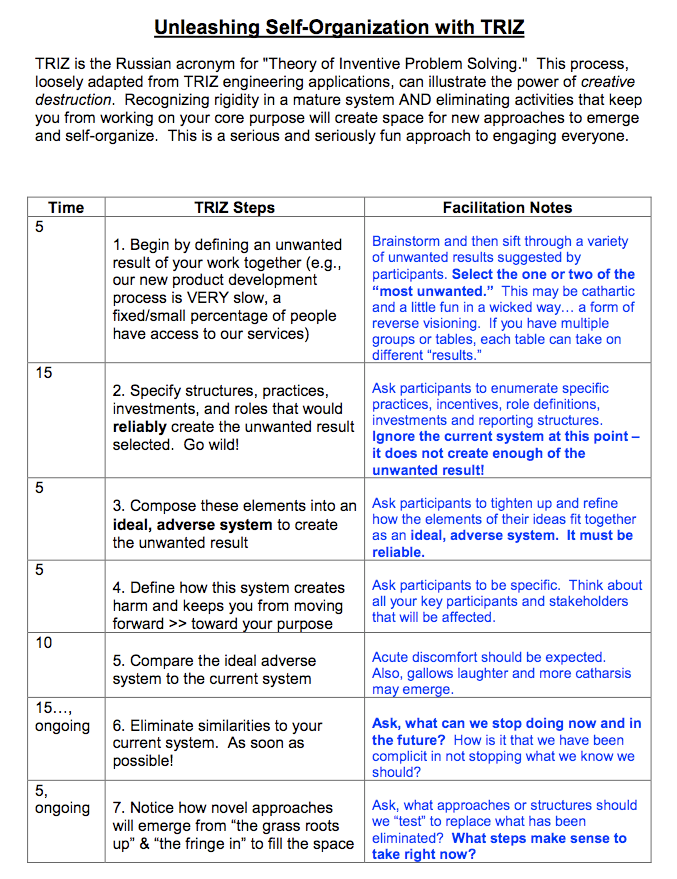
There is a group problem-solving method included in the Knowledge Sharing Toolkit — discussed in a post of a few days ago — that I found particularly intriguing. The method in question goes by the name TRIZ (pronounced "trees" because it is the tranliteration of a Russian acronym), or "theory of inventive problem-solving."
The TRIZ method was originally developed to help people creatively solve engineering problems. The method has since, in simplified form, been adopted for a whole range of situations in which people need to get beyond conventional thinking (or even a state of denial) that is impeding their efforts to improve how they work.
The Knowledge Sharing Toolkit webpage outlining TRIZ directs readers to an example documented at the Center for Integration of Medicine and Innovative Technology (CIMIT) blog. This particular case, presented in an eleven-minute video, involves exploring how to improve delivery of primary care to patients. The discussion is facilitated by Keith McCandless, a long-time TRIZ practitioner.
The process McCandless follows has seven steps, as shown in the graphic below:
Steps 2 through 4 indicate why the TRIZ technique is sometimes called "reverse brainstorming."
It's easy to get immersed in lots of technical detail about the TRIZ approach, but you probably don't want to unless you're working actively in an engineering-intense field. Still, if you're inclined to learn more about how TRIZ has developed since it was first conceived in 1946, you can visit Ideation International and The TRIZ Journal.
Productivity is in the news these days as people take note that it is rising impressively in the US even as unemployment remains high. What lies behind the ability of companies to maintain needed output levels with fewer employees?
One known source of productivity gains is investment in information technology. But some companies do markedly better in realizing productivity gains from IT than others. Why?
Erik Brynjolfsson, a professor at MIT's Sloan School of Management and Director of the MIT Center for Digital Business, and Adam Saunders, a lecturer at UPenn's Wharton School, have been investigating this question. The answer they offer in a recently published book is that
companies with the highest level of returns to their technology investment are doing more than just buying technology; they are inventing new forms of organizational capital to become digital organizations. These innovations include a cluster of organizational and business-process changes, including broader sharing of information, decentralized decision-making, linking pay and promotions to performance, pruning of non-core products and processes, and greater investments in training and education.
You can access the introduction and first chapter of Brynjolfsson and Saunders' book here.
[Earlier reference to the points Brynjolfsson and Saunders make in their book can be found in a post from July of last year. Brynjolfsson's views (along with those of co-auther Andrew McAfee) concerning measurement of economic activity that improves on the standard GDP measure are discussed in a post from last month.]
The concept of "mindfulness" has numerous definitions in writings on psychology, business management, and self-help.1 While I'm interested in any useful insights people have to offer on achieving "mindfulness" through meditation techniques, or through following such suggestions as, "When you are stuck in traffic, pay attention to your breathing, or the sky, or the sights around you,"2 etc., what I want to focus on here is the notion of mindfulness developed by Ellen Langer, a professor of psychology at Harvard.
Langer defines mindfulness as "a flexible state of mind in which we are actively engaged in the present, noticing new things and sensitive to context" (The Power of Mindful Learning, 1998). As an example of how this type of mindfulness can be cultivated, you can have a look at the report (pdf) on training of tourism managers that Gianna Moscardo, a professor of business studies at James Cook University in Queensland, Australia, published in the Journal of Tourism Studies in 1997.3
Moscardo investigated whether she could use exercises aimed at increasing mindfulness to produce more flexible thinking and effective problem-solving in students.
Her experiment involved four groups, which ultimately became three when the two experimental groups were combined. The experimental groups were given the following exercise: I would like you to think of yourself as the manager or director of a regional tourist authority whose responsibilities include promotion and development of the tourist products available in your region. You have been asked by your board of directors to consider opportunities in your region for the “seniors” market, that is people over the age of 65. The following questions are about the development of activities for this group of visitors.
1. Make a list of tourist activities or experiences that you believe could be appropriate for “senior” travellers.
2. Can you think of any advantages that “senior” travellers have over other travellers for enjoying their holidays? Please list them below.
3. Can you now list below any restrictions that might exist for “senior” travellers.
4. Finally, I would like you to imagine yourself as a “senior” traveller and I would like you to write a paragraph which describes your ideal holiday. Remember this is your ideal holiday for when you are 65 years or older.
The experimental groups were then asked to:
consider the region that you have been studying in the previous practicals and I would like you to design a two day tour in your region for a small group (8-12 people) of “senior” visitors. Write out the itinerary below and include information on the type of transport you would use, the accommodation, the places to be visited and the activities that would be available.
Three further tasks were similar. One involved identifying problems a group of disabled travelers and their families "might have in enjoying a holiday in your region." The next asked for solutions to these problems. The final task was to mock up a brochure with suggestions for how tourists could spend their time enjoyably if they were caught in a spell of bad weather.
The control group was given the same set of four tasks, but without the preceding exercise.
There was also a comparison group that was asked to "design a two day tour in your region for a small group (8-12 people) of visitors." Their responses were used to garner "baseline data on the range and type of activities on offer in the regions [the students were studying] for tourists in general."
Though the results did not uniformly support the hypothesis that "mindfulness training exercises would encourage more flexible, less stereotyped thinking about a range of tourist situations," the overall pattern was consistent with the hypothesis.
The moral of the story is that you can expect better results in terms of flexible thinking and creativity if you take active steps to get learners to think afresh about what categories are appropriate for sorting information in a particular situation, and to consider the issues in the situation from the perspectives of all relevant parties.
__________ 1 You can get an idea of the range of definitions of "mindfulness" from a 2008 post on Delany Dean's blog.
In a striking example of concision, the Wall Street Journal has published a 1½-page summary of research on the drivers of innovation that Frank Rothaermel (College of Management at the Georgia Institute of Technology) and Drew Hess (McIntire School of Commerce at the University of Virginia) published two years ago in a 24-page academic paper (pdf).1
Rothaermel and Hess analyzed data covering the pharmaceutical industry in the period 1980-2001 to identify the mechanisms that best enabled firms to develop "dynamic capabilities," i.e., the ability to recognize and adapt to market and technological change, such as the rise of biotechnology.
The researchers began with the general view that "antecedents" (drivers) of innovation can be found simultaneously and interdependently at the individual, firm, and network levels. By "network level," Rothaermel and Hess are referring to external organizations in which a firm might invest resources, e.g, through forming an alliance with another firm or a university, or by making an acquisition of another firm.
To test their theory, Rothaermel and Hess investigated several hypotheses that the theory implies. (You can learn in detail about the rationale for these hypotheses by having a look at their paper.) The hypotheses are:
Hypothesis 1A. A firm's innovative output is a positive function of its intellectual human capital. In the case of pharamaceutical firms, this intellectual human capital was measured in terms of the number of scientists employed.
Hypothesis 1B. A firm's innovative output is a positive function of its star scientists, controlling for nonstar scientists. Star scientists were defined as those with publication and citation records well above average.
Hypothesis 2. A firm's innovative output is a positive function of its R&D capability. R&D was measured in terms of inflation-adjusted dollars (with firm revenues treated as a control variable).
Hypothesis 3A. A firm's innovative output is a positive function of its alliances with new technology providers. These providers include universities, research institutions, and biotechnology firms.
Hypothesis 3B. A firm's innovative output is a positive function of its acquisitions of new technology firms.
Complementarity Hypothesis. Antecedents to innovation located at the intersections between the individual and the firm (Hypothesis 4A), between the individual and the network (Hypothesis 4B), and between the firm and the network (Hypothesis 4C) complement one another, i.e., interactions across levels are positive, and thus increase a firm's innovative output.
Substitution Hypothesis. Antecedents to innovation located at the intersections between the individual and the firm (Hypothesis 5A), between the individual and the network (Hypothesis 5B), and between the firm and the network (Hypothesis 5C) substitute for one another, i.e., interactions across levels are negative, and thus decrease a firm's innovative output.
Rothaermel's and Hess's results included:
Hypothesis 1A was supported. "... the most effective way to achieve continuous innovation over the long term is to hire and cultivate talented people. Companies that innovate through hiring will have stronger control over their intellectual property and often a steadier pipeline of future inventions because they aren't relying on outside partners for any part of the innovation process."
Hypothesis 2A was not supported. "The odds of this strategy [investing in talented people] working improve when a company builds a team of both star and nonstar employees. Having people who can prospect for new ideas (star scientists, for example) and people who can turn those ideas into actual products and services (rank-and-file knowledge workers) makes successful innovation more likely."
Hypothesis 2B was partially supported. "Rather than finding a linearly positive relationship beween R&D expenditures and biotech patenting, ... we find that this relationship is characterized by diminishing marginal returns."
Hypothesis 3A was not supported, but Hypothesis 3B was. I.e., the data indicate that alliances do not increase innovative output, while acquisitions do. (But see also the findings below for Hypotheses 4B and 5B.)
Hypothesis 5A was supported (and Hypothesis 4A was not). I.e., "a firm's intellectual human capital (proxied by its total scientists) and a firm's R&D capability are substitutes for one another ... Star scientists and R&D capability also substitute for one another ..."
Hypothesis 5B was supported (and Hypothesis 4B was not). If a company is using human capital as an innovation strategy, it only makes sense to also invest in alliances if those alliances bring unique assets that the company does not already have access to from its internal talent.
Hypothesis 4C was supported (and Hypothesis 5C was not). "Alliances and internal R&D spending often complement each other ... because internal knowledge allows companies to more readily identify the most promising research areas, which in turn allows them to select the most promising research partners. Internal knowledge also helps companies better understand the information that is exchanged between partners, increasing the efficiency of such arrangements."
The most complementary innovation strategies are forming alliances and making acquisitions. "That's because forming a joint venture with a company before trying to buy it gives a company inside information about the target's worth and the value of the research it is seeking to acquire."
In concluding their 2007 paper, Rothaermel and Hess sum up with the basic recommendation that
firms should, with the help of star scientists, identify an exogenous paradigm shift, and then assemble the requisite human assets in the form of rank-and-file scientists.
Their advice to firm managers is to avoid
the "grab bag" approach to innovating, [i.e.,] employing a variety of available mechanisms simultaneously without knowledge of the possible deleterious interaction effects. Our research demonstrates that, due to path dependency and constraints imposed on a firm's financial-, managerial-, and research-related resources, a tandem approach may actually lead to decreases in innovative output. ...Instead, the managers who take a discerning and discriminating approach towards selecting innovation mechanisms will be most successful in building the dynamic capabilities necessary to continuously innovate.
__________ 1 "Building Dynamic Capabilities: Innovation Driven by Individual-, Firm-, and Network-Level Effects," Frank T. Rothaermel and Andrew M. Hess, Organization Science, Vol. 18, No. 6 (Nov-Dec 2007), pp. 898-921.
It is always encouraging to find research support for techniques promoted by business trainers, since all too often trainers' prescriptions and advice are not backed up by solid evidence of effectiveness.
What I have in mind at the moment is the recently published paper, "Lessons from a Faraway Land: The Effect of Spatial Distance on Creative Cognition," by Lile Jia, Edward Hirt, and Samuel Karpen (JHK), social psychologists at Indiana University.1
The experimental results JHK report indicate that, for example, the S.C.A.M.P.E.R. brainstorming technique, the subject of one of my earliest posts back in 2006, embodies a cognitive principle that has a plausible theoretical basis for which there is growing experimental confirmation.
According to the authors' abstract of their paper,
Recent research ... has identified temporal distance as a situational moderator of creativity. According to Construal Level Theory ... temporal distance is just one case of the broader construct of psychological distance.2 In the present research, we investigated the effect of another dimension of psychological distance, namely, spatial distance, on creative cognition and insight problem solving. In two studies, we demonstrate that when the creative task is portrayed as originating from a far rather than close location, participants provide more creative responses (Study 1) and perform better on a problem solving task that requires creative insight (Study 2).
The JHK research came to my attention from reading a July 21 article at ScientificAmerican.com by Oren Shapira and Nira Liberman of Tel Aviv University. In addition to describing the JHK article, Shapira and Liberman outline how inducing other types of psychological distance can boost creativity. As Shapira and Liberman explain,
... previous studies ... demonstrated that distancing in time — projecting an event into the remote future — and assuming an event to be less likely (that is, distancing on the probability dimension) can also enhance creativity. In a series of experiments that examined how temporal distance affects performance on various insight and creativity tasks, participants were first asked to imagine their lives a year later (distant future) or the next day (near future), and then to imagine working on a task on that day in the future. Participants who imagined a distant future day solved more insight problems than participants who imagined a near future day. They also performed better on visual insight tasks, which required detecting coherent images in "noisy" visual input, as well as on creative generation tasks (e.g., listing ways to improve the look of a room). Similar evidence has been found for probability. Participants were more successful at solving sample items from a visual insight task when they believed they were unlikely, as opposed to likely, to encounter the full task.
As Shapira and Liberman point out, one of the implications of the JHK research is that actually traveling a significant distance from home might promote creativity, and there is indeed evidence that this is the case.
__________ 1 "Lessons from a Faraway Land: The Effect of Spatial Distance on Creative Cognition," Lile Jia, Edward R. Hirt, and Samuel C. Karpen, Journal of Experimental Social Psychology, Vol. 45, No. 5 (September 2009), pp. 1127-1131.
2Shapira and Liberman explain, "anything that we do not experience as occurring now, here, and to ourselves falls into the 'psychologically distant' category."
In April 2008, three HP employees and four employees of Jump Associates1presented (pdf) to a conference in Paris the story of HP's approach to measuring the contribution of design to achieving the business goals of new-product design projects.
The bottom line:
A well-designed measurement system can serve as both a catalyst for stronger collaboration between all the stakeholders in an organization's product development process and a compass for creative teams to make sure they're heading in the right direction.
The central tool HP uses is something they call the D3 Matrix, illustrated in the graphic below.
Column 1: Goals related to the development process Column 2: Goals related to HP's portfolio of products Column 3: Goals that are row-specific
Each cell in the matrix "represents a strategic design goal that can be pursued on a project." The foundation is the set of goals in the bottom row, which relate to striving to simplify by:
making the development process more efficient
improving the user experience over a range of products in HP's portfolio
optimizing the supply chain in a way that doesn't detract from the user experience
The second tier of goals relates to designing products in a way that further differentiates HP from its competition by:
addressing unmet customer needs with compelling solutions
coordinating groups of products so they work together better
building customers' emotional connection with HP (the "Wow" factor)
Finally, the top tier captures goals relating to using design to innovate by:
cultivating new growth prospects
creating a balanced portfolio of innovations that foster both short-term and long-term success
creating proprietary assets that provide HP with a sustainable competitive advantage
The authors explain that HP has learned quite a bit about how to make sure their approach to design measurement actually works. They offer five best-practice tips — stay focused on your goals, base your metrics on your goals, communicate using a common language, use real-time input to monitor your progress, narrate and illustrate your story — which they explain with admirable clarity.
It is well worth one's time to read the commentary on these tips. A key point is that
for these practices to thrive and become an integral part of a business, they need to operate within a process that's structured enough to drive towards larger strategic business goals while remaining flexible enough to enable exploration, creativity and discovery. Measurement tools can't replace good design judgment. Instead they should add structure to discussions about the value of design.
__________ 1 The presentation was titled "The Holy Grail of Design Measurement." The authors from HP were Deborah Mrazek, Sam Lucente, and Steve Sato; the authors from Jump Associates were Adam Menter, Conrad Wai, Katherine Wakid, and Philip Hartley. They were speaking at the International DMI Education Conference, whose 2008 theme was "Design Thinking: New Challenges for Designers, Managers and Organizations." DMI is the Design Management Institute.
A s a follow-on to an earlier post dealing with discovery-driven planning, an approach to developing and executing initiatives involving new markets, products, or services, here is a video in which the developers of the technique, Ian MacMillan of the Wharton School and Rita Gunther McGrath of Columbia Business School, discuss application of the technique in a period in which growth in the economy as a whole is decelerating, or even turning negative.
On June 22, the Wall Street Journal published an article by John Bessant (Imperial College Business School, London), Kathrin Möslein (School of Business and Economics, University of Erlangen-Nuremberg, Germany), and Bettina von Stamm (Innovation Leadership Forum, England) outlining nine ways organizations can go about developing ideas for innovative products and services.
The nine approaches Bessant, Möslein, and von Stamm describe are:
Building scenarios — "imagine detailed opportunities and threats" for your organization.
Soliciting ideas on the Web — InnoCentive.com is an example of "a site where people and companies look for help in solving scientific and business challenges." Another is BMW's "Virtual Innovation Agency" site, bmwgroup.com/via.
Enlisting lead users — Lead users "tend to be people working in or using products in a specific market who are frustrated by the tools, goods or services currently available and yearn for something better." Bessant, Möslein, and von Stamm cite the example of surgeons offering ideas for altering products so that they better fit the surgeons' needs. Another example is the BBC's site for lead users, Backstage.bbc.co.uk.
Doing a "deep dive" — This is the ethnographic approach that I've seen getting increasing attention. It involves "market research that uses detailed, firsthand observation to learn more about consumers' needs or wants."
Experimenting — Bessant, Möslein, and von Stamm call this "probe and learn." Your organization undertakes "actively experimenting with new ideas in a new context." The new context is a segment of a market where you are not currently active or strong. The intended outcome of your experiments is insight concerning what this segment finds valuable now, or is likely to find valuable in the foreseeable future.
Getting ideas from employees — "For example, the duties of procurement, sales or finance groups can be expanded to include learning about trends they encounter that ordinarily might be considered not of primary interest to the company."
Catering to internal entrepreneurs — Some companies, such as 3M and Google, "reserve blocks of time for scientists or engineers [or other employees] to explore their own ideas." Bessant, Möslein, and von Stamm add, "It helps to have an established pathway to make sure the best new ideas get taken forward."
Getting departments talking to each other — An approach many companies find effective is setting up communities of practice.
Promoting diversity — One approach is to "seek innovation partners with whom [you] wouldn't normally work." Another very important approach is to recruit employees with different life experiences and perspectives.
A complementary issue is how an organization builds its capacity for innovation, a subject you can read about in this post.
Early in 2007, Geoffrey James posted an article at bnet.com that offers good advice on how to win thoughtful consideration of an idea you believe will help your organization.
The article is short and easy to read, so I'll just outline what you'll find there:
Step 1 Confirm that you and your idea are a credible match. People you approach with the idea have to believe you know what you're talking about.
Step 2 Frame your idea with a strong narrative. Help people see intuitive sense in what you're suggesting, and help them feel good about endorsing it.
Step 3 Map the idea to the perspective of the decision-maker. For instance, if the decision-maker is the CFO, he/she is apt to be focused on return on investment. On the other hand, if you're dealing with the COO, a key issue is apt to be the likelihood of smooth implementation.
Step 4 Reduce or eliminate downside risk. The decision-maker will undoubtedly think about what could go wrong with your plan. Anticipate concerns, and prepare responses that show how risks can be substantially mitigated (e.g., through using a pilot to test and refine the idea).
Step 5 Close the deal. You need to "create momentum to keep your idea moving forward."
In a companion item, James offers contrasting "Wrong Way" and "Right Way" memos to illustrate what he believes is the best way to broach your idea in writing to a senior manager.
Earlier this month, James added a post to his "Sales Machine" blog at bnet.com that lets you test your grasp of the above process. It's a good refresher.
What experiences help people think creatively? William Maddux (INSEAD) and Adam Galinsky (Kellogg School of Management, Northwestern University) have recently published a paper (pdf) detailing the results they obtained when they investigated whether there is an association between living abroad and creativity.1
Maddux and Galinsky carried out five studies:
"Studies 1 and 2 provided initial demonstrations that time spent living abroad (but not time spent traveling abroad) showed a positive relationship with creativity."
Study 1 involved tackling a problem that required creative insight to solve. Participants who had lived abroad had a greater success rate than those who had not lived abroad.
Study 2 involved a mock negotiation. A successful outcome required "outside the box" thinking. Again, those participants who had lived abroad succeeded more often than those who had not.
Study 3 investigated why living abroad seemingly contributes to creativity. The study "demonstrated that priming foreign living experiences temporarily enhanced creative tendencies for participants who had previously lived abroad." [link added]
Study 3 used an experimental approach with participants, all of whom had lived abroad. The participants were assigned randomly to four groups:
One group "were asked to imagine living in a foreign country and, in particular, about the types of things that happen, how they feel and behave, and what they think during a particular day living abroad."
A second group "were asked to imagine and write about a day traveling in a foreign country."
A third group was primed "with cognitions associated with a nonforeign experience: a day in their life in their hometown."
The fourth group was a control. They were given a prime in which they "were asked to recall and write about what happened the last time they went to the supermarket."
As hypothesized, the first group had a higher success rate in solving the creativity challenge — a word game — than those in the other groups (and the remaining groups had descending rates of success, as expected). Furthermore, the "temporary facilitative effect of comtemplating experiences living abroad was strongest for those participants who had lived abroad the longest."
In Study 4, participants worked on the same creativity task as in Study 1. Maddux and Galinsky hypothesized that adaptation to a foreign culture is a key mechanism underlying the link between living abroad and creativity. The results of the study indicated that, indeed, "the degree to which individuals had adapted to different cultures while living abroad mediated the link between foreign living experience and creativity."
Study 5 was another experimental effort. The creativity task was drawing an imagined foreign alien. As in Study 3, all participants had spent time living abroad and were assigned randomly to four groups:
One group "were asked to imagine adapting themselves to a foreign culture and to write about the types of things that would happen, how they would feel and behave and what they would think about during a particular day adapting themselves to a foreign culture."
A second group "imagined and wrote about observing a foreign culture."
A third group was a control. Participants "recalled and wrote about learning a new sport." The idea was "to present a condition that was similar to adaptation in novelty but that did not involved a foreign experience."
The fourth group was also a control. They received no priming prior to drawing their imagined space alien.
As hypothesized, "priming the experience of adapting to a foreign culture temporarily enhanced creativity for participants who had previously lived abroad."
To summarize: "Across all five studies, [Maddux and Galinsky] consistently found that living (but not traveling) in and adapting to other cultures was associated with greater creativity." Note that "this effect occurred independently of a number of personality variables and other possible confounding factors (e.g., cognitive ability)." Studies 4 and 5 demonstrated the importance of adaptation in explaining the link between living abroad and creativity. "Overall, [the] results suggest that the experience of living abroad, as well as the specific attitudes and approaches individuals take during their foreign culture experiences are significant predictors of creativity."
Maddux and Galinsky "acknowledge that the current data do not demonstrate that living abroad causes permanent changes in trait-based creativity." Further research is necessary to test the longevity of the impact of living abroad on creativity. Maddux and Galinsky also note that "the current studies cannot rule out the reverse pathway: that creative people may be more likely to live abroad than noncreative people," On the other hand, Maddux and Galinsky are able to cite a number of reasons to believe that the causation indeed runs from living abroad to creativity, rather than vice versa.
As Galinsky puts it in a brief report of the research published by the Kellogg School, he and Maddux show "that there is some sort of psychological transformation that needs to occur when people are living in a foreign country in order to enhance creativity. This may happen when people work to adapt themselves to a new culture."
And Maddux comments, “This research may have something to say about the increasing impact of globalization on the world, a fact that has been hammered home by the recent financial crisis. Knowing that experiences abroad are critical for creative output makes study abroad programs and job assignments in other countries that much more important, especially for people and companies that put a premium on creativity and innovation to stay competitive.” (An earlier post on the value of studying abroad is here.)
__________ 1 William W. Maddux and Adam D. Galinsky, "Cultural Borders and Mental Barriers: The Relationship Between Living Abroad and Creativity," Journal of Personality and Social Psychology, Vol. 96, No. 5 (May 2009), pp. 1047-1061.
Inventory of Proposed Causes of the Financial Crisis
Reports produced by the Congressional Research Service (CRS) at the Library of Congress are not routinely made available to the public. I agree with OpenCRS that this is an unsatisfactory state of affairs. Until such time as the policy changes, anyone wanting to have a look at material from CRS is dependent on a site such as OpenCRS, or on making a special request for a particular report to a member of Congress.
A timely example of a CRS report that has made it into the public domain is "Causes of the Financial Crisis" (January 29, 2009) by Mark Jickling, a Specialist in Financial Economics at CRS.
Jickling explains the purpose and structure of his report in the summary with which it begins:
While some may insist that there is a single cause, and thus a simple remedy, the sheer number of causal factors that have been identified tends to suggest that the current financial situation is not yet fully understood in its full complexity. This report consists of a table that summarizes very briefly some of the arguments for particular causes, presents equally brief rejoinders, and includes a reference or two for further reading. It will be updated as required by market developments.
Jickling's table enumerates twenty-six causal factors that have been proposed by various analysts and commentators:
Imprudent mortgage lending
Housing bubble
Global financial imbalances (e.g., China's accumulation of vast amounts of US Treasury debt instruments)
Over-the-counter derivatives (about which information concerning risk exposures is limited)
Fragmented regulation
No systemic risk regulator
Short-term incentives
Tail risk (i.e., risk associated with extremely rare, but not impossible, events)
Black Swan theory (i.e., the notion that the financial crisis is due to such an extremely rare confluence of factors that trying to guard against future repetition would require unduly onerous new regulations that would very seriously inhibit growth)
Note: For more information about OpenCRS, you can browse their FAQ.