!DOCTYPE html PUBLIC "-//W3C//DTD XHTML 1.0 Strict//EN" "http://www.w3.org/TR/xhtml1/DTD/xhtml1-strict.dtd">
Streamline Training & Documentation
Streamline Training & Documentation
Saturday, February 27, 2010
Alfred Sloan's Memoir X: Summing Up
In Chapter 23 of My Years with General Motors, Alfred Sloan summarizes one of his central convictions concerning management of a multi-division corporation: It has been a thesis of this book that good management rests on a reconciliation of centralization and decentralization, or "decentralization with co-ordinated control."
Eash of the conflicting elements brought together in this concept has its unique results in the operation of a business. From decentralization we get initiative, responsibility, development of personnel, decisions close to the facts, flexibility — in short, all the qualities necessary for an organization to adapt to new conditions. From co-ordination we get efficiencies and economies. It must be apparent that co-ordinated decentralization is not an easy concept to apply. There is no hard and fast rule for sorting out the various responsibilities and the best way to assign them. The balance which is struck between corporate and divisional responsibility varies according to what is being decided, the circumstances of the time, past experience, and the temperaments and skills of the executives involved.
The concept of co-ordinated decentralization evolved gradually at General Motors as we responded to tangible problems of management. As I have shown, at the time its development began, some four decades ago, it was clearly advisable to give each division a strong management which would be primarily responsible for the conduct of its business. But our experience in 1920-21 also demonstrated the need for a greater measure of control over the divisions than we had attained. Without adequate control from the central office, the divisions got out of hand and failed to follow the policies set by corporation management, to the great detriment of the corporation. Meanwhile, the corporation management was in no position to set the best policies, since it was without appropriate and timely data from the divisions. A steady flow of operating data, for which procedures were later set up, finally made real co-ordination possible.
[. . .]
Much of my life in General Motors was devoted to the development, organization, and periodic reorganization of these governing groups [governing committees and policy groups] in central management. This was required because of the paramount importance, in an organization like General Motors, of providing the right framework for decisions. There is a natural tendency to erode that framework unless it is consciously maintained. Group decisions do not always come easily. There is a strong temptation for the leading officers to make decisions themselves without the sometimes onerous process of discussion, which involves selling your ideas to others. The group will not always make a better decision than any particular member would make; there is even the possibility of some averaging down. But in General Motors I think the record shows that we have averaged up. Essentially this means that, through our form of organizatipon, we have been able to adapt to the great changes that have taken place in the automobile market in each of the decades since 1920.
The trauma of the Great Depression was intense in the auto industry. Alfred Sloan's response was to re-emphasize the importance of having a strong and agile central policy-making capability, even as policy execution remained the responsibility of the individual GM divisions.
As Sloan recalls in Chapter 10 of My Years with General Motors, The automobile industry in the United States and Canada dropped from a production of about 5.6 million cars and trucks, worth about $5.1 billion at retail, in 1929, to about 1.4 million units, worth about $1.1 billion in 1932. That was lower than any year since the war year 1918.
Thanks to the financial and operating controls, the development of which I have described in earlier chapters, General Motors did not approach disaster as it had in the 1920-21 slump. We made an orderly step-by-step retreat in all matters, including wage and salary reductions. Sales by our United States and Canadian plants dropped to 526,000 cars and trucks in 1932 as compared with about 1.9 million in 1929, a tremendous drop (72 per cent) when you consider the many expenses that are fixed. That we fared relatively better than the industry is shown by the fact that our share of the market increased from 34 per cent in 1929 to 38 per cent in 1932, the trough year of the depression. Our profits dropped from about $248 million in 1929 to $165,000 in 1932, still in the black, thanks mainly to our financial-control procedures. In 1932 we were operating at less than 30 per cent of capacity.
[. . .]
... Inevitably when an industrial enterprise is shaken with such a force as we met at the onset of the great depression, there has to be confusion. In November 1933 I began to write again on the subject of new policies, beginning at the beginning, on the subject of policy itself. I said:
I feel that this [policy] phase of the general organization problem is of particular importance to General Motors, not because of its size particularly but on account of the nature of its business, subject as it is, to what I might term "rapid changes". In other words, I contend a unit of the automotive industry has far less "coasting ability", I might term it, than units in most any other industry that might be selected for comparison. As I analyze our picture, looking forward into the future, our success or, let me say, the maintenance of our position, absolutely depends upon the ability of our organization to lay down a strategy as will enable us to forecast the rapid changes that are taking place and will continue to take place in the various activities in which we are interested, involving all the functional divisions within such activities, and to provide for those changes with sufficient rapidity.
In making this statement I am not minimizing in any sense, the importance of effectively and economically carrying out such policies as may be adopted — I am simply trying to emphasize the point that the policy phase is of vital concern because, unless we can, with reasonable intelligence, meet this issue — no matter how able an administrative set-up [i.e., policy execution set-up] we may have, it is limited in its opportunity to function. I might add further, that looking forward I feel that we have got to more aggressively deal with that phase of our problems than we have in the past. It is going to be harder to maintain both our competitive position and our profit position. We can not afford to take the time in the future that we have in the past to make up our minds what we should do with respect to changes in trends which are having an influence on our position ...
My main purpose in the memorandum from which the above passages are taken was to reassert the purely policy-making role of the Executive Committee.
Alfred Sloan's Memoir VI: Getting Dealers Up to Speed
The woes of discontinued General Motors dealers have been much in the news lately. It's interesting to go back in time some eight decades to see how Alfred Sloan viewed the issue of developing a strong distribution system based on franchised dealerships. In Chapter 16 of My Years with General Motors, Sloan recalls: Alhough in the 1920s we had made great advances in getting the facts about General Motors' economic position, we did not then have the facts regarding the economic position of our dealers, and so were handicapped in thinking through dealer problems. When a dealer's profit position was failing, we had no way of knowing whether this was due to a new-car problem, a used-car problem, a service problem, a parts problem, or some other problem. Without such facts is was impossible to put any sound distribution policy into effect.
In the Proving Ground address which I mentioned earlier [delivered to the Automobile Editors of American Newspapers on September 28, 1927 in Milford MI], I made the following observations on this subject:
... I want to outline to you what I believe to be a great weakness in the automotive industry today and what General Motors is trying to do to correct that weakness.
I have stated frankly to General Motors dealers, in almost every city in the United States, that I was deeply concerned with the fact that many of them, even those who were carrying on in a reasonably efficient manner, were not making the return on their capital that they should. Right here let me say that so far as General Motors dealers are concerned, from what facts I have — I realize there has been much improvement during the past two or three years, but interested as the management of General Motors must be in every step from the raw material to the ultimate consumer, and recognizing that this chain of circumstances is no stronger than its weakest link, I feel a great deal of uncertainty as to the operating position of our dealer organization as a whole. I hope that this feeling of uncertainty is unwarranted. I am sure that with a responsibility so great, all elements of uncertainty must be eliminated and that our dealers should know the facts about their operating position as clearly and as scientifically as I have outlined to you we feel that we know the facts about General Motors' operating position.
This brings us back to ... two words — proper accounting. Many of our dealers, and the same thing applies to dealers of other organizations, have good accounting systems. Many of them have indifferent ones and I regret to say that too large a percentage of them have practically no accounting system at all. Many of those who have accounting systems, through lack of their being properly developed, are not able to effectively use them. In other words, they are not so developed that they give the dealer the facts about his business; where the leaks are; what he should do to improve his position. As I said before, uncertainty must be eliminated. Uncertainty and efficiency are as far apart as the North Pole is from the South. If I could wave a magic wand over our dealer organization, with the result that every dealer could have a proper accounting system, could know the facts about his business and could intelligently deal with the many details incident to his business in an intelligent manner as a result thereof, I would be willing to pay for that accomplishment an enormous sum and I would be fully justified in doing so. It would be the best investment General Motors ever made.Accordingly, in 1927 we set up an organization called Motors Accounting Company. We developed a standardized accounting system applicable to all dealers and sent a staff into the field to help install it and to establish an audit system.
Portrait of Alfred P. Sloan, Jr. (1875-1966) Sloan Building (E52) MIT Sloan School of Management (MIT Sloan Japan Club)
For instance, in Chapter 3, "Concept of the Organization," Sloan writes about his frustration in 1918, when General Motors acquired United Motors, a group of parts and accessory companies of which Sloan was president: ... I found that if I followed the prevailing practice of intercorporate relations I would no longer be able to determine the rate of return on investment for these accessory divisions individually or as a group. This would necessarily mean that I would lose some degree of managerial control over my area of operations. At that time, material within General Motors was passing from one operating division to another at cost, or at cost plus some predetermined percentage. My divisions in the United Motors Corporation had sold both to outside customers and to their allied divisions at the market price. I knew that I operated a profit-making group, and I wished to continue to be able to demonstrate this performance to the general management, rather than to have my operating results on interdivisional business swallowed up in the extra bookkeeping profits of some other division. It was a case of keeping the information clear.
It was not, however, a matter of interest to me only with respect to my divisions, since as a member of the Executive Committee, I was a kind of general executive and so had begun to think from the corporate viewpoint. The important thing was that no one knew how much was being contributed — plus or minus — by each division to the common good of the corporation. And since, therefore, no one knew, or could prove, where the efficiencies and inefficiencies lay, there was no objective basis for the allocation of new investment. This was one of the difficulties with the expansion program of that time. It was natural for the divisions to compete for investment funds, but it was irrational for the general officers of the corporation not to know where to place the money to best advantage. In the absence of objectivity it was not surprising that there was a lack of real agreement among the general officers. Furthermore, some of them had no broad outlook, and used their membership on the Executive Committee mainly to advance the interests of their respective divisions.
I had taken up the question of interdivisional relations with Mr. Durant [president of GM at the time] before I entered General Motors and my views on it were well enough known for me to be appointed chairman of a committee "to formulate rules and regulations pertaining to interdivisional business" on December 31, 1918. I completed the report by the following summer and presented it to the Executive Committee on December 6, 1919. I select here a few of its first principles which, though they are an accepted part of management doctrine today, were not so well known then. I think they are still worth attention.
I stated the basic argument as follows:
The profit resulting from any business considered abstractly, is no real measure of the merits of that particular business. An operation making $100,000.00 per year may be a very profitable business justifying expansion and the use of all the additional capital that it can profitably employ. On the other hand, a business making $10,000,000 a year may be a very unprofitable one, not only not justifying further expansion but even justifying liquidation unless more profitable returns can be obtained. It is not, therefore, a matter of the amount of profit but of the relation of that profit to the real worth of invested capital within the business. Unless that principle is fully recognized in any plan that may be adopted, illogical and unsound results and statistics are unavoidable ...
Generating Business Value from IT III: A Case Study
As a way of bringing together the concepts discussed in my two previousposts on generating business value from IT, I'd suggest reading a December 2007 case study (pdf) by Jeanne Ross, director of the MIT Sloan School's Center for Information Systems Research and Cynthia Beath, a professor emerita at the McCombs School of Business of the University of Texas at Austin.
The case abstract gives this overview of the case:
Pacific Life is a diversified financial services company with a history of autonomous business units. Pacific Life had five independent divisions, including Life Insurance, Annuities and Mutual Funds, and Investments. These divisions served different customers and responded to different regulatory and market requirements. Pacific Life executives embrace decentralization as the best structure for capturing excellence in the individual businesses, so they are willing to sacrifice some potential efficiencies. But while they are usually willing to forego the benefits of a more centralized organization structure, they are not willing to assume any unnecessary risks. This case describes how the company governs shared IT services and enterprise risk management to limit its risk exposure while reaping the benefits of decentralization.
Cameron Cosgrove, the vice president for IT in the Life Insurance Division, explains how Pacific Life decides which IT services will be centralized and which will be located in the business divisions:
Where the divisions have IT requirements that are unique to their core business and they need flexibility to have that independence to just GO, we've put those services into the divisions. Where the need is common and can be shared and the consensus is it's a commodity, and competitive advantage isn't really going to be derived from there, then the focus becomes running that service like a utility with low cost and reliability being the drivers — that's what ITS [the group providing IT shared services] is supposed to do for the divisions.
A key part of the decision-making structure is a set of nine Enterprise Architecture Groups (EAGs), whose role, as spelled out in a Pacific Life internal document, is to "create economies of scale, reduce support, maintenance and training needs, improve quality while reducing complexity, and optimize reusability throughout the company." Ross and Beath explain that "EAGs prioritized and scheduled initiatives to improve, upgrade or harmonize ITS's technology assets or services ... [and] secured funding for ITS-related initiatives."
Providing overall guidance is Pacific Life's Information Technology Council (ITC), which approves "the operating budget for ITS, prioritizing any projects that ITS proposed to improve its services, along with other enterprise-wide initiatives that required ITS to make infrastructure investments or process changes." A key responsibility for the ITC is implementation of "policy decisions flowing from Information Security, BCP [Business Continuity Planning], Compliance and Audit and their respective steering committees that had implications for ITS. These policies often drove the need for strategic ITS initiatives."
In sum, "Together the ITC and EAGs generated some of the benefits of IT centralization without centralizing all of Pacific Life's IT assets."
Gary Klein, a research psychologist, published his most recent book, Streetlights and Shadows: Searching for the Keys to Adaptive Decision Making, in October of last year. The book continues in the vein he has been exploring for many years, namely reporting on what his research reveals concerning the way in which experts make decisions.
The MIT Press's summary of Klein's book explains that he offers
... realistic ideas about how to make decisions in real-life settings. He provides many examples — ranging from airline pilots and weather forecasters to sports announcers and Captain Jack Aubrey in Patrick O'Brian's Master and Commander novels — to make his point. All these decision makers saw things that others didn't. They used their expertise to pick up cues and to discern patterns and trends. We can make better decisions, Klein tells us, if we are prepared for complexity and ambiguity and if we will stop expecting the data to tell us everything.
The first chapter of the book is available online. You can preview the book — on a limited basis — at Google Books.
There is an informative review at Diane Coyle's blog, and you can read an excellent overview of Klein's work, as of ten years ago, in an article Fast Company published in August 2000. Five years later, Klein was interviewed by NASA's ASK Magazine, producing another clear, compact account of his thinking on decision-making.
Yesterday's post referenced Don Vandergriff's workshop, "Deciding Under Pressure and Fast." Today I'd like to call attention to an overview of research on performing under pressure that lends support to Vandergriff's insistence on the necessity that people get ample practice in making decisions under time pressure.
The article in question is "Avoiding the Big Choke," by Elizabeth Svoboda, in the February/March 2009 issue of Scientific American Mind. Choking is defined as "performance decrements under pressure circumstances."1
Though much of Svoboda's article is devoted to activities like playing golf and public speaking, not to Vandergriff's main focus on training people who need to plan and execute military and law enforcement actions, there is a key point in Svoboda's report that is clearly applicable to any job requiring an ability to think on one's feet: "The best way to make a performance situation feel like rehearsal ... is to subject yourself to the same anxiety-packed conditions during practice that you expect to encounter" in the actual situation for which you are preparing.
Svoboda cites Raôul R.D. Oudejans, a professor in the Faculty of Human Movement Sciences of VU University Amsterdam. Oudejans conducted a study with Dutch police, the results of which "indicate that turning up the heat from the very first day of practice may be one of the most effective ways to immunize yourself against blowing it."
Art Markman, a psychology professor at the University of Texas at Austin, weighs in with the complementary idea that "[t]he more exposure you get to these high-pressure situations, and the more you succeed [despite them], he less likely you're going to get that whole affective experience" of feeling distractingly nervous about your performance.
Svoboda summarizes: "the more comfortable you feel, the less likely you are to be affected by pressure." To become as comfortable as possible, you should devise "a high-tension practice regimen appropriate to your particular performance situation."
In concluding, Svoboda cites Harry Wallace, a psychology professor at Trinity University in San Antonio. She says:
The most effective strategies ... are the ones that imbue performers with the assurance that they can deal with any eventuality. This mind-set proves helpful even (and perhaps especially) when something goes wrong. According to Prof. Wallace, "Part of the key is not being overconfident in advance and recognizing that you may feel more anxiety than you expect. You want to address any concerns far in advance of performance. You don't want to have any second thoughts about your likelihood of success."
The affinity of this admonition with the philosophy underlying "Deciding Under Pressure and Fast" is apparent.
__________ 1 Svoboda adopts the definition used by Roy Baumeister, a professor of social psychology at Florida State University.
Don Vandergriff V: "Deciding Under Pressure and Fast" Workshop
Don Vandergriff's main training program is his "Deciding Under Pressure and Fast" workshop. The video clip below — from 0:30 to 3:17 — gives you a taste of the workshop's approach, a look at what Vandergriff's Adaptive Leadership Methodology looks like in action, and a couple of participant responses to the workshop.
The Transatlantic Network 2020 (TN 2020) summit where this workshop took place ran from September 28 to October 3, 2008 in Belfast, Northern Ireland, and Dublin, Ireland. The Vandergriff workshop took place on September 29 and 30.
As explained on their website, TN 2020 "works to strengthen ties between Europe and North America through the creation of a sustainable network of young leaders." TN 2020 is sponsored by the British Council.
Don Vandergriff III: Themes in the Adaptive Leadership Methodology
In a long blog post (which seems to be the source of the article I discussed yesterday), Don Vandergriff and Fred Leland, a lieutenant in the Walpole (MA) Police Department and a security consultant, discuss the Adaptive Leadership Methodology (ALM) in detail.
Some of their key points have been covered in my previousposts. Today I'd like to note the three themes that they identify as applying to all Adaptive Leadership scenarios:
"[S]tudents learn to approach their analysis of the terrain (or tactical environment) and the opponent (criminal) with the objective of identifying that which they can use to their advantage. With respect to the enemy (criminal element), we teach our students to identify enemy strengths (which they must avoid) and weaknesses (which they must exploit)."
"[I]t is vital that students understand the long term consequences of their immediate actions. This requires the ability to operate within the framework of their higher headquarters 'Commander’s Intent.' In order to reinforce this concept, students see orders as 'contracts' between senior and subordinate. The higher commander assigns a mission (the short term contract) with the understanding that the subordinate leader will be allowed maximum latitude in figuring out exactly how he will accomplish that mission. The only stipulation is that the subordinate leader’s 'solution' must not violate the Commander’s Intent. This intent constitutes the long term contract between senior and subordinate. Ethical conduct and adherence to the Rules of Engagement (ROE) are always part of the Commander’s Intent, and this serves to emphasize the often strategic-level consequences of actions at the lowest levels."
"ALM-based courses [focus] on the way that 'tactics' are defined. In ALM-based courses, instructors describe tactics as unique 'solutions' to specific problems, not tasks or drills that must be executed through doctrinal formulas or set procedures. Following fixed rules not only results in predictability, it quickly becomes an excuse for not thinking. Since courses using ALM focus on 'how to think' about tactical problem-solving, while developing an individual’s competence and confidence, anything that discourages creative thought has no place in its curriculum."
Leland and Vandergriff cite William Lind's theory of "maneuver warfare" as the basis for these themes. Lind's theory is spelled out in his 1985 Maneuver Warfare Handbook.
Don Vandergriff II: Developing Adaptive Leaders at West Point
A couple of earlierposts discussed John Boyd, who served as an Air Force officer from 1951 to 1975. Among his notable contributions to military thinking is the "OODA loop," aka the "Boyd Cycle," a decision-making process summarized in the graphic below.
Adapted from ""No 'Approved Solutions' in Asymmetric Warfare" (pdf), by Maj. Chad Foster. The Orientation phase is highlighted because the orientation process is emphasized in West Point's military science classes that use the Adaptive Leadership Methodology.
The OODA Loop is now embedded in military science courses taught to cadets at the US Military Academy at West Point. This is part of a broader framework designed to develop students' adaptive leadership skills.
As Maj. Chad Foster explains in a brief article (pdf) published in the August 2009 issue of West Point's Assembly magazine, Don Vandergriff's Adaptive Leadership Methodology (ALM) is now used in Academy military science classes in order to nurture "effective decision-making and adaptability through experiential learning."
The graphic below shows how ALM governs the flow of a class. The OODA Loop comes into play at the points where students need to reach decisions on how to handle scenarios the teacher presents.
The emphasis is on the Orientation phase of the OODA Loop
because this is when the cadet attempts to make sense out of the information at hand. The decision is important, but how the cadet arrived at it is just as important.
In concluding his article, Foster notes that implementing the Adaptive Leadership Methodology at West Point involved considerable effort, but that the results — in terms of student engagement and learning — have clearly made the effort worthwhile.
Don Vandergriff I: Teaching the Adaptive Leadership Methodology
Back in December, Donald Vandergriff, a retired US Army officer who now acts as a consultant on leadership development, wrote a post for his blog that gives a good idea of the type of training he recommends — and conducts — for members of the armed forces and civilian law enforcement organizations.
Vandergriff advocates leadership development training that emphasizes adaptability. As you can see from his blog post, Vandergriff is focused on adaptability because it is essential for being able to handle complex problem situations, especially when time is of the essence.
In brief, Vandergriff teaches the Adaptive Leadership Methodology as follows:
Experimentation comes first through the execution of Tactical Decision-Making Exercises (TDEs) [see below] followed by the officers briefing their decisions, plans or orders. After the officer explained him or herself and responded to criticism from their peers and me, the group executed an intense instructor-facilitated after-action review (AARs). The “teaching” was accomplished through AARs as the officers discovered for themselves the concepts and principles included in workshop’s outcomes.
Vandergriff explains how the TDEs are set up:
Each TDE consisted of a scenario summary and a map with graphics. I either handed out a printed copy of the scenario or issued it verbally to the officers, requiring them to listen closely and take notes. The TDEs were two types (1) immediate decision exercises that gave the officers only 30 seconds or a few minutes to make a decision and (2) planning exercises that are longer in duration and culminate in the briefing of orders. In either case, the officers were given limited time and limited information to make their decisions and to complete their plans. This induced stress and allowed them to discover for themselves that delaying decisions until one has “perfect intelligence” or to wait for “permission” is both unrealistic and ineffective.
Citing the work of Robert Bjork, a psychology professor at UCLA for support, Vandergriff reports that he has consistently found that long-term learning is greater if specific tasks are taught in the larger context of problem solving (as opposed to being taught in isolation as a series of lessons that take the form "in situation X, do the following").
There is a group problem-solving method included in the Knowledge Sharing Toolkit — discussed in a post of a few days ago — that I found particularly intriguing. The method in question goes by the name TRIZ (pronounced "trees" because it is the tranliteration of a Russian acronym), or "theory of inventive problem-solving."
The TRIZ method was originally developed to help people creatively solve engineering problems. The method has since, in simplified form, been adopted for a whole range of situations in which people need to get beyond conventional thinking (or even a state of denial) that is impeding their efforts to improve how they work.
The Knowledge Sharing Toolkit webpage outlining TRIZ directs readers to an example documented at the Center for Integration of Medicine and Innovative Technology (CIMIT) blog. This particular case, presented in an eleven-minute video, involves exploring how to improve delivery of primary care to patients. The discussion is facilitated by Keith McCandless, a long-time TRIZ practitioner.
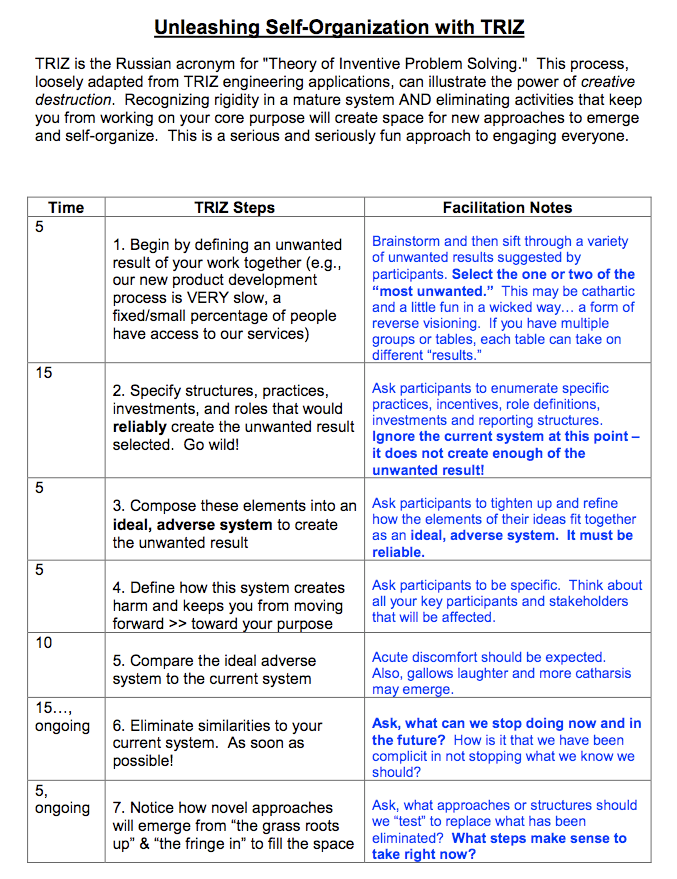
The process McCandless follows has seven steps, as shown in the graphic below:
Steps 2 through 4 indicate why the TRIZ technique is sometimes called "reverse brainstorming."
It's easy to get immersed in lots of technical detail about the TRIZ approach, but you probably don't want to unless you're working actively in an engineering-intense field. Still, if you're inclined to learn more about how TRIZ has developed since it was first conceived in 1946, you can visit Ideation International and The TRIZ Journal.
The Moral Sense Test (MST), sponsored by the Cognitive Evolution Laboratory at Harvard's psychology department, is "a Web-based study into the nature of human moral judgment." Researchers at the lab use the MST as part of an effort to understand how people decide what is right and wrong. As the researchers explain:
To answer this question, we have designed a series of moral dilemmas to probe the psychological mechanisms underlying our moral judgments. By presenting these dilemmas on the Web, we hope to gain insight into the similarities and differences between the moral judgments of people of different ages, from different cultures, with different educational backgrounds and religious beliefs, involved in different occupations and exposed to very different circumstances.
. . .
Our aim is to use data from the MST, as well as other experiments, to characterize the nature of our moral psychology, how it evolved, and how it develops in our species, creating individuals with moral responsibilities. The MST has been designed for all humans who are curious about that puzzling little word “ought” — about the principles that make one action right and another wrong.
You can take the test yourself here. The lab promises strict confidentiality both for the demographic information you provide (age, sex, etc.) and for your responses to the test items.
Those test items are moral dilemmas (when I took it, there were twenty-one), for which you are asked to indicate your assessment of the moral course of action.
There is no immediate feedback. Instead, you are able, if you wish, to browse through the lab's publications to see which of the publications referencing the MST might be of interest.
Is moral judgment accomplished by intuition or conscious reasoning? An answer to this question demands a detailed account of the moral principles in question. Here we investigate three principles guiding subjects’ moral judgments and then ask whether they are invoked to explain those judgments. Across a variety of moral dilemmas, subjects’ judgments about the permissibility of harming an individual aligned with three principles: (1) harm caused by action is worse than harm caused by omission, (2) harm intended as the means to a goal is worse than harm foreseen as the side-effect of a goal, and (3) harm involving physical contact with the victim is worse than harm involving no physical contact. Subjects generally appealed to the first and third principles in their justifications, but not to the second principle. This finding has significance for the methods and theories of moral psychology: the moral principles used in judgment must be directly compared to those articulated in justification and, when they are, evidence emerges that some moral principles are available to conscious reasoning while others are not.
The article appeared n Psychological Science in 2006 (vol. 17, no. 12, pp. 1082-1089).
On the other hand, it is certainly a mistake to think that one should always simply sit and wait for grim circumstances to pass. John Maynard Keynes view on this point is famous . . . But this long run is a misleading guide to current affairs. In the long run we are all dead. Economists set themselves too easy, too uselss a task if in tempestuous seasons they can only tell us that when the storm is long past the ocean is flat again.
In a world in which managers are typically flooded with information, it's essential to regularly evaluate what's helpful and what isn't.
The November 2009 issue of Chief Learning Officer has a helpful article in which Chris Moore, president of Zeroed-In Technologies, offers a tool for assessing data reports, such as those presenting metrics a company is using to track the results of training.
Moore suggests asking these questions for each report:
What do you do with the report?
What decisions does it help you make?
What is the norm or target for the metrics on the report?
What actions do you take if the report deviates from the norm?
On a scale of 1 to 5, how important is this report to your work success?
How quickly can you refresh the report with current data points?
Is the report too granualar or not granular enough?
Who are the other consumers of the report? What do they do with the information? How would they answer these questions?
The idea is to ensure that metrics managers are (ostensibly) monitoring provide information that can actually guide their decision-making.
Productivity is in the news these days as people take note that it is rising impressively in the US even as unemployment remains high. What lies behind the ability of companies to maintain needed output levels with fewer employees?
One known source of productivity gains is investment in information technology. But some companies do markedly better in realizing productivity gains from IT than others. Why?
Erik Brynjolfsson, a professor at MIT's Sloan School of Management and Director of the MIT Center for Digital Business, and Adam Saunders, a lecturer at UPenn's Wharton School, have been investigating this question. The answer they offer in a recently published book is that
companies with the highest level of returns to their technology investment are doing more than just buying technology; they are inventing new forms of organizational capital to become digital organizations. These innovations include a cluster of organizational and business-process changes, including broader sharing of information, decentralized decision-making, linking pay and promotions to performance, pruning of non-core products and processes, and greater investments in training and education.
You can access the introduction and first chapter of Brynjolfsson and Saunders' book here.
[Earlier reference to the points Brynjolfsson and Saunders make in their book can be found in a post from July of last year. Brynjolfsson's views (along with those of co-auther Andrew McAfee) concerning measurement of economic activity that improves on the standard GDP measure are discussed in a post from last month.]
As a follow-on to my recent post dealing with Nobel laureate Oliver Williamson's work on the boundaries of the firm, I'd mention that you can get a good idea of the state-of-the-art in the study of organizational economics by looking through the reading list for a course on that subject offered jointly by MIT and Harvard.
Uses of organizational economics within firms, between firms, and beyond firms (Robert Gibbons)
The reading list includes both foundational material, e.g., Ronald Coase's classic paper on "The Nature of the Firm" from 1937; and contemporary material, e.g, chapters from Baker and Gibbons' forthcoming compilation, The Handbook of Organizational Economics.
Michael D. Watkins on Managing Business Transitions
In the January 2009 issue of the Harvard Business Review, Michael D. Watkins, a one-time business professor and now chairman of Genesis Advisers, lays out a robust approach for leaders to follow in handling various business transitions, such as getting a start-up off the ground, or overseeing a distressed company's turnaround.
"Picking the Right Transition Strategy" explains Watkins' STARS framework, which outlines the challenges and opportunities inherent in five types of business transition. In addition to start-ups and turnarounds (S and T), STARS covers situations of accelerated growth (a company entering a period of rapid expansion), realignment (a company facing the need to significantly adjust its strategy in order to remain successful), and sustaining success (an executive taking over a company whose previous leader was highly effective).
Watkins spells out the full details of the STARS framework in his recently published book, Your Next Move: The Leader's Guide to Successfully Navigating Major Career Transitions. The HBR article focuses on a case study that illustrates how one senior executive, with conscious deliberation, handled a pair of assignments quite differently because the first was a turnaround, while the second was a realignment.
The case example highlights the fact that the same fundamental principles which "will ease your transition and increase your odds of long-term leadership success" come into play in all situations, but must be applied in ways specific to the particular type of transition involved. The fundamental principles are (in edited form):
Organize to learn about the business — Figure out what you most need to learn, from whom, and how you can accelerate the learning process.
Define the new strategic intent for the organization — Develop and communicate a compelling vision for what the organization will become. Outline a clear strategy for achieving the vision.
Establish priorities — Identify a few vital goals and pursue them vigorously. Think about what you need to have accomplished by the end of your first year in your new position.
Build your leadership team — Evaluate the team you inherited. When bringing new members onto the team, aim for a balance between people from inside and outside the organization.
Secure early wins — Think through how you plan to "arrive" in the new organization. Find ways to build personal credibility and energize the ranks.
Create supporting alliances — Identify how the organization really works and who has influence. Create key coalitions in support of your initiatives.
In parallel with the above principles relating to managing organizational change, Watkins addresses the "pillars of self-management" that someone assuming a leadership role must embrace in order to adapt personally, as needed:
Enhance self-awareness — In particular, know the leadership style that you adopt most reflexively, and be prepared to set it aside for a more suitable style if the particular transition you're managing requires that.
Exercise personal discipline — Ask yourself what behaviors with which you are particularly comfortable, you should now be doing less of; and what behaviors that you don't much enjoy, you should now be doing more of.
Build complementary teams — Get people to help you who have strengths that offset your weaker points.
You can listen to Watkins discuss much of this material in the 9:24 video below, in which he is interviewed by Sarah Green, an editor at harvardbusiness.org. Watkins also talks about on-boarding and about how you can help your family adjust to changes they have to make (e.g., moving to a new city) because of your new role.
From Part VI, Section III, of Adam Smith's Theory of Moral Sentiments. . . To act according to the dictates of prudence, of justice, and proper beneficence, seems to have no great merit where there is no temptation to do otherwise. But to act with cool deliberation in the midst of the greatest dangers and difficulties; to observe religiously the sacred rules of justice in spite both of the greatest interests which might tempt, and the greatest injuries which might provoke us to violate them; never to suffer the benevolence of our temper to be damped or discouraged by the malignity and ingratitude of the individuals towards whom it may have been exercised; is the character of the most exalted wisdom and virtue. Self-command is not only itself a great virtue, but from it all the other virtues seem to derive their principal lustre.
Elinor Ostrom's Research on Management of Common Resources
You can get an overview of Elinor Ostrom's work on "self-organizing and self-governing forms of collective action" in an interview (pdf) she gave Paul Aligica in 2003.
Elinor Ostrom talking in Stockholm about getting "Beyond the Tragedy of the Commons" (2009) (Stockholm Resilience Centre)
In the interview, Ostrom explains the gist of her thinking:
Academics, aid donors, international nongovernmental organizations, central governments, and local citizens need to learn and relearn that no government can develop the full array of knowledge, institutions and social capital needed to govern development efficiently and sustainably. The sheer variety of cultural and biological adaptations to diverse ecological conditions is so great that I am willing to make the following assertion: Any single, comprehensive set of formal laws intended to govern a large expanse of territory containing diverse ecological niches is bound to fail in many of the areas where it is applied.
Improving the abilities of those directly engaged in the particulars of their local conditions to organize themselves in deeply nested enterprises is potentially a more successful strategy for solving resource problems than attempting to implement idealized, theoretically optimal institutional arrangements. There is plenty that national government officials can do to help a self-governing society. They can provide efficient, fair, and honest court systems, effective property right systems and large-scale infrastructure projects — such as national highways — that cannot be provided locally.
Ostrom emphasizes the importance of viewing self-organized groups as complex adaptive systems and of recognizing the value of polycentric governance.
Complex adaptive systems are composed of a large number of active elements whose rich patterns of interaction produce emergent properties that are not easy to predict by analyzing the separate parts of a system. One can see them as consisting of rules and interacting agents that adapt by changing the rules dynamically on the basis of experience. ... [S]ocial scientists have yet to develop many of the concepts needed to understand the adaptability of systems. ...
Many of the capabilities of complex adaptive systems are retained in a polycentric public enterprise system. By "polycentric" I mean a system where citizens are able to organize not just one but multiple governing authorities, as well as private arrangements, at different scales. Each unit may exercise considerable independence to make and enforce rules within a circumscribed scope of authority for a specified geographical area. ... Self-organized resource governance systems, in such a system, may be special districts, private associations, or parts of a local government.
...
Serious empirical research has now shown that polycentric systems tend to generate higher levels of output at similar or lower costs than monocentric systems governing similar ecological, urban, and social systems.
Another, more recent overview of Ostrom's work is provided in the video below, which records the 8½-minute talk she gave earlier this year at the Stockholm Resilience Centre.
(Background information on Ostrom's Stockholm talk is here.)